2 cities

 Search
 Brazil
 Antarctica
 Argentina
 Bolivia
 Chile
 Colombia
 Ecuador
 Guyana
 French Guiana
 Falkland Islands (Malvinas)
 Paraguay
 Peru
 Suriname
 Uruguay
 Venezuela
 Germany
 Austria
 Belgium
 Croatia
 Denmark
 Slovakia
 Slovenia
 Spain
 Finland
 France
 Greece
 the Netherlands
 Hungary
 Ireland
 Iceland
 Italy
 Luxembourg
 Norway
 Poland
 Portugal
 the United Kingdom
 the Czech Republic
 Sweden
 Switzerland
 Turkey
 Bermuda
 Canada
 the United States
 Greenland
 Mexico
 Saint Pierre and Miquelon
 the Dominican RepublicJapanTurkey
 South Africa
 Egypt
 Australia
 Fiji
 New Zealand
 Papua New Guinea
Province · Chugoku
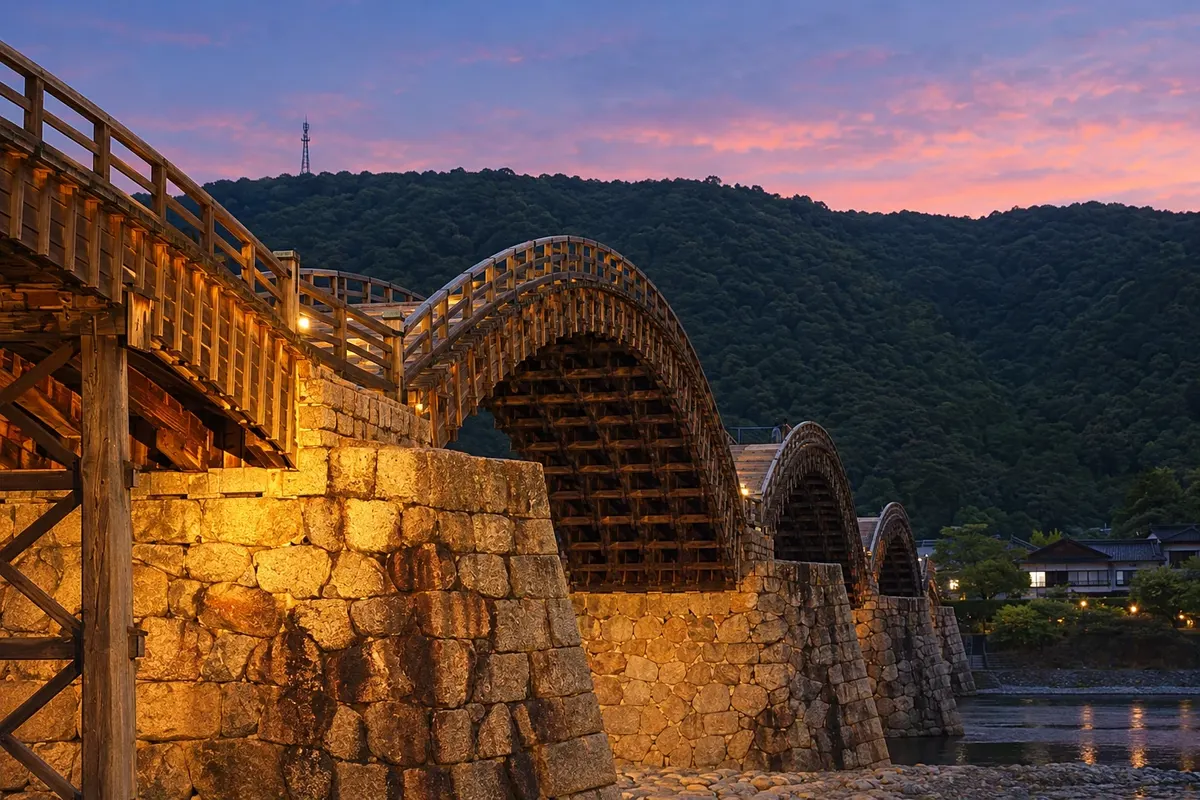
Kintai Bridge in Iwakuni, the castle town of Hagi, the Akiyoshidai plateau, the red gates of Motonosumi, and Shimonoseki’s pufferfish.
In the photo: Kintai Bridge, Yamaguchi.
Illustrative images. The pictures in this guide are illustrations based on the real place, not photographs, and may differ from it.

The province
Yamaguchi occupies the western tip of Honshu, between the Sea of Japan and the Inland Sea, and connects to Kyushu via tunnels and the Kanmon Strait bridge. It was the domain of Choshu, whose samurai led the Meiji Restoration in the 19th century. The local specialty is pufferfish (fugu), prepared by licensed chefs.
Hagi, on the north coast, preserves samurai districts with earthen walls and gates at the foot of the castle ruins. The Shoka Sonjuku school, where Yoshida Shoin taught future leaders of modern Japan, and the Hagi reverberatory furnace are part of the Meiji Industrial Revolution sites, a UNESCO World Heritage listing since 2015. Hagi ware ceramics, in soft colors, are used in the tea ceremony.
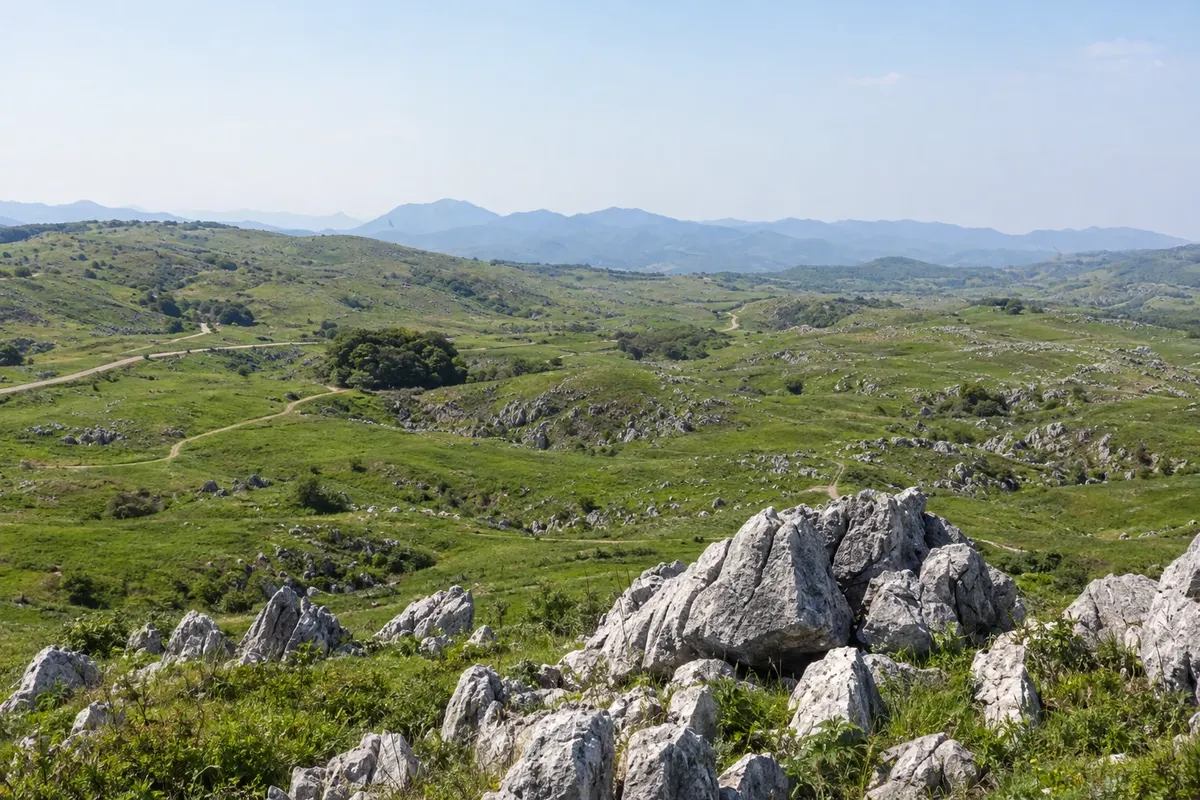
Akiyoshidai is Japan’s largest limestone plateau, with white rocks scattered across the grassland. Underneath it, Akiyoshido Cave has wide galleries and stone terraces filled with water. On Nagato’s coast, the Motonosumi shrine has more than a hundred red torii gates in a row down to the sea.
In Iwakuni, Kintai Bridge spans the Nishiki River with five wooden arches, with a castle atop the hill. Shimonoseki has the Karato fish market, and a pedestrian tunnel under the Kanmon Strait leads on foot to Kyushu. In the capital Yamaguchi, Ruriko-ji’s five-story pagoda is a national treasure.
Destinations
Cities
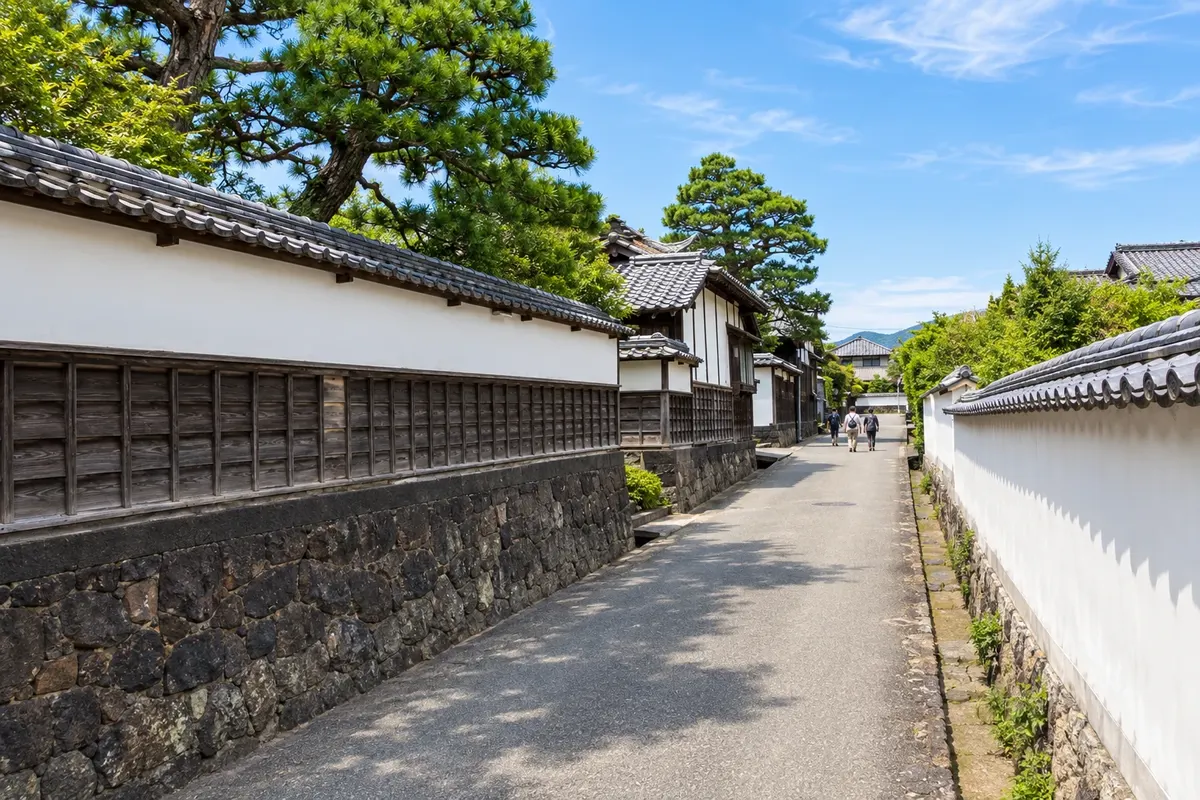
Hagi is the former castle town of the Mori on the Sea of Japan coast in Yamaguchi. It features streets with white walls and samurai and merchant houses, the castle ruins in Shizuki Park, Yoshida Shoin’s Shokasonjuku and other UNESCO Meiji sites, as well as Hagi-yaki pottery kilns. Bicycles are the common way to get around.
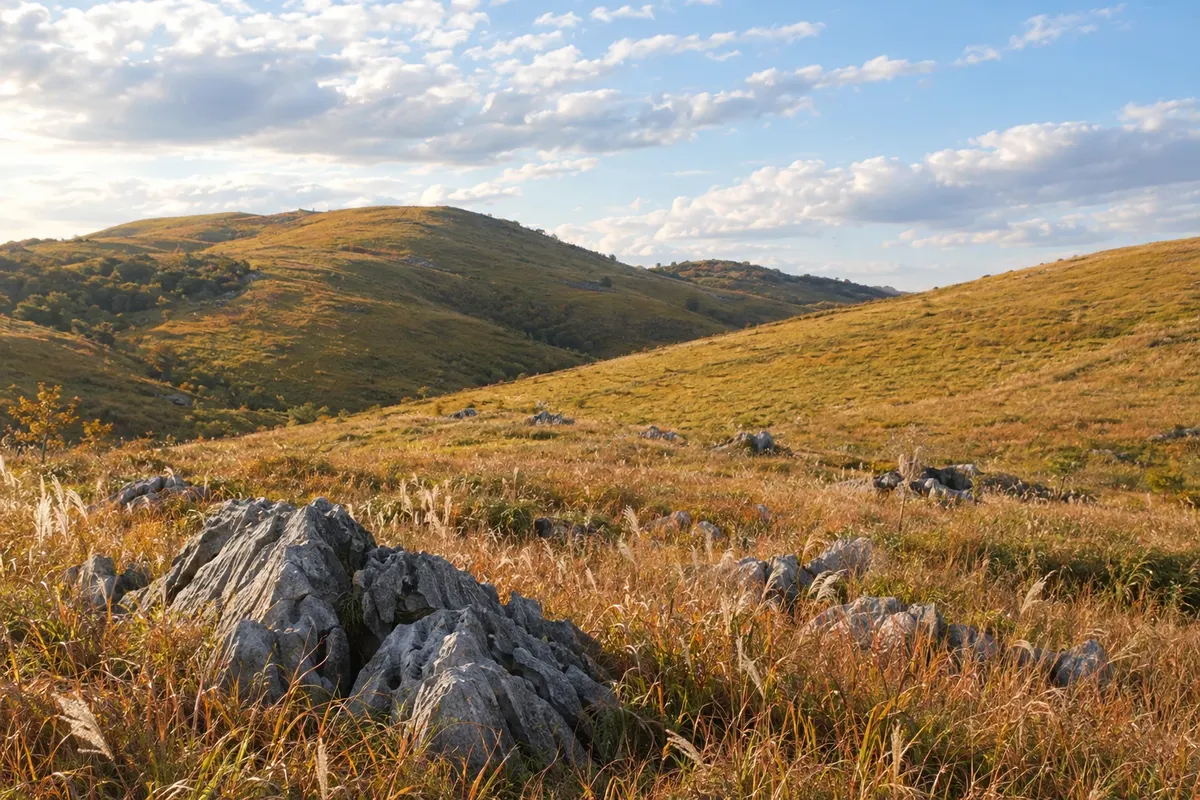
Mine is the inland city in Yamaguchi where Akiyoshidai, a karst plateau of grass and limestone rocks, and the Akiyoshido cave, one of the largest in the country, are located. The city center is about 15 km from the plateau; access is via the Akiyoshido area, which has hotels, shops and museums.
Cherry blossoms generally bloom around early April at Kintai Bridge. In November, maples color the valleys and gardens of Yamaguchi and Hagi. The pufferfish season runs from October to March. In February, the grass of Akiyoshidai is burned in an annual ritual. The cave maintains a stable temperature year-round.
The Sanyo Shinkansen stops at Shin-Iwakuni, Shin-Yamaguchi and Shin-Shimonoseki; from Hiroshima to Shin-Yamaguchi it’s about 30 minutes. Yamaguchi Ube Airport (UBJ) and Iwakuni Airport (IWK) receive flights from Tokyo. Express buses link Shin-Yamaguchi to Hagi in about 1 hour and to Akiyoshidai in about 45 minutes.
Your questions
By express bus from Shin-Yamaguchi Shinkansen station, in about 1 hour. In Hagi, a loop bus passes the old districts, and rented bicycles make it easy to get around the flat town.
The cave has entrances at both ends and a route of about 1 km open to visitors. An elevator connects the cave interior to the Akiyoshidai plateau.
In Shimonoseki, especially at the Karato market and at specialized restaurants in the city. Pufferfish is served thinly sliced raw, in hotpot, or fried, prepared by chefs with a license.
Yes. A pedestrian tunnel of about 780 meters passes under the strait between Shimonoseki and Moji in Kitakyushu, and a line on the floor marks the border between the two prefectures.
Beyond the guide


