2 cities

 Search
 Brazil
 Antarctica
 Argentina
 Bolivia
 Chile
 Colombia
 Ecuador
 Guyana
 French Guiana
 Falkland Islands (Malvinas)
 Paraguay
 Peru
 Suriname
 Uruguay
 Venezuela
 Germany
 Austria
 Belgium
 Croatia
 Denmark
 Slovakia
 Slovenia
 Spain
 Finland
 France
 Greece
 the Netherlands
 Hungary
 Ireland
 Iceland
 Italy
 Luxembourg
 Norway
 Poland
 Portugal
 the United Kingdom
 the Czech Republic
 Sweden
 Switzerland
 Turkey
 Bermuda
 Canada
 the United States
 Greenland
 Mexico
 Saint Pierre and Miquelon
 the Dominican RepublicJapanTurkey
 South Africa
 Egypt
 Australia
 Fiji
 New Zealand
 Papua New Guinea
Province · Chugoku
Korakuen Garden, the Crow Castle, Kurashiki’s canals, the Kibi cycling route and the bridge to Shikoku across the Inland Sea.
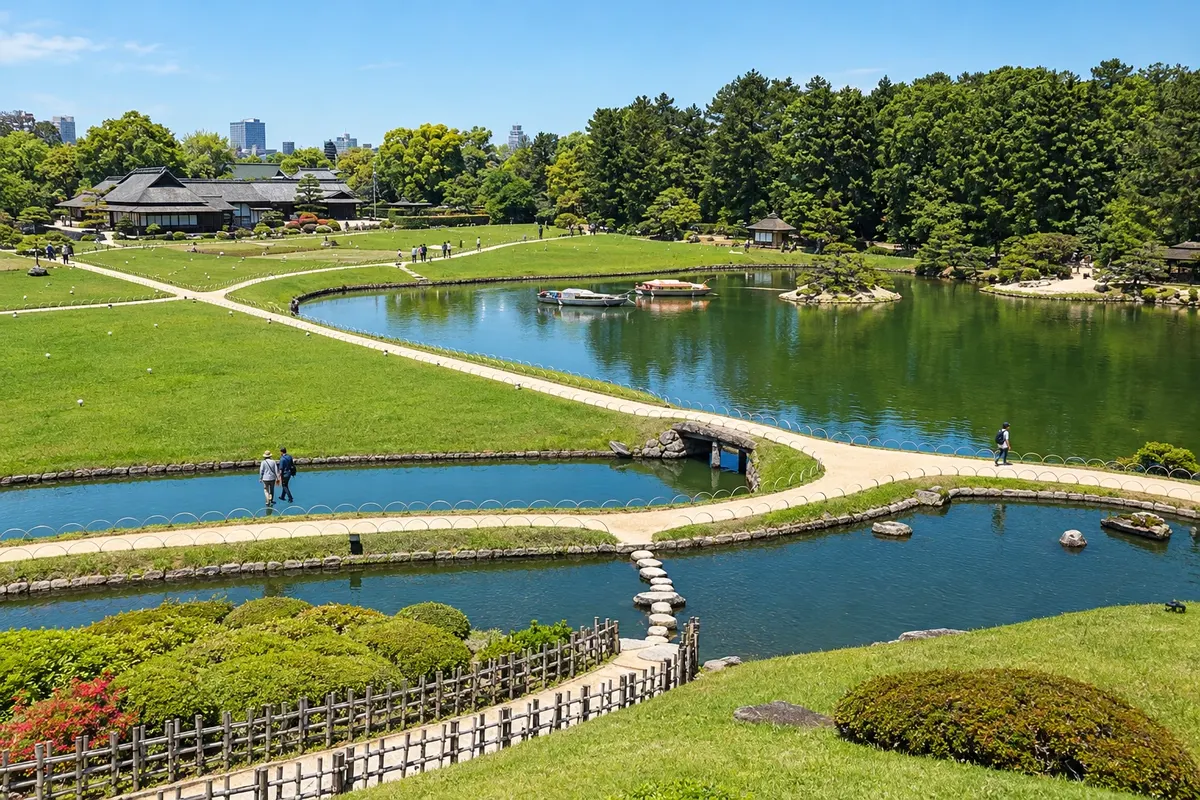
In the photo: Koraku-en Garden, in Okayama.
Illustrative images. The pictures in this guide are illustrations based on the real place, not photographs, and may differ from it.

The province
Okayama lies on the coast of the Inland Sea, between Hiroshima and Hyogo. It has relatively little rain, which is why the prefecture is called the land of the sun. It is known for white peaches and grapes, and for the legend of Momotaro, the boy born from a peach who defeated the demons of an island.
In the capital, Okayama, Korakuen, from the late 17th century, is one of Japan’s three great gardens, with lawns, ponds, an artificial hill and teahouses. Across the river stands Okayama Castle, with black walls, nicknamed the Crow Castle. The tower was reconstructed and houses a museum.
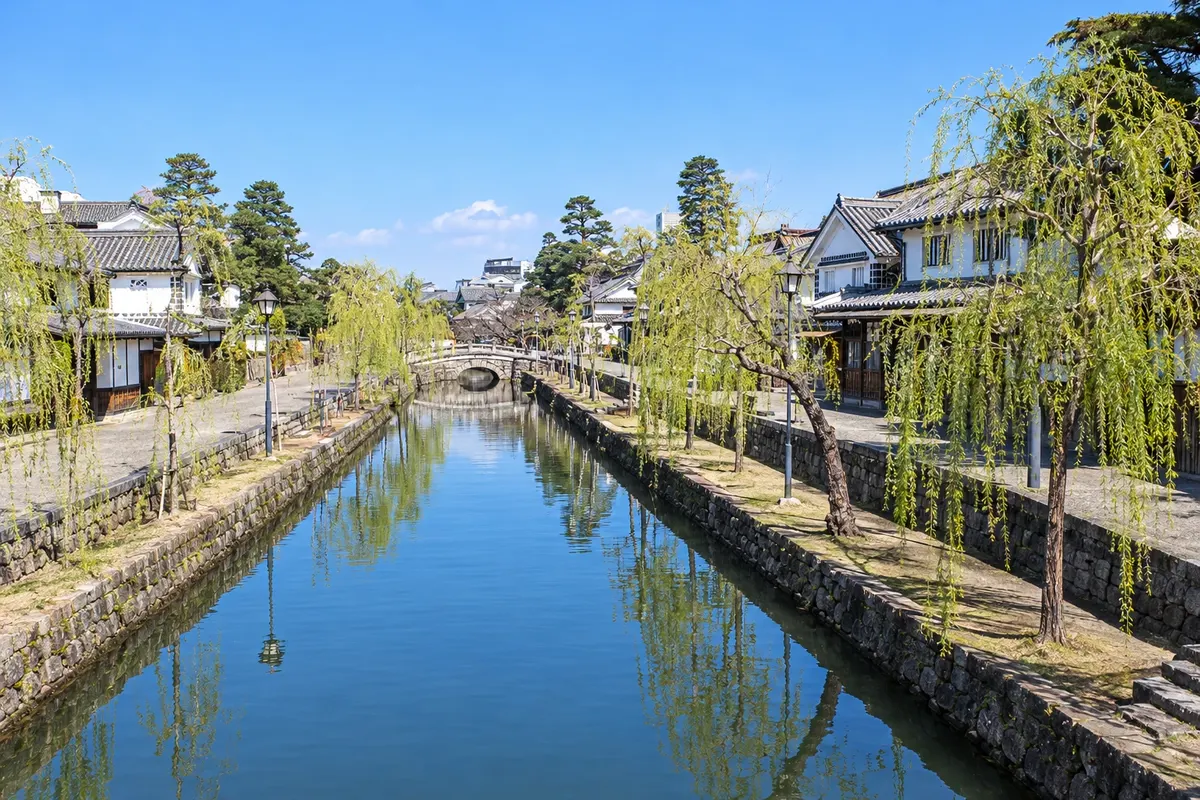
Kurashiki preserves the Bikan quarter, with a canal lined by willows and white-walled warehouses patterned with diamonds. The Ohara Museum of Art, opened in 1930, was the first museum of Western art in Japan, with works by El Greco and Monet. The Kojima district on the coast is known for denim production.
On the Kibi plain, a cycling route passes shrines such as Kibitsu, with a long covered corridor, and ancient burial mounds. In Imbe, kilns produce Bizen pottery, unglazed. The Seto-Ohashi Bridge from Kojima crosses the Inland Sea to Shikoku, and ferries to the art islands of Naoshima depart from Uno port.
Destinations
Cities
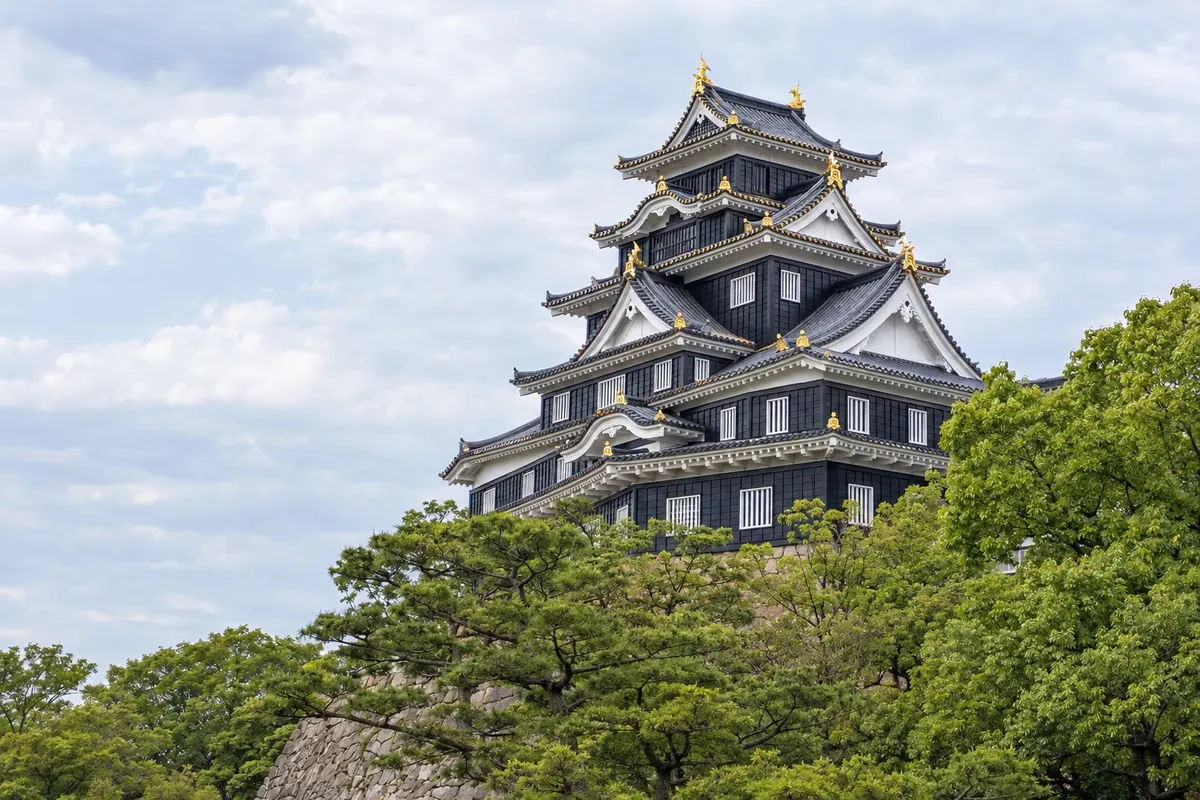
Capital of the like-named prefecture, Okayama is on the Sanyo shinkansen line and at the junction for trains to Shikoku and Matsue. On the banks of the Asahi River are Korakuen Garden and Okayama Castle, with its black walls. To the west of the city, Kibitsu Shrine has a long covered corridor and is linked to the Momotaro legend.
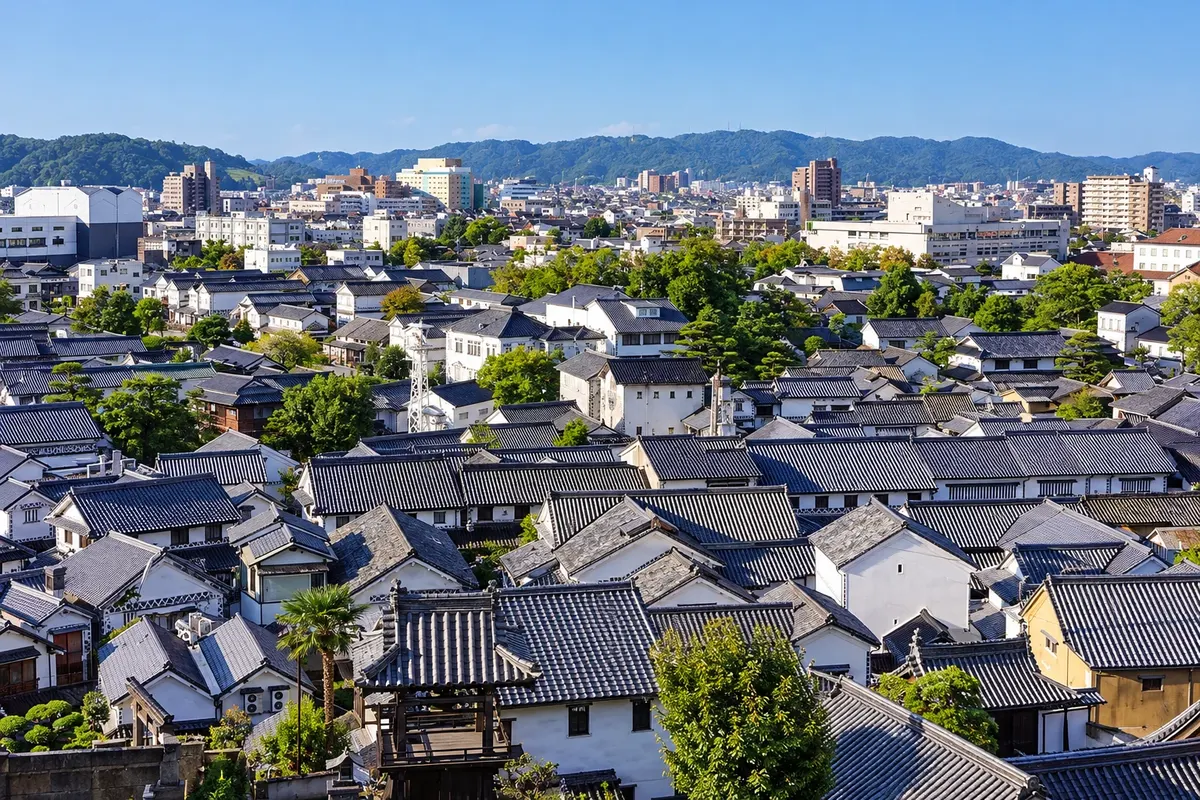
Kurashiki is a city west of Okayama, known for the Bikan district, with a canal lined by willows and white warehouses with black bands, from when it was a rice and cotton trading post. The Ohara Museum of Art, the brick mills of Ivy Square and streets of old shops are there. Kojima, in the southern part of the municipality, is known for jeans.
The climate is mild year-round, with less rain than the rest of the country. At Korakuen, the cherry trees usually bloom around late March to early April. White peaches are harvested in July and August, and grapes from August to October. The garden’s maples turn red in November, and winters tend to be dry and not very cold.
The Sanyo Shinkansen connects Shin-Osaka to Okayama in about 45 minutes, to Tokyo in about 3 hours 20 minutes, and to Hiroshima in about 35 minutes. Kurashiki is about a 15-minute train ride from Okayama. Okayama Airport (OKJ) has flights from Tokyo and other cities. To reach Naoshima, take a train to Uno and then a ferry. Express trains run from Okayama to Shikoku, Matsue and Tottori.
Your questions
About an hour and a half to walk the garden unhurriedly. Including the castle across the river, half a day is enough.
Yes. Kurashiki is about 15 minutes by train, and the Bikan quarter is roughly a 15-minute walk from the station. Half a day allows time to see the canal and the Ohara Museum.
Take a train to Uno in about 50 minutes, then a ferry to Miyanoura port on Naoshima in about 20 minutes. There are also ferries from Takamatsu on Shikoku.
It’s a flat route of about 15 km between Bizen-Ichinomiya and Soja stations, passing shrines, temples, rice fields and ancient burial mounds. Bicycles are available to rent at both ends.
Beyond the guide


