1 city

 Search
 Brazil
 Antarctica
 Argentina
 Bolivia
 Chile
 Colombia
 Ecuador
 Guyana
 French Guiana
 Falkland Islands (Malvinas)
 Paraguay
 Peru
 Suriname
 Uruguay
 Venezuela
 Germany
 Austria
 Belgium
 Croatia
 Denmark
 Slovakia
 Slovenia
 Spain
 Finland
 France
 Greece
 the Netherlands
 Hungary
 Ireland
 Iceland
 Italy
 Luxembourg
 Norway
 Poland
 Portugal
 the United Kingdom
 the Czech Republic
 Sweden
 Switzerland
 Turkey
 Bermuda
 Canada
 the United States
 Greenland
 Mexico
 Saint Pierre and Miquelon
 the Dominican RepublicJapanTurkey
 South Africa
 Egypt
 Australia
 Fiji
 New Zealand
 Papua New Guinea
Province · Kanto
The hot springs of Kusatsu, Ikaho and Minakami, the silk‑spinning works of Tomioka, the marshes of Oze and the daruma dolls of Takasaki.
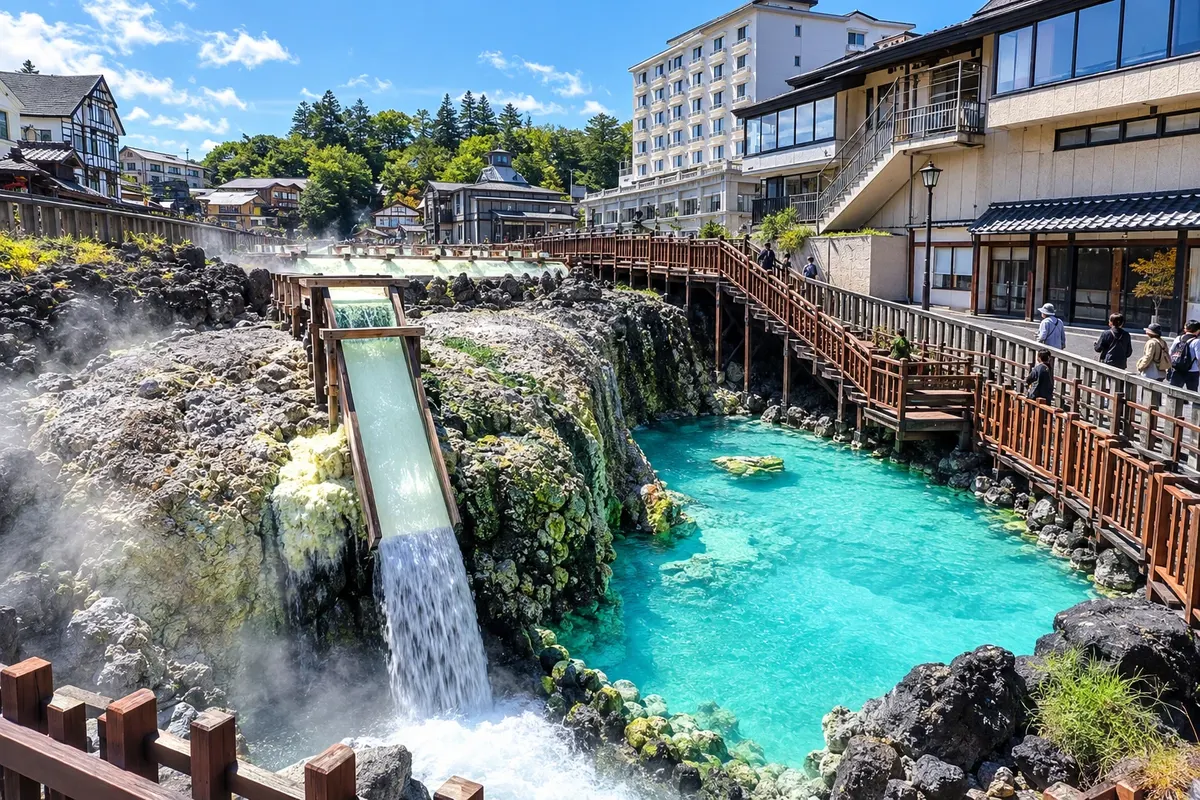
In the photo: Kusatsu Onsen’s yubatake, in Gunma.
Illustrative images. The pictures in this guide are illustrations based on the real place, not photographs, and may differ from it.

The province
Gunma lies northwest of Tokyo, landlocked, among mountains and volcanoes. It is one of the prefectures with the most hot springs in the country. In winter, dry winds descend from the mountains onto the plain. In Takasaki they make daruma dolls, round and red, in which one eye is painted when making a wish.
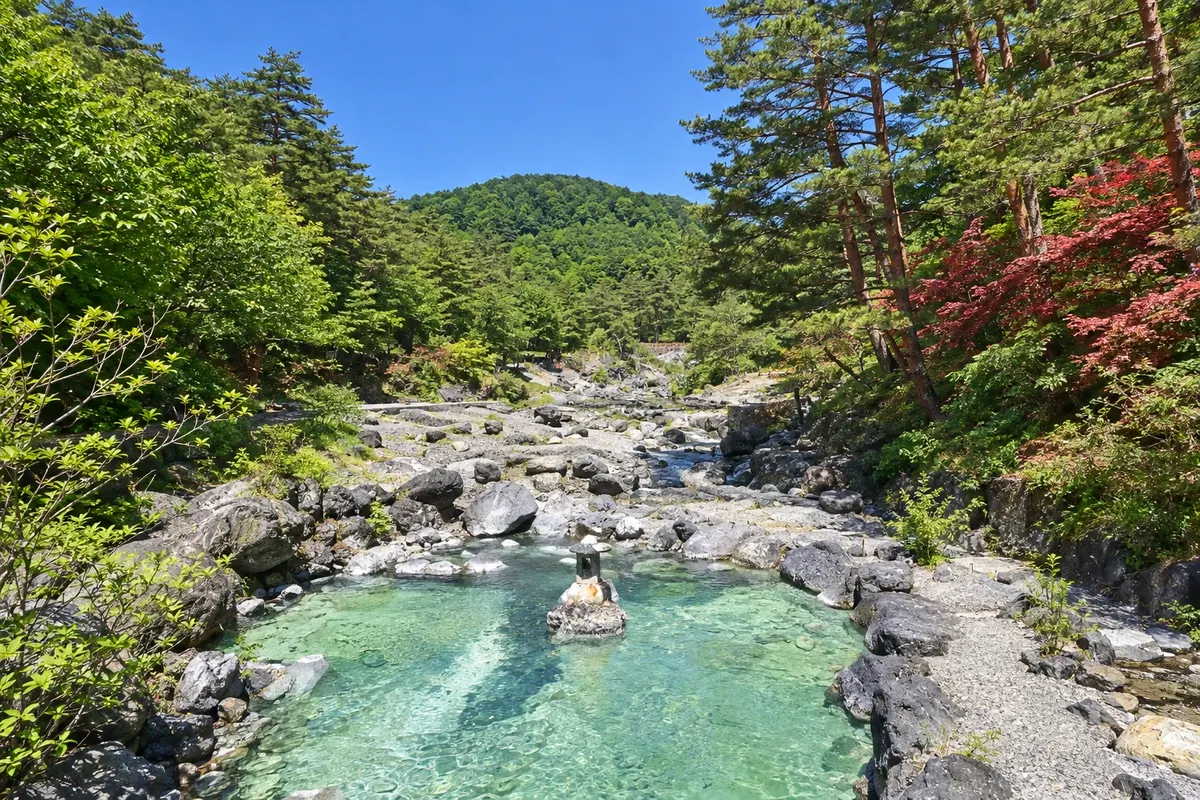
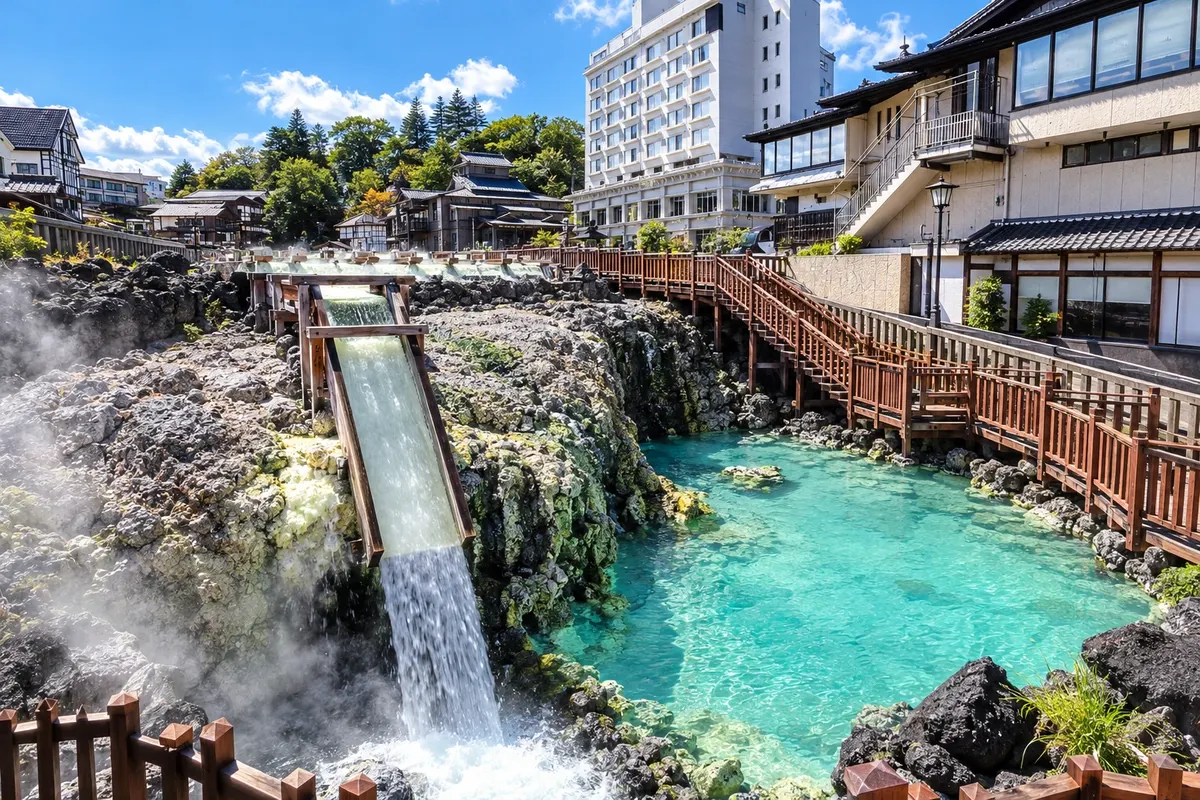
Kusatsu’s center features the yubatake, a field of hot spring water that runs through wooden channels, emitting steam and sulfur. The water comes out very hot and acidic, and the yumomi — the tradition of stirring it with long wooden boards to cool it — is performed with songs in a hall beside it. Sainokawara Park has a large outdoor bath.
Ikaho has a stone staircase through the middle of town, with shops and bathhouses on both sides. Minakami, near Mount Tanigawa, is sought for rafting on the Tone River in spring and summer, and for skiing in winter. Oze, a marshy plateau shared with Fukushima and Niigata, is crossed by wooden boardwalks among white flowers that appear in May and June.
In Tomioka, the silk‑spinning mill opened by the government in 1872, equipped with machines and French technicians, was the country’s first large modern factory. The complex of brick buildings has been a UNESCO World Heritage Site since 2014 and can be visited with guides.
Destinations
The hot springs receive visitors year‑round. Oze’s flowers appear between late May and June, and the plateau closes in winter. Rafting on the Tone River runs from spring to early autumn, with higher water during snowmelt. The mountains turn red in October, and lower‑lying Ikaho in November. From December to March, Kusatsu and Minakami have snow and skiing.
The Joetsu Shinkansen and the Hokuriku Shinkansen connect Tokyo to Takasaki in about 50 minutes; the Joetsu stops at Jomo‑Kogen, for Minakami. For Kusatsu, JR Agatsuma Line trains reach Naganohara‑Kusatsuguchi, and a bus completes the journey in about 25 minutes; there are also direct buses from Shinjuku. Tomioka is about 40 minutes from Takasaki on the Joshin Railway.
Your questions
By train to Naganohara‑Kusatsuguchi on the JR Agatsuma Line, then by bus to central Kusatsu. Direct buses from Shinjuku take about 4 hours without transfers.
It is the field of hot spring water in the center of the village, where the water runs through wooden channels to cool before going to the bathhouses. At night it is illuminated, and the surroundings have shops and public bathhouses.
Between late May and October. The white flowers called mizubasho appear in May and June, and the golden autumn grasses in September and October. In winter, snow closes access.
The cocoon warehouses, the spinning hall with the machines, and the house of the French engineer who ran the factory. Guided tours explain the silk production that supplied Japanese exports at the end of the 19th century.
Beyond the guide