

 Brazil
 Antarctica
 Argentina
 Bolivia
 Chile
 Colombia
 Ecuador
 Guyana
 French Guiana
 Falkland Islands (Malvinas)
 Paraguay
 Peru
 Suriname
 Uruguay
 Venezuela
 Germany
 Austria
 Belgium
 Croatia
 Denmark
 Slovakia
 Slovenia
 Spain
 Finland
 France
 Greece
 the Netherlands
 Hungary
 Ireland
 Iceland
 Italy
 Luxembourg
 Norway
 Poland
 Portugal
 the United Kingdom
 the Czech Republic
 Sweden
 Switzerland
 Turkey
 Bermuda
 Canada
 the United States
 Greenland
 Mexico
 Saint Pierre and Miquelon
 the Dominican Republic
 South Africa
 Egypt
 Australia
 Fiji
 New Zealand
 Papua New Guinea
Province · Kanto
Tóquio
Asakusa and Senso-ji, Shibuya and Shinjuku, the Meiji Shrine, Ueno’s museums, the Tokyo Skytree and the Ogasawara Islands.
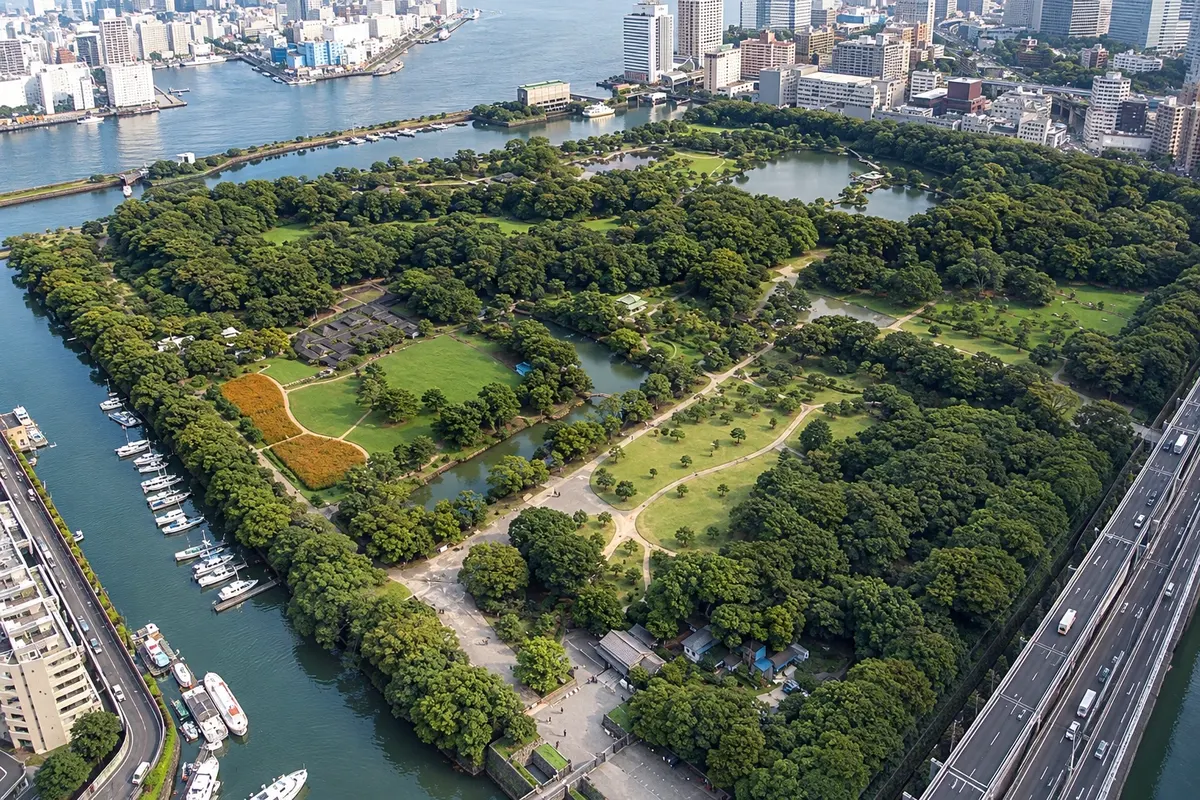
In the photo: Hama-rikyū Gardens, Tokyo.
Illustrative images. The pictures in this guide are illustrations based on the real place, not photographs, and may differ from it.

The province
Get to know Tóquio
Tokyo is Japan’s capital and one of the world’s largest urban areas. Officially a metropolis, it has 23 special wards at its core, cities to the west such as Hachiōji and Mitaka, and islands in the Pacific: the Izu Islands and, about 1,000 km away, the Ogasawara Islands, a UNESCO natural heritage site since 2011. The city was called Edo until 1868, when the emperor left Kyoto and moved here.
In the east, Asakusa hosts Senso-ji, the city’s oldest temple, with the Kaminarimon gate and the Nakamise shopping street. Across the Sumida River stands the Tokyo Skytree, 634 meters tall with observation decks. Ueno Park brings together the Tokyo National Museum and the National Museum of Western Art, designed by Le Corbusier and part of a UNESCO site. Akihabara concentrates electronics, manga and game shops.
In the center are the Imperial Palace, whose east gardens are open to visitors, and the shops of Ginza. To the west, Shibuya has the country’s best-known pedestrian crossing; Harajuku and Omotesandō offer fashion boutiques; and the Meiji Shrine sits in a forest planted in the early 20th century. Shinjuku has skyscrapers, the Shinjuku Gyoen garden and the observation deck of the metropolitan government building, which has free entry. The outer Tsukiji market and the artificial island of Odaiba complete the bay side.
The city has thousands of restaurants, from ramen and sushi counters to izakaya, and neighborhoods with distinct character, like Yanaka, with old streets, and Shimokitazawa. To the west, Mount Takao has trails about an hour from the center. The Ogasawara Islands are reachable only by ship, a trip of roughly one day.
When to go
In Ueno, at Chidorigafuchi and along the Meguro River, cherry trees usually bloom in late March and remain in flower through early April. May is pleasant. the rainy season runs from June into early July, and July and August are hot and humid, with festivals and fireworks. September can still bring typhoons. October and November are mild, and ginkgo trees turn yellow in late November. Winter is dry and sunny, with little snow.
Getting there
Haneda Airport (HND) is about 15 km from the center: the monorail and Keikyu trains reach Hamamatsuchō and Shinagawa in 15–30 minutes. Narita Airport (NRT), in Chiba, is about 60 km away; the Narita Express and the Keisei Skyliner take about an hour. Shinkansen from all directions arrive at Tokyo, Shinagawa and Ueno stations. Within the city, the subway and the JR Yamanote loop line reach almost everywhere; Suica or PASMO cards are used for trains and buses.
Your questions
Frequently asked questions about Tóquio
How many days should you set aside for Tokyo?
Four days allow you to see Asakusa, Ueno, the center, Shibuya, Harajuku and Shinjuku without rushing. With more days you can add day trips to Nikko, Kamakura or Hakone, all about one to two hours by train.
Which airport is closer to central Tokyo, Haneda or Narita?
Haneda, about 15 km away, with trains reaching the center in under half an hour. Narita is about 60 km away and takes roughly an hour by express train.
How do you get around Tokyo?
By subway and train. The JR Yamanote loop connects the main neighborhoods, and subway lines fill in the network. Reloadable Suica and PASMO cards work on both systems, on buses and in many shops.
How do you reach the Ogasawara Islands?
Only by ship, departing from Takeshiba Port on a voyage of about 24 hours to Chichijima. Sailings are infrequent, and minimum stays often require a few days: plan well in advance.
Beyond the guide


