

 Brazil
 Antarctica
 Argentina
 Bolivia
 Chile
 Colombia
 Ecuador
 Guyana
 French Guiana
 Falkland Islands (Malvinas)
 Paraguay
 Peru
 Suriname
 Uruguay
 Venezuela
 Germany
 Austria
 Belgium
 Croatia
 Denmark
 Slovakia
 Slovenia
 Spain
 Finland
 France
 Greece
 the Netherlands
 Hungary
 Ireland
 Iceland
 Italy
 Luxembourg
 Norway
 Poland
 Portugal
 the United Kingdom
 the Czech Republic
 Sweden
 Switzerland
 Turkey
 Bermuda
 Canada
 the United States
 Greenland
 Mexico
 Saint Pierre and Miquelon
 the Dominican Republic
 South Africa
 Egypt
 Australia
 Fiji
 New Zealand
 Papua New Guinea
Province · Kanto
Ibaraki
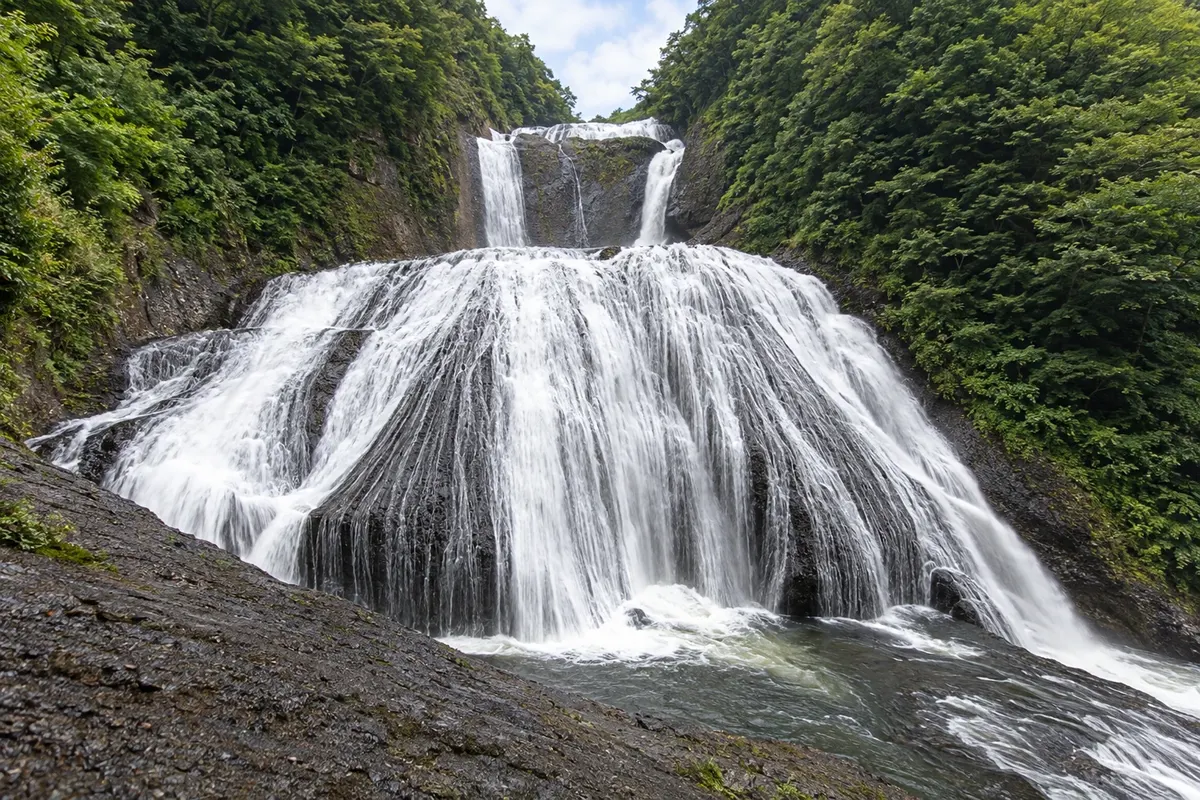
Hitachi Park and the blue nemophilas, Mito’s Kairakuen garden, Fukuroda Falls, Mount Tsukuba and Kashima Shrine.
In the photo: Fukuroda Falls, in Ibaraki.
Illustrative images. The pictures in this guide are illustrations based on the real place, not photographs, and may differ from it.

The province
Get to know Ibaraki
Ibaraki lies northeast of Tokyo, between the Pacific and Lake Kasumigaura, the country’s second largest lake. Most of the prefecture is agricultural plain, known for melons, chestnuts and Mito natto, the fermented soy. To the north, the hills rise toward the Tohoku mountains.
In Mito, the capital, Kairakuen is counted among Japan’s three great gardens, alongside Kenroku-en and Korakuen. It has thousands of plum trees that bloom from February to March, and a grove of bamboo and cedars. Nearby, the Kodokan was the school of the samurai of the Mito domain.
At Hitachi Park in Hitachinaka, a whole hill turns blue when the nemophilas bloom, usually from late April to mid-May. In autumn, the same hill is covered with kochias, rounded shrubs that change from green to red. The park is large and has bike paths and gardens of other flowers throughout the year.
In the north, Fukuroda Falls in Daigo drops in four tiers over a rock face and can partially freeze in the coldest winters. Mount Tsukuba, with two peaks, has a funicular, a gondola and hiking trails, and from the top you can see the Kanto plain. On the southeast coast, Kashima Shrine, set among ancient trees, is one of the oldest in the region.
When to go
Kairakuen’s plum trees bloom from February to March. Hitachi Park’s nemophilas usually flower from late April to mid-May, and the kochias turn red in October. In November maples and oaks redden around Fukuroda Falls and on Tsukuba’s slopes. July and August make the plain humid and hot, and the winter months are dry with almost no snow.
Getting there
JR Joban line express trains connect Tokyo and Ueno to Mito in about 1 hour 20 minutes. The Tsukuba Express runs from Akihabara to Tsukuba in about 45 minutes, and buses go up to the mountain from there. Hitachi Park is about a 15-minute bus ride from Katsuta Station. Ibaraki Airport (IBR) has flights to Sapporo, Kobe, Fukuoka, Okinawa and some nearby international cities.
Your questions
Frequently asked questions about Ibaraki
When do the nemophilas at Hitachi Park bloom?
Generally from late April to mid-May, with variation from year to year. The park posts bloom updates on its website, and visitor numbers are large during the early May holidays.
How do I get to Hitachi Park from Tokyo?
Take an express train to Katsuta on the JR Joban line, then a bus to the park entrance. There are also direct buses from Tokyo during the flower season. The trip takes about two hours.
What is the Kairakuen garden?
It’s a public garden opened in the 19th century by the lord of the Mito domain, with thousands of plum trees of many varieties and a wooden pavilion, the Kobuntei. It sits beside Lake Senba, a short walk from Mito Station.
How do you climb Mount Tsukuba?
From the side of Tsukuba Shrine, a funicular goes up to the Nantai peak; from the opposite side, a gondola reaches the Nyotai peak. Trails connect the base to both peaks and take about 90 minutes to climb.
Beyond the guide


