

 Antarctica
 Argentina
 Bolivia
 Chile
 Colombia
 Ecuador
 Guyana
 French Guiana
 Falkland Islands (Malvinas)
 Paraguay
 Peru
 Suriname
 Uruguay
 Venezuela
 Germany
 Austria
 Belgium
 Croatia
 Denmark
 Slovakia
 Slovenia
 Spain
 Finland
 France
 Greece
 the Netherlands
 Hungary
 Ireland
 Iceland
 Italy
 Luxembourg
 Norway
 Poland
 Portugal
 the United Kingdom
 the Czech Republic
 Sweden
 Switzerland
 Turkey
 Bermuda
 Canada
 the United States
 Greenland
 Mexico
 Saint Pierre and Miquelon
 the Dominican Republic
 Japan
 South Africa
 Egypt
 Australia
 Fiji
 New Zealand
 Papua New Guinea
State · North
Rondônia
Rondônia was born from a railway opened in the forest and grew with a road that brought people from all over the country. Porto Velho, on the banks of the Rio Madeira, preserves both stories.
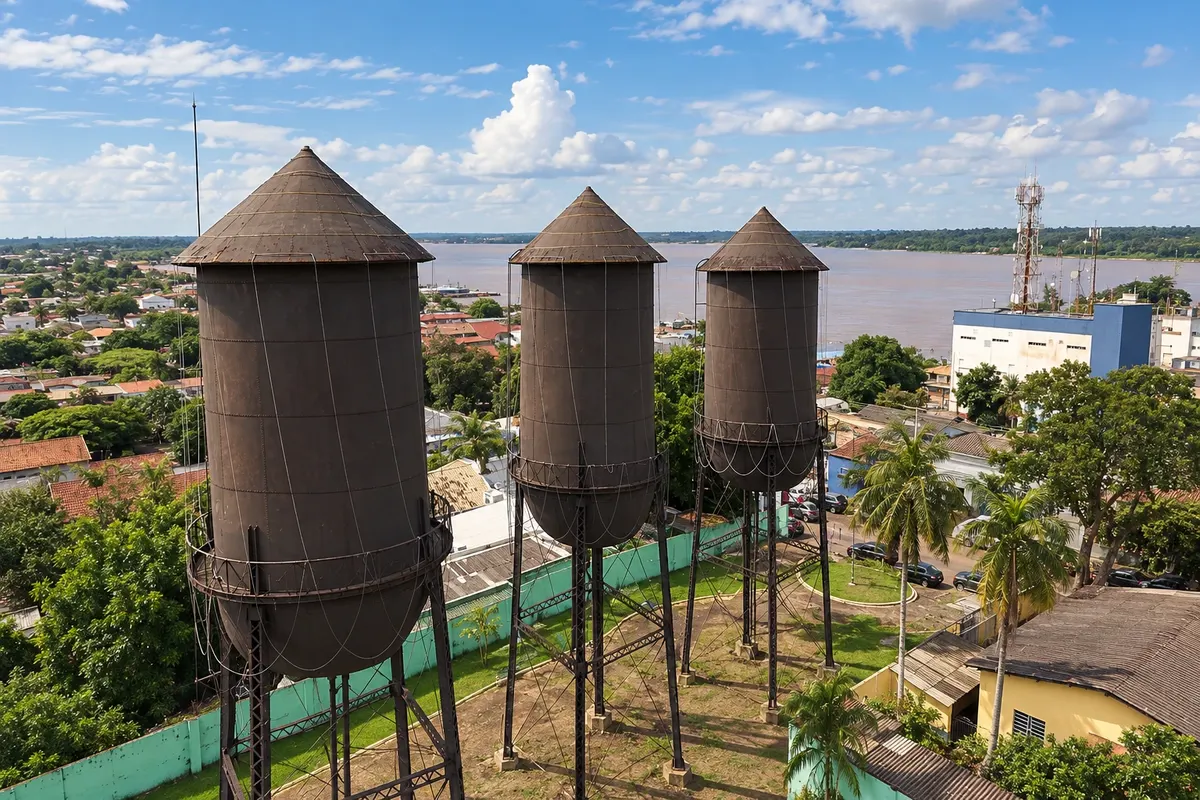
In the photo: Três Caixas d’Água and Rio Madeira in the background, Porto Velho (RO)
Illustrative images. The pictures in this guide are illustrations based on the real place, not photographs, and may differ from it.


The state
Get to know Rondônia
Rondônia lies in the southwest of the Amazon, on the border with Bolivia. The territory was settled in waves: rubber at the beginning of the 20th century, the construction of the Madeira-Mamoré railway and, from the 1970s on, the opening of BR-364, which brought farmers from the South, Southeast and Northeast. That mix shows up in the accent, the festivals and the food.
Porto Velho emerged next to the construction camp of the Estrada de Ferro Madeira-Mamoré, built between 1907 and 1912 to bypass the rapids of the Rio Madeira and export Bolivian rubber. Thousands of workers died during the works, which became known as the Ferrovia do Diabo. The yard of the old station, with locomotives and sheds, sits by the river. Nearby, the Três Caixas d’Água, brought from the United States in the railway era, became a symbol of the capital.
The Rio Madeira defines the landscape. Boats leave the port for trips to riverside communities, and the waterfront is the place for sunset. Inland, the Forte Príncipe da Beira, an 18th‑century Portuguese fortress on the Rio Guaporé, and Guajará-Mirim, on the Bolivian border, are many hours by road from the capital.
The food mixes river and countryside. Roast tambaqui, fish caldeirada and pirarucú coexist with dishes brought by migrants from the South. The Arraial Flor do Maracujá, the state's largest folkloric festival, brings together quadrilhas and bois‑bumbás at Parque dos Tanques in Porto Velho in mid‑year months.
When to go
The rainy season runs from November to April and fills the Madeira, making dirt roads difficult. From June to September the weather is dry and hot; at the end of that period, smoke from fires can obscure Porto Velho's sky and worsen air quality. May and October are transition months. The Arraial Flor do Maracujá takes place mid‑year, with dates set for each edition.
How to get there
The Aeroporto Internacional de Porto Velho – Governador Jorge Teixeira de Oliveira is in the capital. BR-364 is Rondônia’s main land route, linking Porto Velho to Cuiabá in Mato Grosso and continuing to Rio Branco in Acre, crossing the Rio Madeira by bridge. BR-319, toward Manaus, has long unpaved stretches and becomes difficult in rain. BR-425 leads to Guajará-Mirim on the border with Bolivia. Scheduled boats travel down the Madeira as far as the Amazon.
Your questions
Frequently asked questions about Rondônia
Does the Madeira-Mamoré train still operate?
The railway was decommissioned in the 1970s. In Porto Velho, the old station complex houses locomotives, carriages and sheds. Train rides are not regular; before going, check whether the complex is open to visitors.
Does Rondônia have a different time zone?
Yes. The clock is one hour behind Brasília time year‑round. Check connecting flights so you don’t miss your departure.
Can you travel from Porto Velho to Manaus by road?
Via BR-319, but the trip is long, with unpaved sections, few service points and mud bogs during the rainy season. Those who go by land usually choose the dry season and a high‑clearance vehicle. The alternative is a boat on the Rio Madeira or a plane.
When is the best time to avoid smoke from fires?
May, June and July — after the rains and before the peak fire season, which typically runs from August to October. People with respiratory issues should avoid the end of the dry season.
Is it worth visiting Guajará-Mirim?
For those who enjoy border towns, yes. The city sits on the banks of the Rio Mamoré, opposite Guayaramerín in Bolivia, and the crossing is by boat. Bring identification and allow at least one overnight because of the distance from the capital.
How many days should you stay in Porto Velho?
Two days are enough for the railway complex, the Três Caixas d’Água, the waterfront and a boat trip on the Madeira. Add extra days if you want to continue to Guajará-Mirim or Forte Príncipe da Beira.
Mapa: @svg-maps/brazil, CC BY 4.0
Beyond the guide


