

 Antarctica
 Argentina
 Bolivia
 Chile
 Colombia
 Ecuador
 Guyana
 French Guiana
 Falkland Islands (Malvinas)
 Paraguay
 Peru
 Suriname
 Uruguay
 Venezuela
 Germany
 Austria
 Belgium
 Croatia
 Denmark
 Slovakia
 Slovenia
 Spain
 Finland
 France
 Greece
 the Netherlands
 Hungary
 Ireland
 Iceland
 Italy
 Luxembourg
 Norway
 Poland
 Portugal
 the United Kingdom
 the Czech Republic
 Sweden
 Switzerland
 Turkey
 Bermuda
 Canada
 the United States
 Greenland
 Mexico
 Saint Pierre and Miquelon
 the Dominican Republic
 Japan
 South Africa
 Egypt
 Australia
 Fiji
 New Zealand
 Papua New Guinea
State · North
Amapá
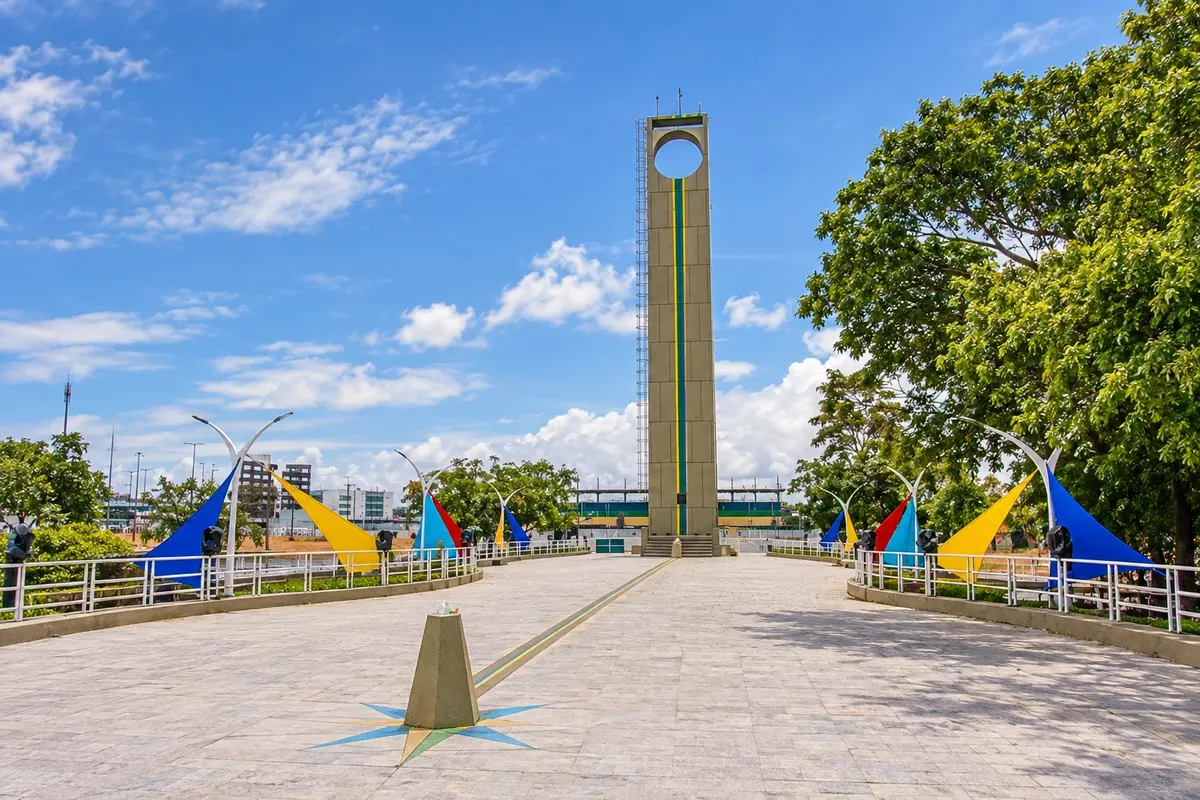
Cut by the linha do Equador and washed by the mouth of the Rio Amazonas, Amapá welcomes visitors in Macapá, a capital with no road link to the rest of the country.
In the photo: Monumento Marco Zero do Equador, Macapá (AP)
Illustrative images. The pictures in this guide are illustrations based on the real place, not photographs, and may differ from it.


The state
Get to know Amapá
Amapá occupies the far north of Brazil, between the mouth of the Rio Amazonas, the Atlantic Ocean and the border with Guiana Francesa. Much of the territory is protected area, with rainforest, flooded fields and mangroves. No road links the state to the rest of the country: it is reached by plane or by boat.
Macapá is the only Brazilian capital cut by the linha do Equador. The Marco Zero, an obelisk in the Zona Sul of the city, marks the spot and fills up at the equinoxes in March and September, when the sun aligns with the opening at the top of the monument. On the banks of the Amazon, the Fortaleza de São José de Macapá, raised by the Portuguese in the 18th century to watch the river entrance, is one of the country's largest colonial fortifications. The waterfront and the wooden pier that juts out over the river are the late-afternoon stroll.
Black culture marks the city. The Marabaixo, a circle dance to the sound of caixas, with women in full skirts, is a cultural heritage of Brazil; the festival cycle takes place in the weeks after Easter, and gengibirra, a ginger drink, circulates in the rodas. A few kilometers from the center, the Quilombo do Curiaú keeps the tradition alive. In food, filhote, tucunaré, regional shrimp, açaí and tacacá are found at the markets and on the waterfront.
When to go
The heat is constant, with little temperature variation throughout the year. The rains are concentrated from January to June. From August to November the weather becomes drier and more stable, better for the waterfront and for boat trips. The equinoxes in March and September bring activity to the Marco Zero, and the Ciclo do Marabaixo follows the Easter calendar, between April and June.
How to get there
The Aeroporto Internacional de Macapá – Alberto Alcolumbre is located in the capital and is the most commonly used entry. From Belém, scheduled boats run to the port of Santana, a municipality neighboring Macapá, in a journey of about a day along the rivers; there are ferries that carry cars. Within the state, BR-156 leaves Macapá north to Oiapoque, on the border with Guiana Francesa; part of it is still unpaved and becomes difficult in the rainy season.
Your questions
Frequently asked questions about Amapá
Can you get to Amapá by car?
Not by road. Anyone who wants to take a car must board it on a ferry from Belém to the port of Santana. For most visitors, flying to Macapá is the simplest way.
When does the sun phenomenon at the Marco Zero happen?
At the equinoxes, around March 20–23 and in September. On those days the sun aligns with the opening of the obelisk and projects a beam of light onto the linha do Equador. There is usually cultural programming at the site.
Where can you watch Marabaixo?
At the rodas of the Ciclo do Marabaixo, in the barracões of Macapá's traditional neighborhoods and at the Quilombo do Curiaú, especially between Easter and June. Outside the cycle, groups perform on the city's commemorative dates.
Is it possible to go from Amapá to Guiana Francesa?
Yes, via Oiapoque, at the end of BR-156, where a bridge crosses the river to Saint-Georges. Guiana Francesa is a territory of France: check in advance with the French consulate the visa and document requirements for Brazilians.
Mapa: @svg-maps/brazil, CC BY 4.0
Beyond the guide


