

 Antarctica
 Argentina
 Bolivia
 Chile
 Colombia
 Ecuador
 Guyana
 French Guiana
 Falkland Islands (Malvinas)
 Paraguay
 Peru
 Suriname
 Uruguay
 Venezuela
 Germany
 Austria
 Belgium
 Croatia
 Denmark
 Slovakia
 Slovenia
 Spain
 Finland
 France
 Greece
 the Netherlands
 Hungary
 Ireland
 Iceland
 Italy
 Luxembourg
 Norway
 Poland
 Portugal
 the United Kingdom
 the Czech Republic
 Sweden
 Switzerland
 Turkey
 Bermuda
 Canada
 the United States
 Greenland
 Mexico
 Saint Pierre and Miquelon
 the Dominican Republic
 Japan
 South Africa
 Egypt
 Australia
 Fiji
 New Zealand
 Papua New Guinea
Central-West
Distrito Federal
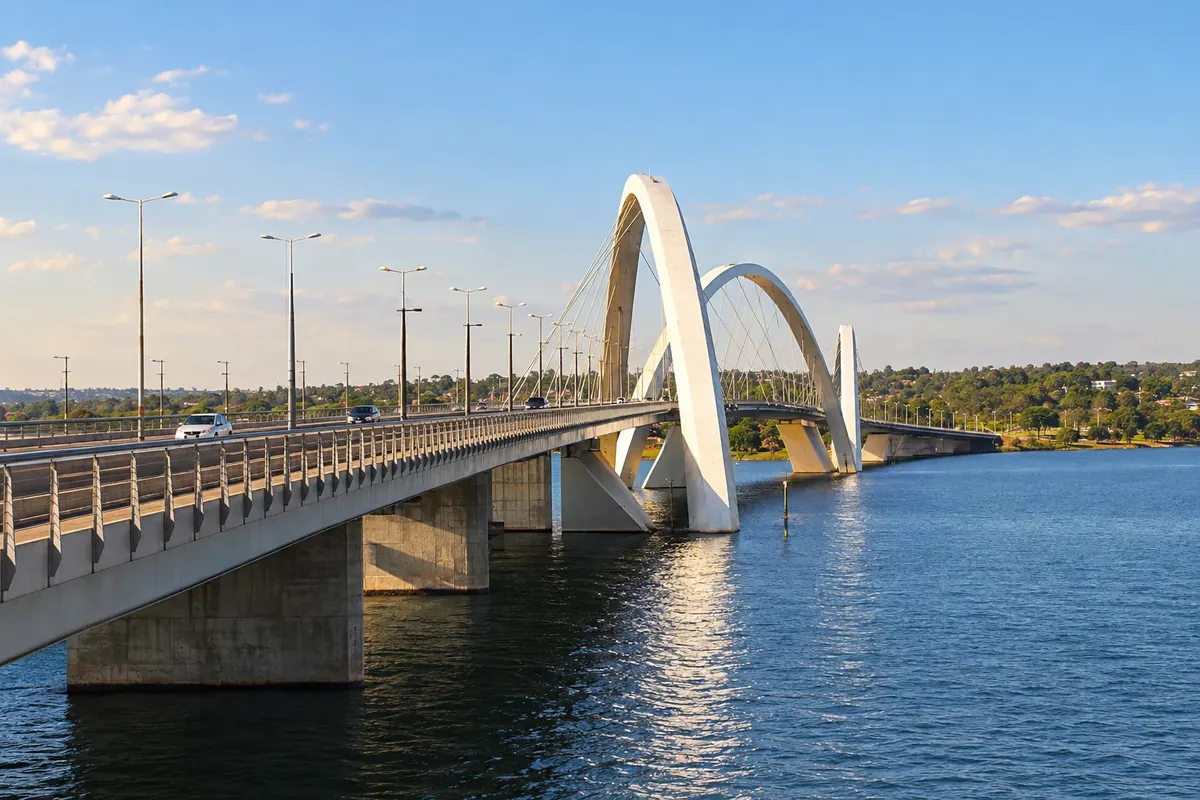
A capital designed from scratch on the Planalto Central, with the open skies of the Cerrado, Lago Paranoá and modern architecture on a citywide scale.
In the photo: Ponte Juscelino Kubitschek and Lago Paranoá, Brasília (DF)
Illustrative images. The pictures in this guide are illustrations based on the real place, not photographs, and may differ from it.


The Federal District
Get to know Distrito Federal
Brasília was inaugurated on April 21, 1960 to move the country's capital inland. The Plano Piloto was laid out by Lúcio Costa, and much of the public architecture bears the signature of Oscar Niemeyer. In 1987 UNESCO recognized the ensemble as a World Heritage Site, a title no other modern city has received.
The classic tour begins on the Eixo Monumental. The Esplanada dos Ministérios leads to the Congresso Nacional and the Praça dos Três Poderes, where the Palácio do Planalto and the Supremo Tribunal Federal are located. Along the way are the Catedral Metropolitana, with its curved columns and stained glass, and the Palácio Itamaraty, surrounded by a reflecting pool. On the other side of the axis, the Torre de TV has an observation deck and a craft and food fair at its base. The Memorial JK preserves the history of the city’s construction.
Lago Paranoá changes the pace of the trip. There are bars and restaurants on the waterfront, boat rides and stand up paddle, and the Ponte JK, with its three arches, makes for good late-afternoon photos. The Palácio da Alvorada sits on the shore. Nearby, the Ermida Dom Bosco is a well-known spot to watch the sunset over the water. In the city center, Parque da Cidade Dona Sarah Kubitschek is the large walking and cycling space.
Outside the Plano Piloto, the Distrito Federal has administrative regions with their own life. Planaltina is older than the capital and hosts the Via Sacra do Morro da Capelinha at Easter. Brazlândia celebrates the harvest at the Festa do Morango. Parque Nacional de Brasília, known as Água Mineral, protects a stretch of Cerrado with trails and natural pools.
When to go
From May to September is the dry season: clear skies, mild days and cool nights. In August and September the air humidity drops significantly, so drink water frequently and use lip balm and saline solution. Rains occur from October to April, with heavy afternoon downpours and a greener Cerrado. The city's anniversary, on April 21, features cultural events, and the Via Sacra in Planaltina takes place on Good Friday.
How to get there
The Aeroporto Internacional de Brasília – Presidente Juscelino Kubitschek receives flights from all regions of the country and some international services. It is one of Brazil’s main air-connection hubs. By road, the BR-040 comes from Belo Horizonte, the BR-060 links the capital to Goiânia and the BR-020 heads toward the northeastern part of Goiás and Bahia. From Brasília, Pirenópolis and Chapada dos Veadeiros, in Goiás, are a few hours’ drive away. Within the city distances are long, and a car or ride-hailing service helps save time.
Your questions
Frequently asked questions about Distrito Federal
How many days are enough to get to know Brasília?
Two days cover the essentials: one for the Eixo Monumental—Esplanada, Catedral, Praça dos Três Poderes, Torre de TV and Memorial JK—and another for Lago Paranoá, Ponte JK and Ermida Dom Bosco. With a third day you can include Parque Nacional de Brasília or a day trip to Pirenópolis in Goiás.
Can you go inside the Congresso Nacional and the palaces?
Yes. The Congresso receives visitors on guided tours. The Palácio do Planalto and Itamaraty also open to the public on specified days, and some require prior booking. Rules change with the official schedule, so check before you go and bring photo ID.
Can you do the sights on foot?
Only in sections. The Esplanada and Praça dos Três Poderes can be walked, but distances between the Eixo Monumental, the lake and the neighborhoods are large and there is little shade. For the rest, use a car, bus or ride-hailing service, and avoid walking in the strong sun during the dry season.
What's the best time to photograph the city?
Between May and September, when the sky is clear and sunsets are more colorful. Ermida Dom Bosco, Ponte JK and Torre de TV are good spots for late-afternoon shots. In the rainy season, dramatic clouds can also make great photos, but downpours may interrupt your outing.
What to bring to cope with the dry weather?
A water bottle, sunscreen, hat, moisturizer, lip balm and saline solution for the eyes and nose. In August and September, when humidity drops further, choose outdoor activities early in the morning and late in the afternoon.
Mapa: @svg-maps/brazil, CC BY 4.0
Beyond the guide


