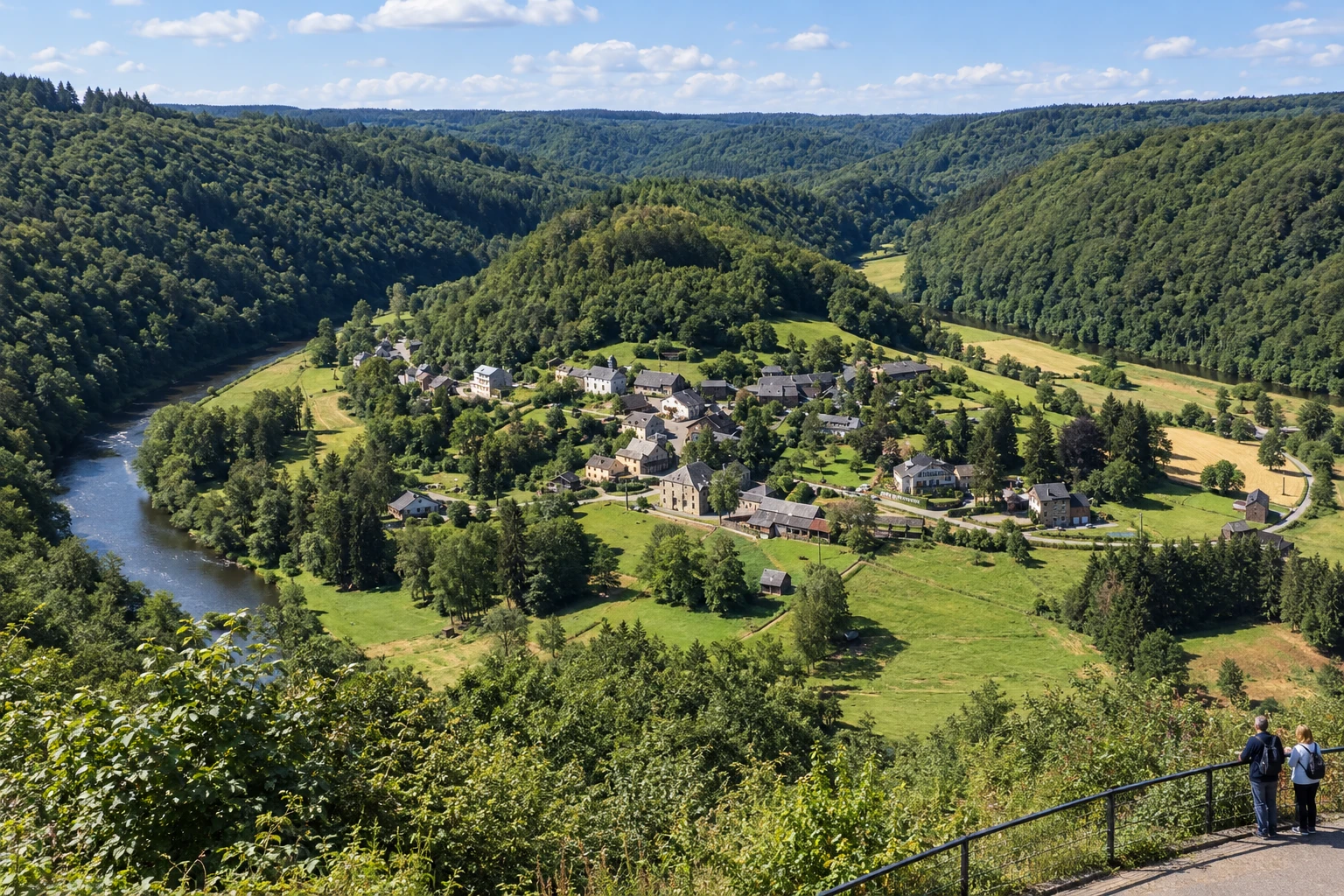
The Belgian Ardennes, in southern and southeastern Wallonia, are a highland region of forests, valleys, and winding rivers. The cold, damp climate has long helped preserve meat, and the region's ham has been served to travelers since at least the early 19th century. Today, Jambon d'Ardenne is one of Wallonia's best-known products.
It is made from a pig's hind leg, which is dry-salted, rubbed with salt, or immersed in brine, then left to age in the cold and dry. Smoking is optional. When the ham is smoked, only wood or sawdust from broadleaf trees is used, never from conifers. The result is a dark red ham with a salty, sometimes smoky flavor, served in thin slices.
The name is protected: Belgium recognized it as a designation of origin in 1974, and the European Union granted it Protected Geographical Indication status in 1996. Only ham made by certified producers in the province of Luxembourg or in certain neighboring cantons of the provinces of Liège and Namur may be called Jambon d'Ardenne. Bastogne, Bouillon, and La Roche-en-Ardenne are all in the province of Luxembourg, within the production area.


 Brazil
 Antarctica
 Argentina
 Bolivia
 Chile
 Colombia
 Ecuador
 Guyana
 French Guiana
 Falkland Islands (Malvinas)
 Paraguay
 Peru
 Suriname
 Uruguay
 Venezuela
 Germany
 Austria
 Croatia
 Denmark
 Slovakia
 Slovenia
 Spain
 Finland
 France
 Greece
 the Netherlands
 Hungary
 Ireland
 Iceland
 Italy
 Luxembourg
 Norway
 Poland
 Portugal
 the United Kingdom
 the Czech Republic
 Sweden
 Switzerland
 Turkey
 Bermuda
 Canada
 the United States
 Greenland
 Mexico
 Saint Pierre and Miquelon
 the Dominican Republic
 Japan
 South Africa
 Egypt
 Australia
 Fiji
 New Zealand
 Papua New Guinea