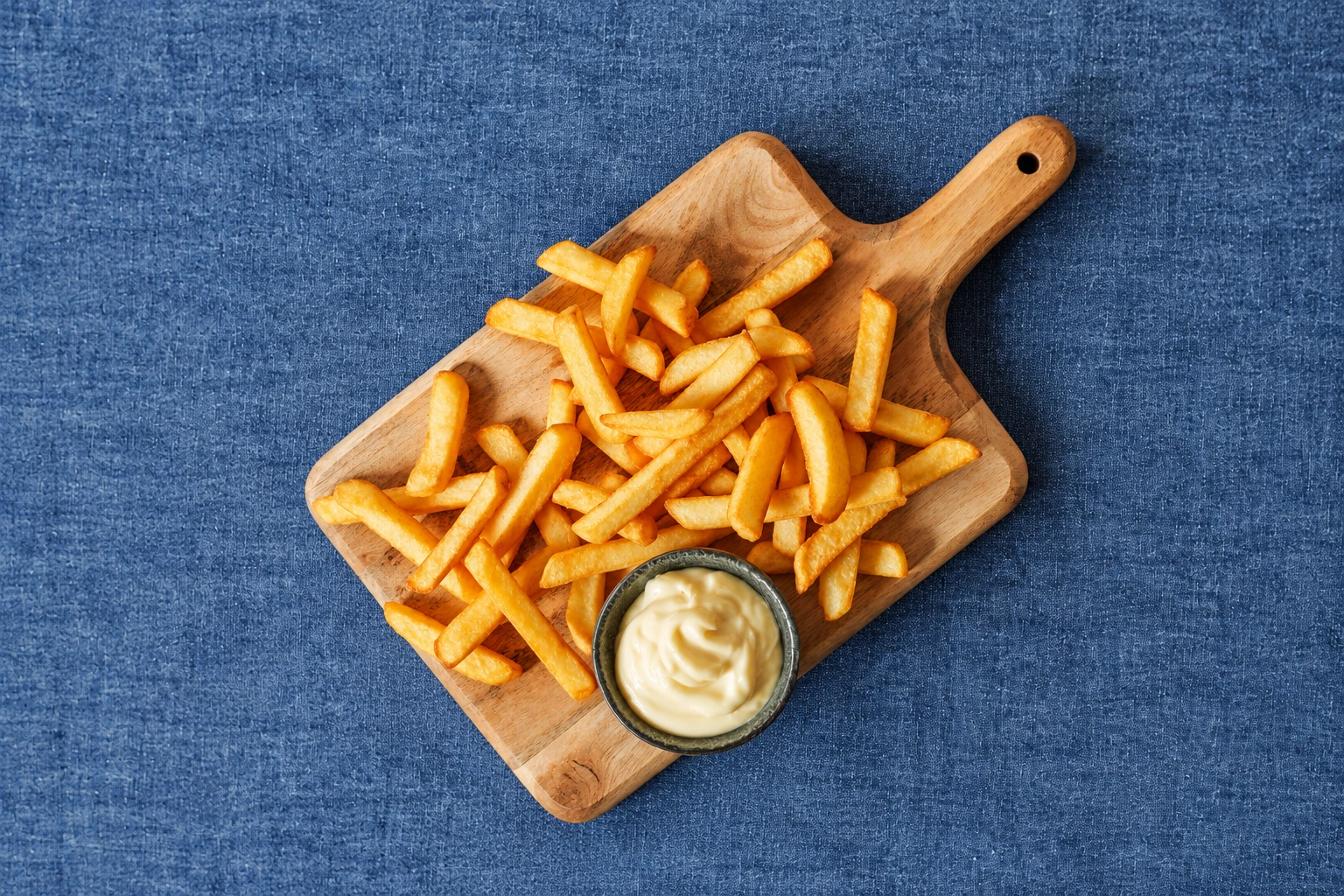
In Belgium, fries have a particular way of being made. The potato, usually the Bintje variety, is cut into sticks about one centimeter thick and fried twice. The first frying, between 130 and 150 °C, only cooks the inside without browning. After resting and cooling, the sticks go back into hotter fat, around 170 to 175 °C, and develop a golden, crispy crust. They come out soft inside and are shaken in a basket to lose excess fat before salting.
Fat is also part of the tradition. For a long time, Belgian frites were made in beef fat — blanc de boeuf in French or ossewit in Flemish — which gives a characteristic flavor. Each friturist chooses their own: beef fat, vegetable fat, or a mixture of the two.
The place of the fries is the fritkot, or frietkot in Flemish: a stall or small kiosk, often next to the church, the station, or the square. There are thousands across the country, usually family businesses where the friturist knows the customers. The Flemish Community recognized the frietkot culture as intangible heritage in 2014; the Fédération Wallonie-Bruxelles did the same in 2016, and the German-speaking Community and the Brussels-Capital Region in 2017. The recognition covers the craft of frying, the stall itself, and the social life around the counter.
The origin of fries is disputed between Belgium and France. A Belgian tradition says that in the Meuse valley, near Namur, Andenne and Dinant, residents used to fry small river fish and, when the water froze, cut potatoes into fish shapes. The story comes from an 18th-century manuscript publicized in the 1980s and is not confirmed: historians note that the potato only reached the Namur region around 1735. On the other side, Belgian historian Pierre Leclercq argues that the stick-cut fried potato was born in Paris in the 19th century. What documents do show is sales at market stalls: according to the patrimoine dossier of the Fédération Wallonie-Bruxelles, Frédéric Krieger, known as Monsieur Fritz, sold frites at the Liège market, most likely in 1838.
Market stalls spread across Belgian cities in the mid-19th century. Fixed, independent fritkots appeared in the 1880s and 1890s, and after World War I almost every train station had one. Their heyday was between 1950 and 1980, when many of them moved into shops and cafés.
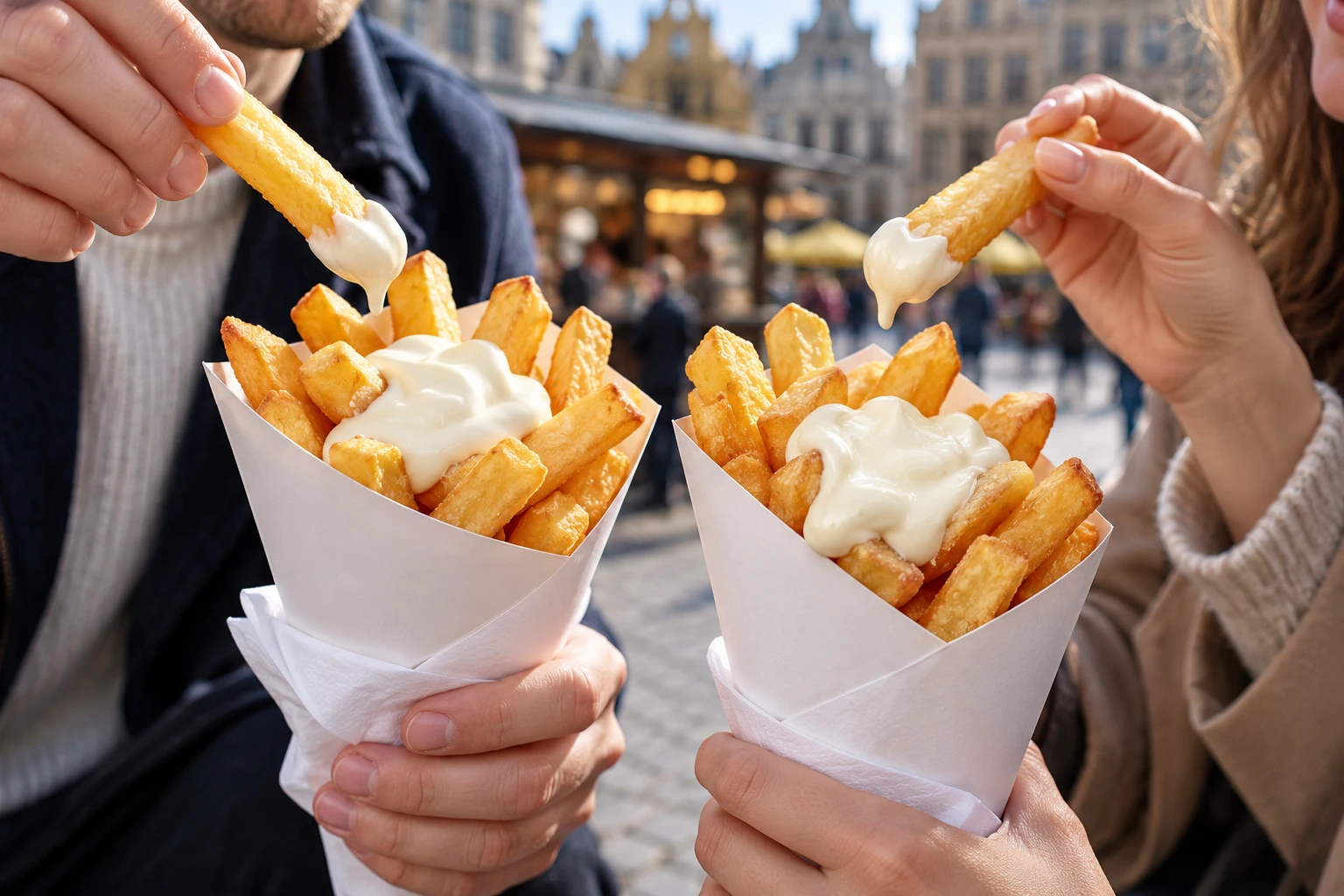
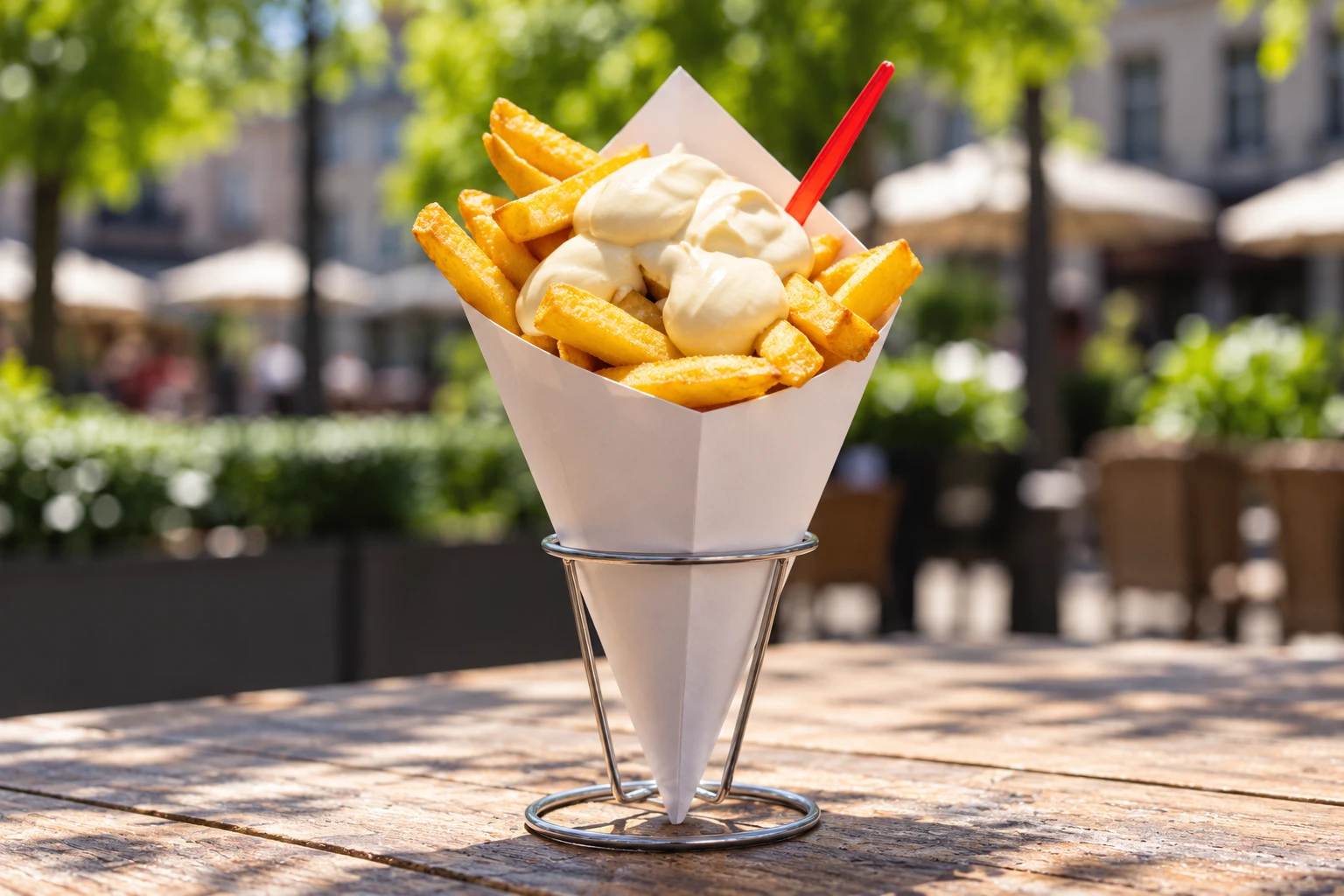
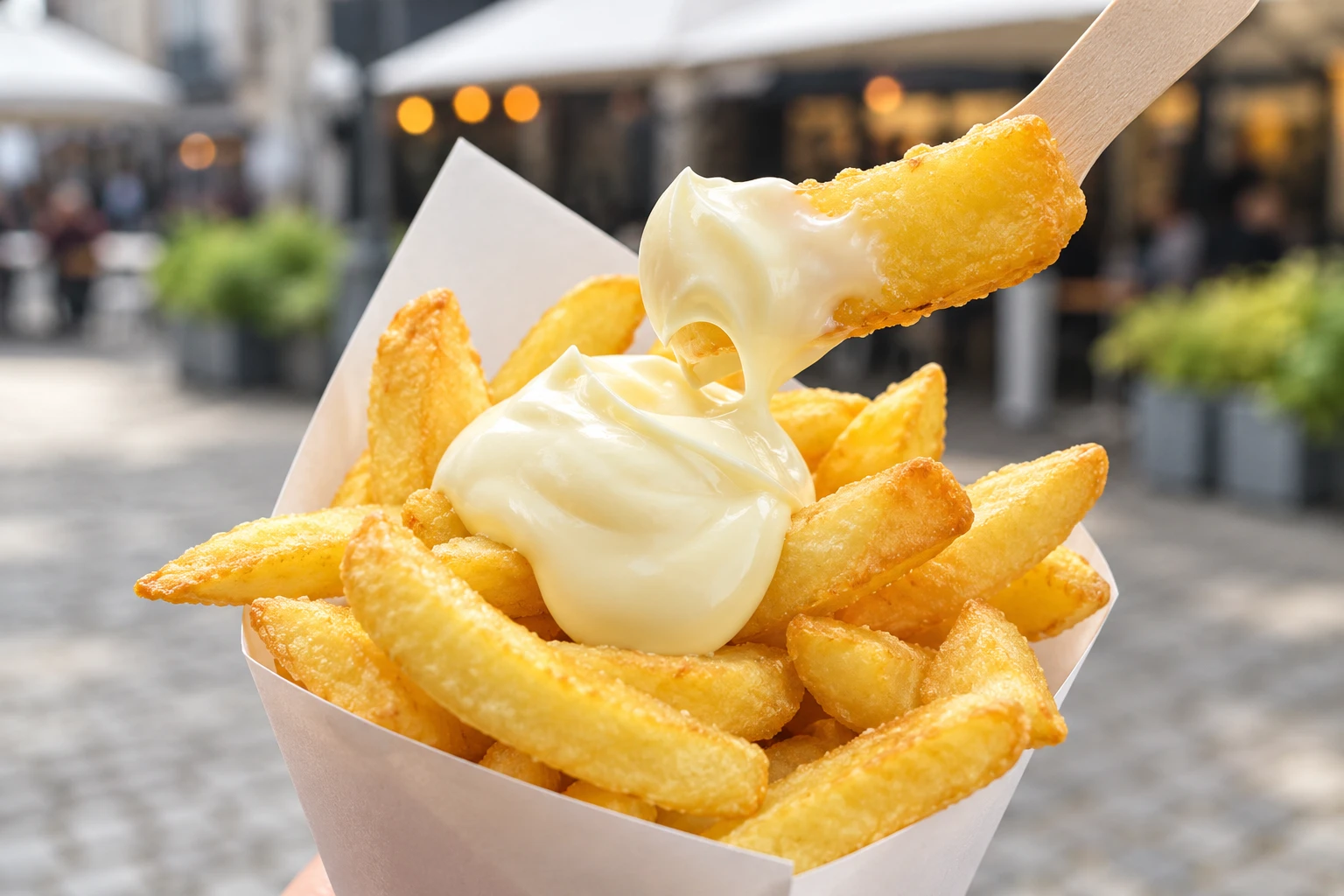
Frites are served in a paper cone or a cardboard box, with salt and a sauce on top or on the side. Mayonnaise is the most requested sauce; tartar, andalouse and samouraï are also common, and in Flanders many people ask for the stoofvlees sauce, from the beef stew cooked with beer. In Ghent the most typical order combines that sauce with mayonnaise. They are eaten hot, right after the second fry, with the hands or with a small fork, and often come with a fried snack such as a croquette, meatball or sausage.


 Brazil
 Argentina
 Bolivia
 Chile
 Colombia
 Ecuador
 Guyana
 French Guiana
 Falkland Islands (Malvinas)
 Paraguay
 Peru
 Suriname
 Uruguay
 Venezuela
 Germany
 Austria
 Croatia
 Denmark
 Spain
 Finland
 France
 Greece
 the Netherlands
 Hungary
 Ireland
 Iceland
 Italy
 Luxembourg
 Norway
 Poland
 Portugal
 the United Kingdom
 the Czech Republic
 Sweden
 Switzerland
 Turkey
 Canada
 the United States
 Mexico
 the Dominican Republic
 South Africa
 Australia
 Fiji
 New Zealand
 Papua New Guinea