Illustrative images. The pictures in this guide are illustrations based on the real place, not photographs, and may differ from it.

Get it on Google Play

Interactive maps

Ocean floor and ocean trenches

The relief hidden beneath the oceans: the mid-ocean ridges, the deepest trenches and the tectonic plates. Compare the depth of the trenches with the height of Everest and find Point Nemo.

Share: WhatsApp

How to use the map

The sea colors show depth: lighter blues are the continental shelves near the coast, and the darker ones are the abyssal plains and the trenches. Yellow lines mark the boundaries between tectonic plates, and orange lines show zones where one plate dives under another.

Tap a trench, marked with an inverted triangle, to place it in the drawing beside. It shows Everest above sea level and the trenches below, all at the same scale.

The red dashed circle is the area around Point Nemo: inside it there is no land. Tap the point to read more about it.

Loading the map…

Tap the trenches to compare them with Everest

The trenches and Everest

    The deepest point of each ocean

    Ocean floor relief: ETOPO1, NOAA (public domain). Tectonic plates: Peter Bird's PB2002 model, from the collection by Hugo Ahlenius and Nordpil (ODC-By). Outlines: Natural Earth (public domain). Trench depths are the most cited measurements and may vary by a few tens of meters.

    The relief of the seafloor

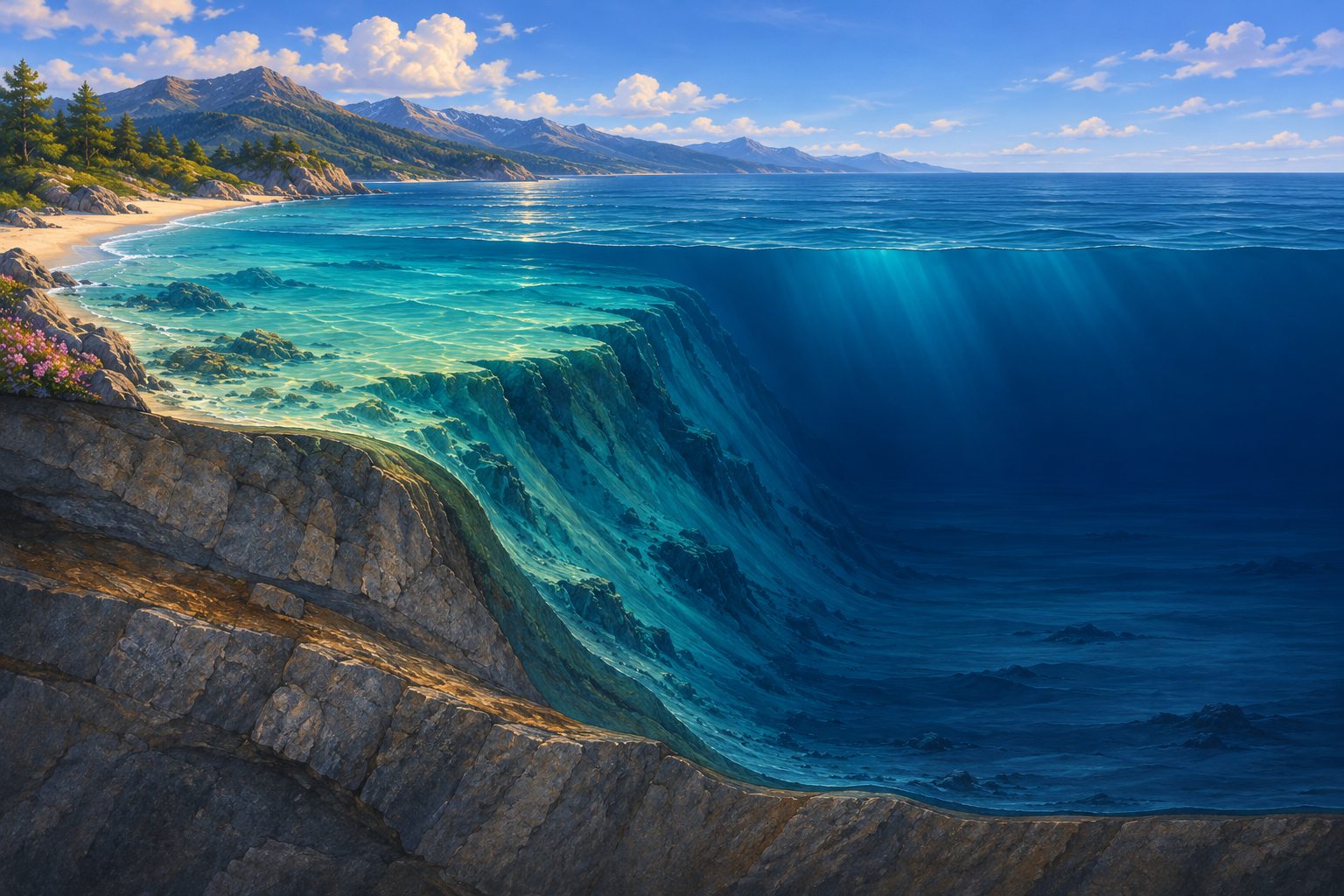
    From the beach to the bottom: the continental shelf, the continental slope, and the abyssal plain.
    From the beach to the bottom: the continental shelf, the continental slope, and the abyssal plain.

    If you leave the beach heading seaward, you go down a kind of staircase. The first step is the continental shelf, the underwater continuation of the continents, shallow and up to about 200 meters deep. This is where almost all coral reefs and most fisheries are located.

    Beyond that comes the continental slope, a steep ramp that drops to 3,000 or 4,000 meters. At its base the abyssal plains begin — nearly flat bottoms covered in sediment, between 3,000 and 6,000 meters deep. On average, the oceans are about 3,700 meters deep.

    A little less than 30% of the seafloor has been mapped in detail, according to the international Seabed 2030 project. The rest is known only from satellite measurements, which show the large shapes but not the details.
    Underwater mountains

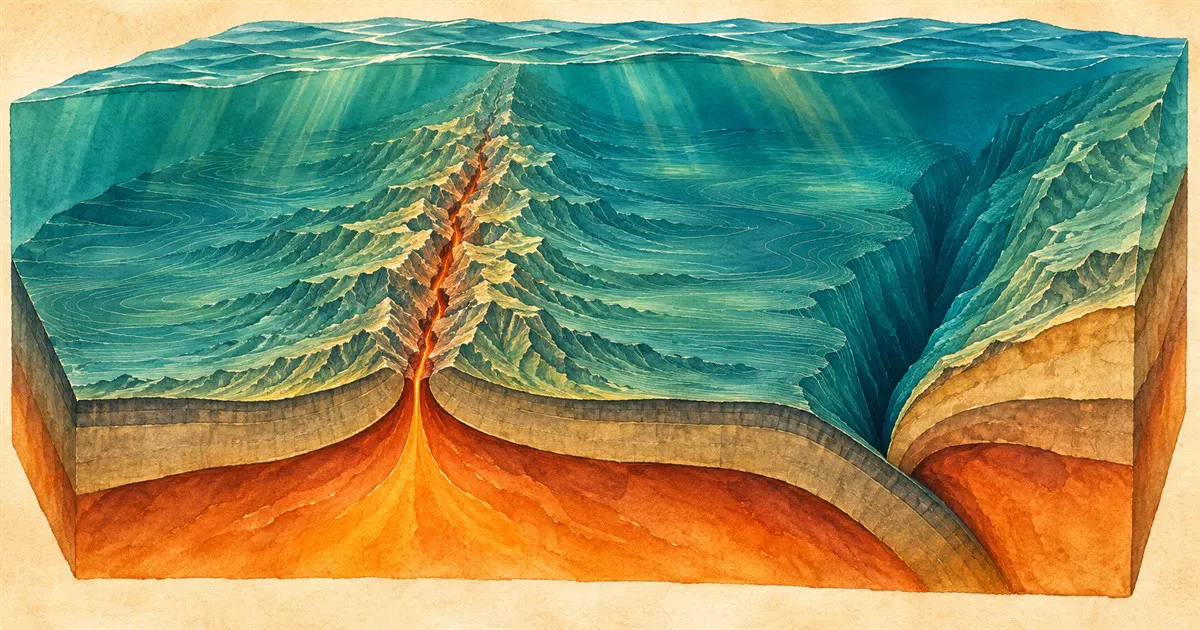
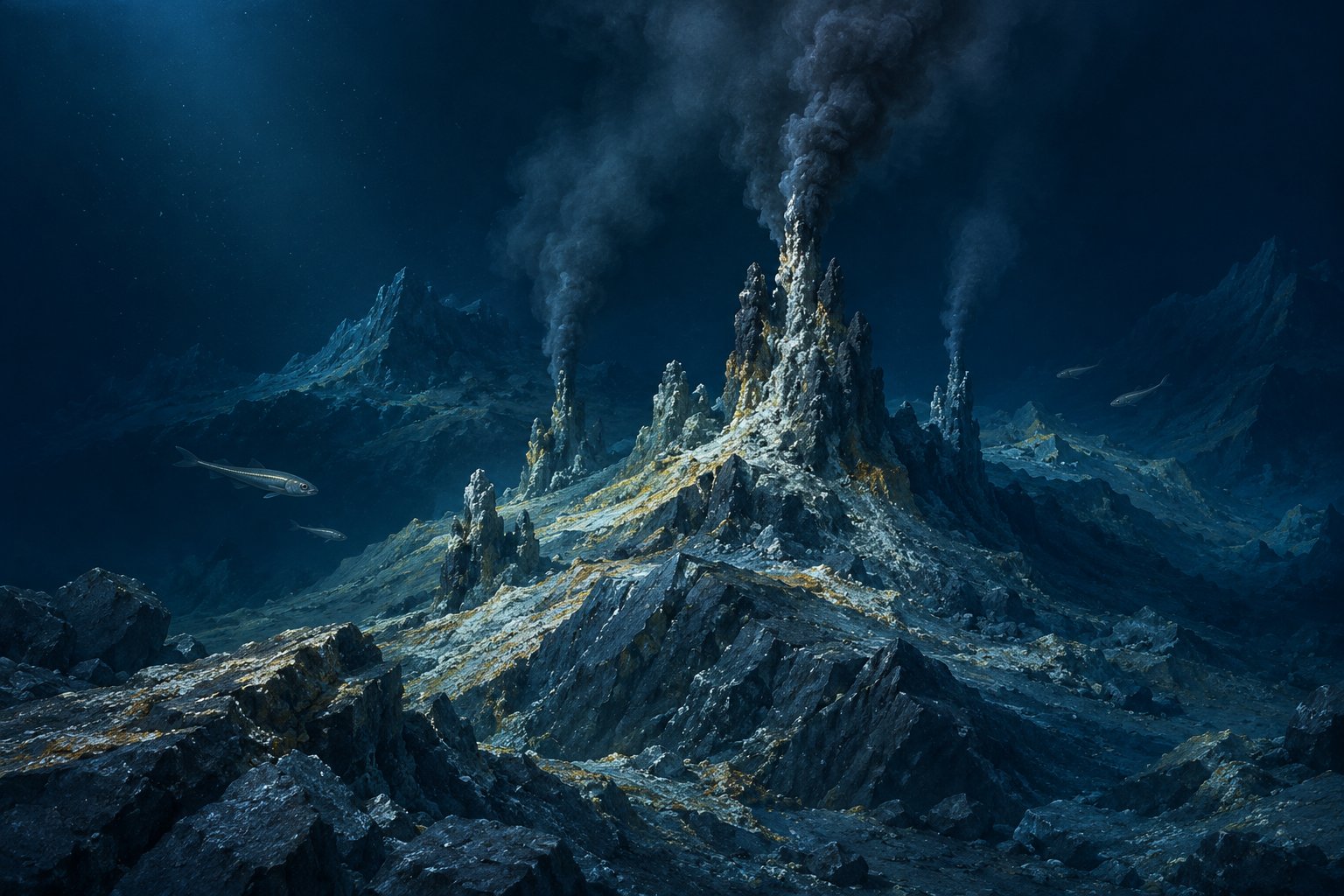
    The ridges form the planet’s largest mountain range, almost entirely underwater.
    The ridges form the planet’s largest mountain range, almost entirely underwater.

    The largest mountain range on Earth is not on the continents. It is the ocean ridge system, nearly 65,000 kilometers long, that circles the planet like the seam of a baseball. More than 90% of it lies on the seafloor; Iceland is one of the rare places where the ridge appears on land.

    Besides the ridges, the seafloor has thousands of seamounts — volcanoes that did not reach the surface. Measured from their base on the ocean floor, Mauna Kea in Hawaii exceeds 10,000 meters and is taller than Everest, although only about 4,200 meters rise above sea level.

    In Brazil, Fernando de Noronha is the summit of a volcanic mountain whose base lies more than 4,000 meters deep, the tip of a chain of seamounts about 550 kilometers long. The Archipelago of Saint Peter and Saint Paul, near the Mid-Atlantic Ridge, is one of the few places on Earth where mantle rocks are exposed above sea level.

    The deepest trenches in the world

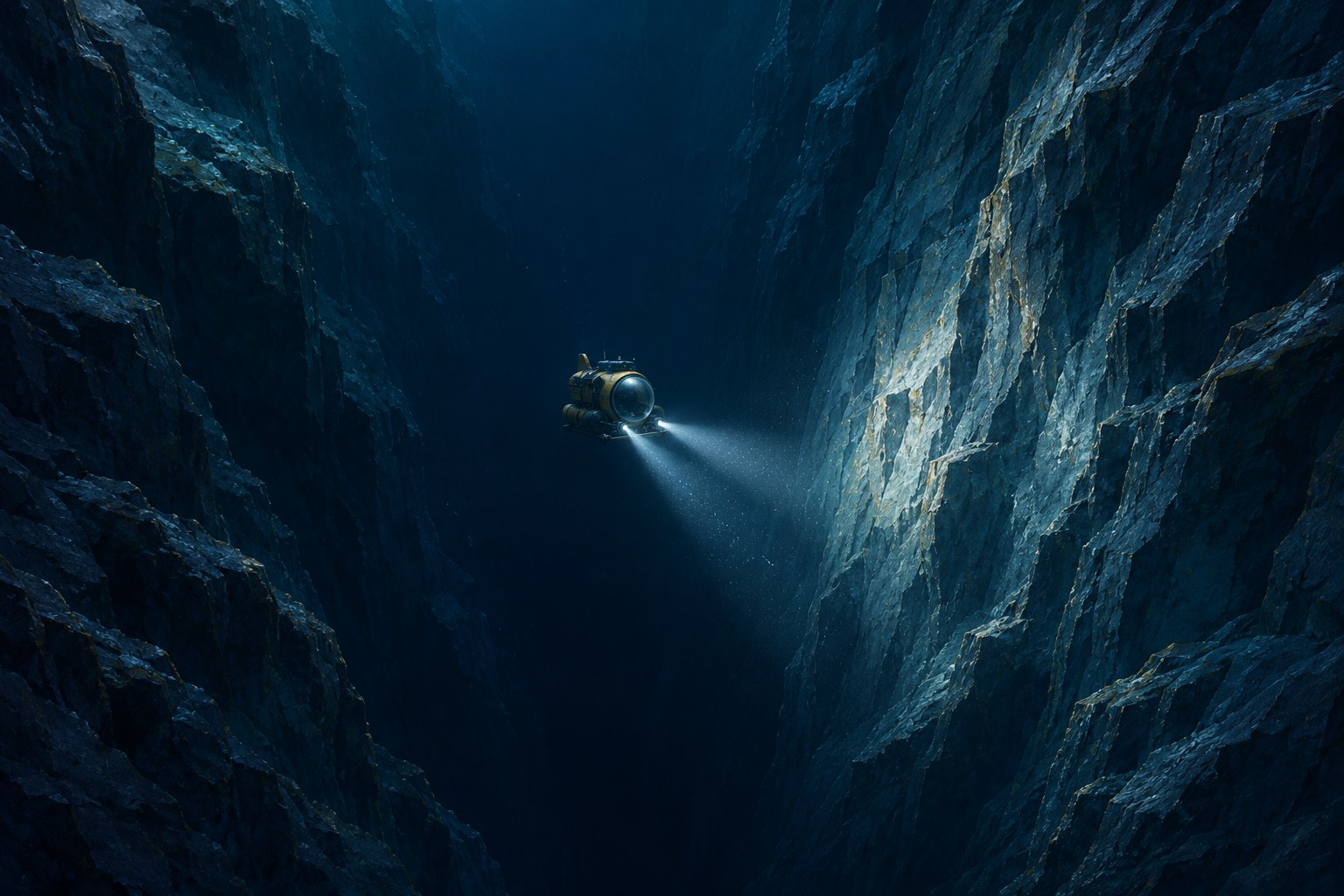
    A submersible descends into the darkness of a trench, where sunlight does not reach.
    A submersible descends into the darkness of a trench, where sunlight does not reach.

    Ocean trenches form where one tectonic plate dives beneath another. They are long, narrow valleys, much deeper than the surrounding seafloor.

    The deepest is the Mariana Trench, in the Pacific Ocean, near Guam. The lowest point, the Challenger Deep, lies about 10,935 meters below sea level. If Everest were placed there, the summit would still be more than 2,000 meters underwater.

    Each ocean has its deepest point: in the Atlantic, the Puerto Rico Trench; in the Indian, the Java Trench; in the Southern Ocean, the South Sandwich Trench; and in the Arctic, the Molloy Trench.

    Tectonic plates

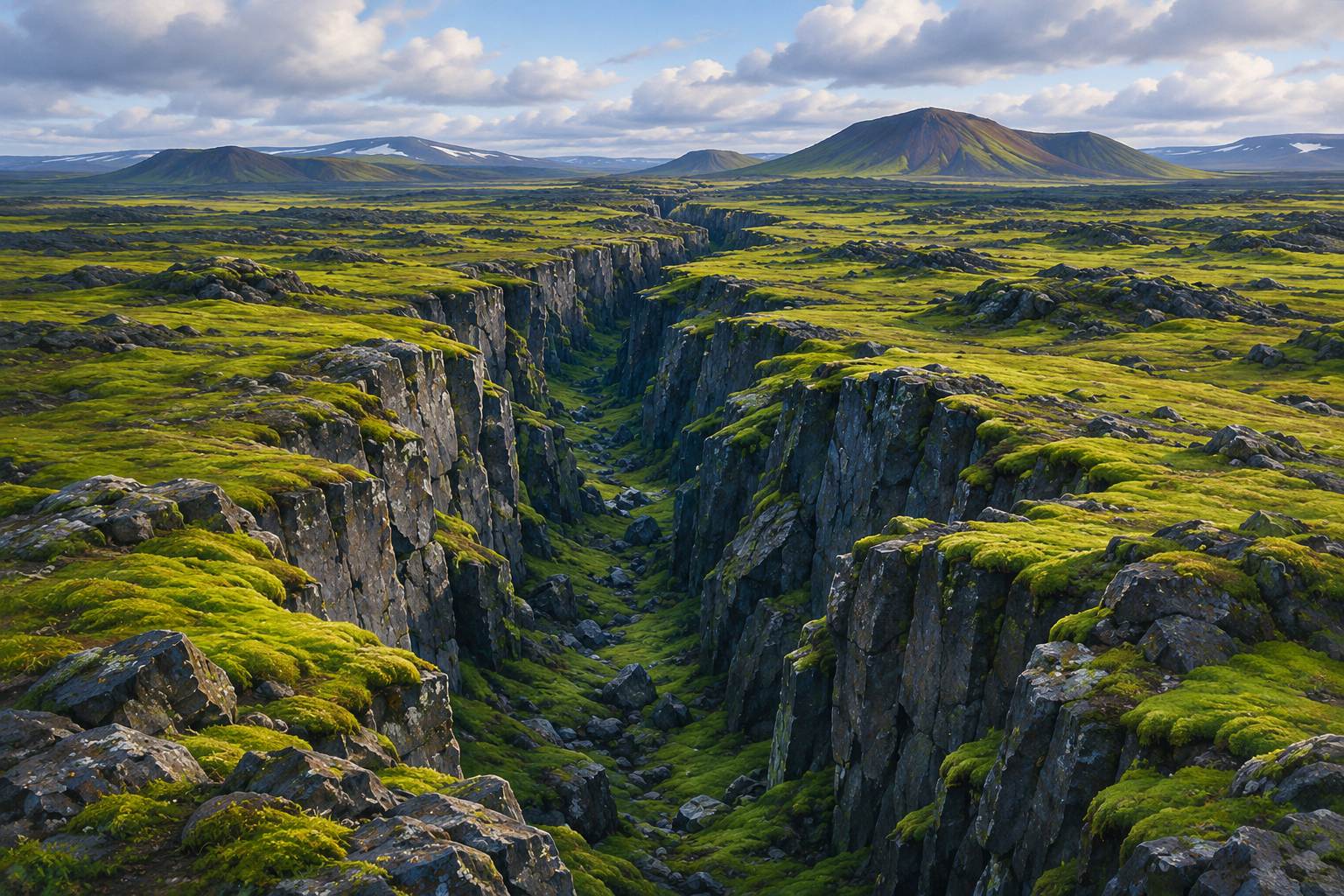
    At Þingvellir in Iceland, the rift between two tectonic plates appears on dry land.
    At Þingvellir in Iceland, the rift between two tectonic plates appears on dry land.

    Earth’s outer layer is divided into large plates that move slowly, just a few centimeters per year. Where they pull apart, mid-ocean ridges form—mountain chains in the middle of the sea, like the Mid-Atlantic Ridge.

    Where they meet, one plate can dive beneath another, forming trenches, volcanoes and earthquakes. This is the case with the Pacific Ring of Fire, which skirts almost the entire ocean.

    Brazil lies in the middle of the South American Plate, far from the plate boundaries. That is why strong earthquakes and active volcanoes are rare in the country.

    Point Nemo

    At Point Nemo, no land is visible for more than 2,600 kilometers.
    At Point Nemo, no land is visible for more than 2,600 kilometers.

    Point Nemo is the spot in the ocean farthest from any land. It is in the South Pacific, 2,688 kilometers from the three nearest landmasses: Ducie Island, Motu Nui (near Easter Island), and Maher Island in Antarctica.

    The name is a tribute to Captain Nemo from the book Twenty Thousand Leagues Under the Sea by Jules Verne. Because it is so remote, the area is used by space agencies for controlled re‑entries of satellites and spacecraft at the end of their service life.

    Astronauts on the International Space Station, about 400 kilometers up, are often closer to Point Nemo than anyone on land.

    Who has already descended to the deepest point

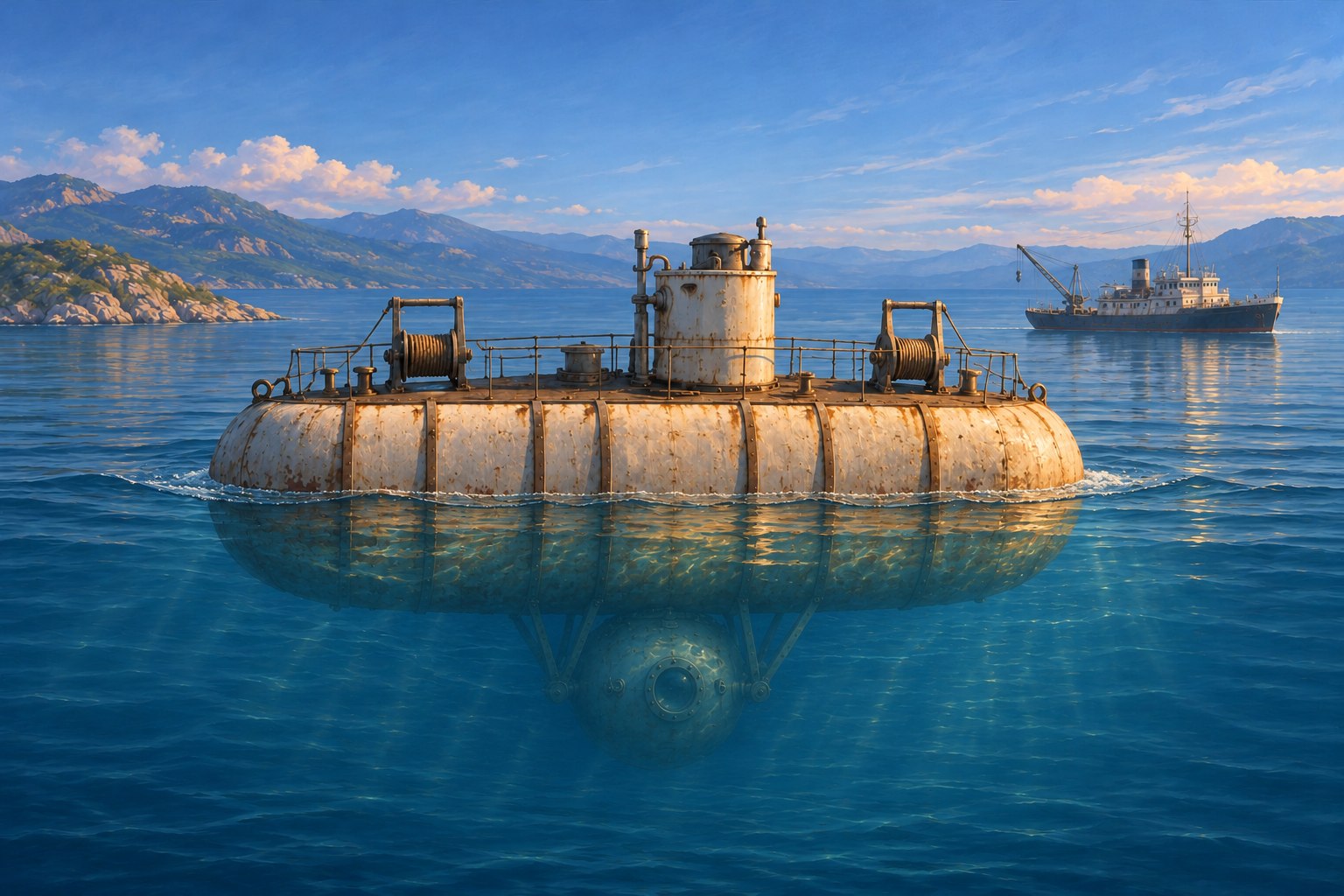
    A bathyscaphe like the Trieste, which reached the bottom of the Mariana Trench in 1960.
    A bathyscaphe like the Trieste, which reached the bottom of the Mariana Trench in 1960.

    In 1960, Swiss explorer Jacques Piccard and American Don Walsh took the bathyscaphe Trieste to the bottom of the Mariana Trench. The descent took almost five hours, and they stayed about 20 minutes down there, scarcely able to see anything because of stirred-up sediment.

    Only in 2012 did someone return to the same spot: filmmaker James Cameron, alone in the submersible Deepsea Challenger. From 2019, with explorer Victor Vescovo’s submersible, more than 20 people have reached the Challenger Deep.

    That’s a small number: more people have been to space than to the deepest point of the ocean.

    The seafloor on the trip

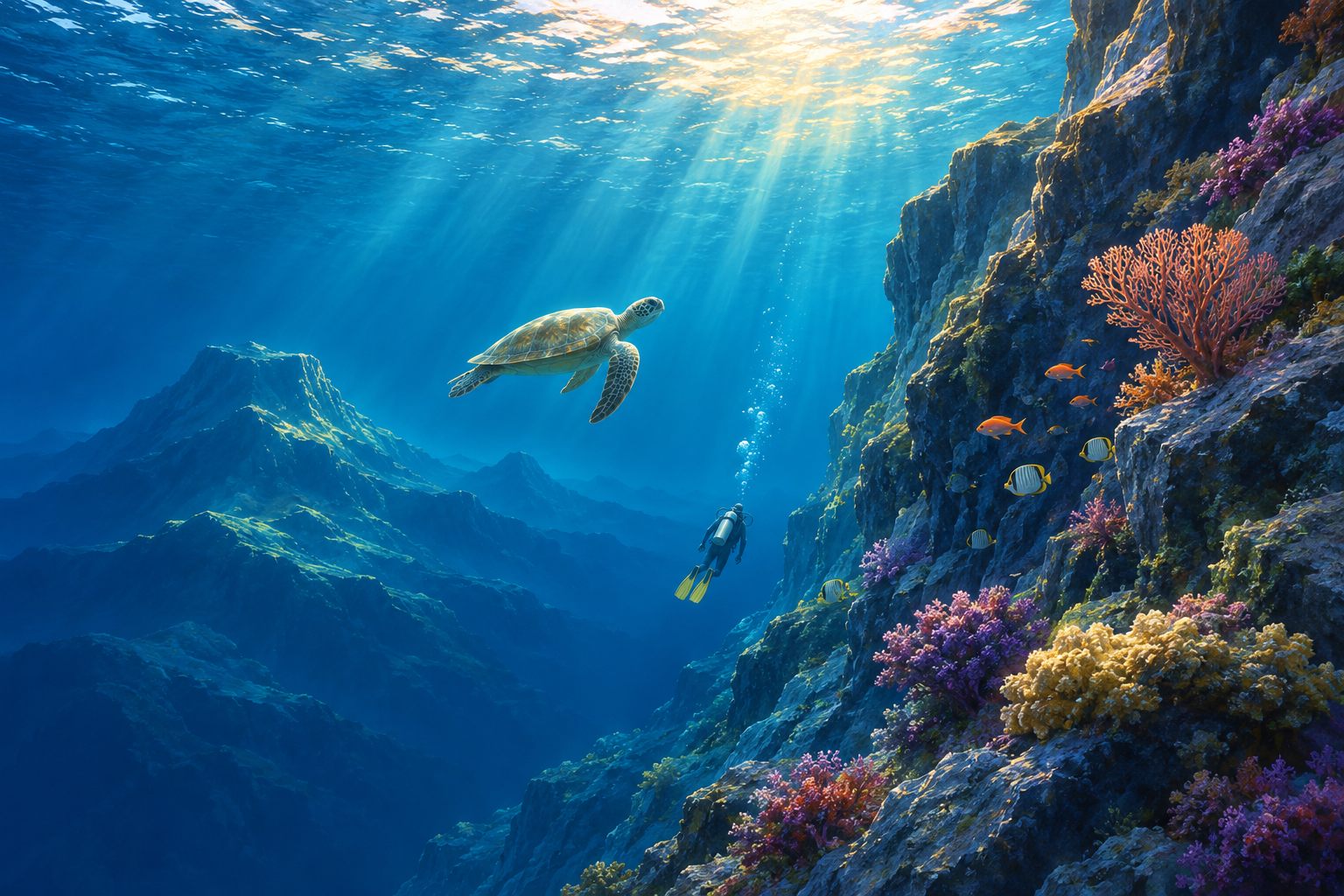
    Diving along the wall of a submarine mountain, in crystal-clear water.
    Diving along the wall of a submarine mountain, in crystal-clear water.

    In Fernando de Noronha, dives descend along the walls of the submarine mountain that forms the archipelago, with turtles, sharks and dolphins, and the water often has more than 30 meters of visibility. For experienced divers, the corvette Ipiranga, wrecked near the island, lies at about 60 meters depth.

    In Iceland, at Þingvellir National Park, you can snorkel or dive in the Silfra fissure between the North American and Eurasian plates, in water so clear you can see more than 100 meters. A drysuit is required, because the water stays near 2 °C year-round.

    Motu Nui, one of the three lands closest to Point Nemo, is a small islet beside Easter Island in Chile, famous for the moai. It is more than 2,600 kilometers from Point Nemo but is the closest a traveler can get to it by land.

    Frequently asked questions

    What is the deepest point in the ocean?

    The Challenger Deep in the Mariana Trench, in the Pacific Ocean, about 10,935 meters below sea level. Measurements vary by several dozen meters depending on the method.

    Would Everest fit inside the Mariana Trench?

    Yes. Everest rises 8,849 meters above sea level, and the Mariana Trench is about 10,935 meters deep. The summit would be more than 2,000 meters below the surface.

    What is Point Nemo?

    It is the spot in the ocean farthest from any land, in the South Pacific, 2,688 kilometers from the nearest islands. It is known as the oceanic pole of inaccessibility.

    What are tectonic plates?

    They are the large pieces that make up Earth’s outer shell. They move a few centimeters per year, and their interactions create mountains, trenches, volcanoes and earthquakes.

    What is the deepest trench in the Atlantic?

    The Puerto Rico Trench, in the Caribbean, about 8,376 meters at its deepest point, the Brownson Abyssal Plain (Brownson Abyss).

    Why does Brazil hardly have strong earthquakes?

    Because the country lies in the middle of the South American Plate, far from plate boundaries where the strongest earthquakes occur. Small tremors happen, but they are rare and weak.