

 Brazil
 Antarctica
 Argentina
 Bolivia
 Chile
 Colombia
 Ecuador
 Guyana
 French Guiana
 Falkland Islands (Malvinas)
 Paraguay
 Peru
 Suriname
 Uruguay
 Venezuela
 Germany
 Austria
 Belgium
 Croatia
 Denmark
 Slovakia
 Slovenia
 Spain
 Finland
 France
 Greece
 the Netherlands
 Hungary
 Ireland
 Iceland
 Luxembourg
 Norway
 Poland
 Portugal
 the United Kingdom
 the Czech Republic
 Sweden
 Switzerland
 Turkey
 Bermuda
 Canada
 the United States
 Greenland
 Mexico
 Saint Pierre and Miquelon
 the Dominican Republic
 Japan
 South Africa
 Egypt
 Australia
 Fiji
 New Zealand
 Papua New Guinea
Illustrative images. The pictures in this guide are illustrations based on the real place, not photographs, and may differ from it.

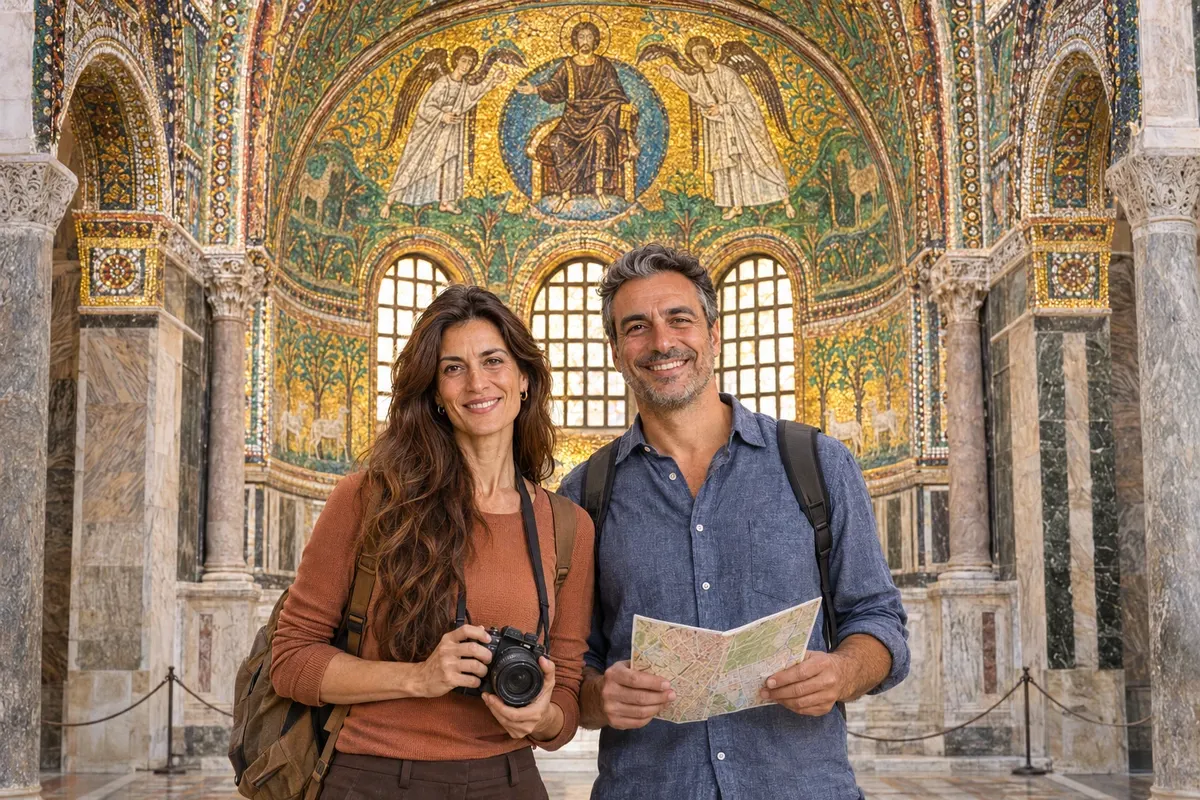
Cultural and heritage travel
Historic mosaics in Italy
Notice how images made of small tesserae cover walls and arches from Ravenna to Palermo.
A face seen from the middle of the church seems to have a continuous outline. When you look at the details, you realize that the curve of the face is made of many small pieces, the tesserae. The mosaic depends on this passage between the part and the whole. Distance, the curvature of the wall and the light interfere with what you can distinguish.
In Ravenna, Palermo, Cefalù and Rome, the visit takes place in buildings where the image is part of the architecture. Before trying to identify each character, look for the point from which the entire scene is visible. See whether it is above the path of someone entering, whether it follows an arch or occupies the back of the church.
San Vitale and the mosaics of Ravenna
Ravenna preserves several sets of early Christian mosaics. In the Basilica of San Vitale, first look at how the figures are arranged in groups. Compare the position of the hands, the direction of the gazes and the details that distinguish one garment from another. Even at a distance, these elements make it possible to recognize hierarchies and relationships between the characters.
Then follow the edge of a scene. Notice where the group of figures ends and the decorative band begins. It can guide the eye along a curve of the building. By changing position within the visiting area, pay attention to which parts of the surface become more brightly lit.
The Palatine Chapel in Palermo
In Palermo, the Palatine Chapel is inside the Royal Palace. The Byzantine mosaics invite two readings. For the first, follow how the images are distributed throughout the chapel interior. For the second, choose a scene at the height of a reference point, such as an arch, and observe how the figures fit into the available space.
A map or a description of the scenes helps you get oriented when there are many details above eye level. Pause to read before looking again. That makes it easier to relate the explanation to a specific image. When planning your visit, check the chapel’s visiting conditions within the palace route.
The Pantocrator in the cathedral of Cefalù
In the Norman cathedral of Cefalù, the mosaic of Christ Pantocrator occupies the apse, the curved section at the back of the church. The figure is recognizable from a distance. Notice the relationship between the face, the hand gesture and the shape of the surface. The design takes into account the viewpoint of someone seeing it from the nave.
Move closer as far as circulation allows and then step back a few paces. Up close you can see color divisions and ornaments. From afar, the outline dominates again. The experience helps explain why an image made for the upper part of a church has different proportions from a work meant to be viewed at eye level.
From the nave to the triumphal arch in Rome
In the Basilica of Santa Maria Maggiore, the ancient mosaics are distributed along the nave and the triumphal arch. Start by locating the two sets from the center. Then choose one side of the nave to follow the sequence. At the arch, notice how the composition changes direction to follow the passage from one part of the building to another.
Churches may reserve areas or times for celebrations. Check access and photography conditions and plan an observation point that keeps the way clear. If a section is distant, an enlarged reproduction consulted afterwards helps to recognize details. It’s useful to note the name of the scene and its position in the building to find it again.
Frequently asked questions
Which cities should you choose for a mosaic itinerary in Italy?
Ravenna brings together early Christian cycles, including those of San Vitale. Palermo and Cefalù allow you to compare a palace chapel and a cathedral in Sicily. In Rome, Santa Maria Maggiore brings the nave mosaics and those of the triumphal arch close together.
What are tesserae?
They are the small pieces that make up a mosaic. Their colors, directions and joints create lines, figures and areas of brightness that combine when the image is seen from a distance.
How to look at mosaics with children?
Ask them to choose a figure and recognize it from two positions. Then have them find a detail that appeared only in the second view. It’s a way to notice how light and distance change the experience.
Where to go: Visiting historic mosaics
Pick a region or type what you are looking for to see the cities and who offers it in each.
-
Ravenna EM
Ravenna’s monuments preserve series of early Christian mosaics, including those in the Basilica of San Vitale.
-
Rome IA
The Basilica of Santa Maria Maggiore preserves ancient mosaics in the nave and on the triumphal arch.
-
Cefalù SI
A mosaic of Christ Pantocrator fills the apse of Cefalù’s Norman cathedral.
-
Palermo SI
The Palatine Chapel houses Byzantine mosaics inside Palermo’s Royal Palace.
More activities in Cultural and heritage travel

Beyond the guide


