Museum
Inhotim
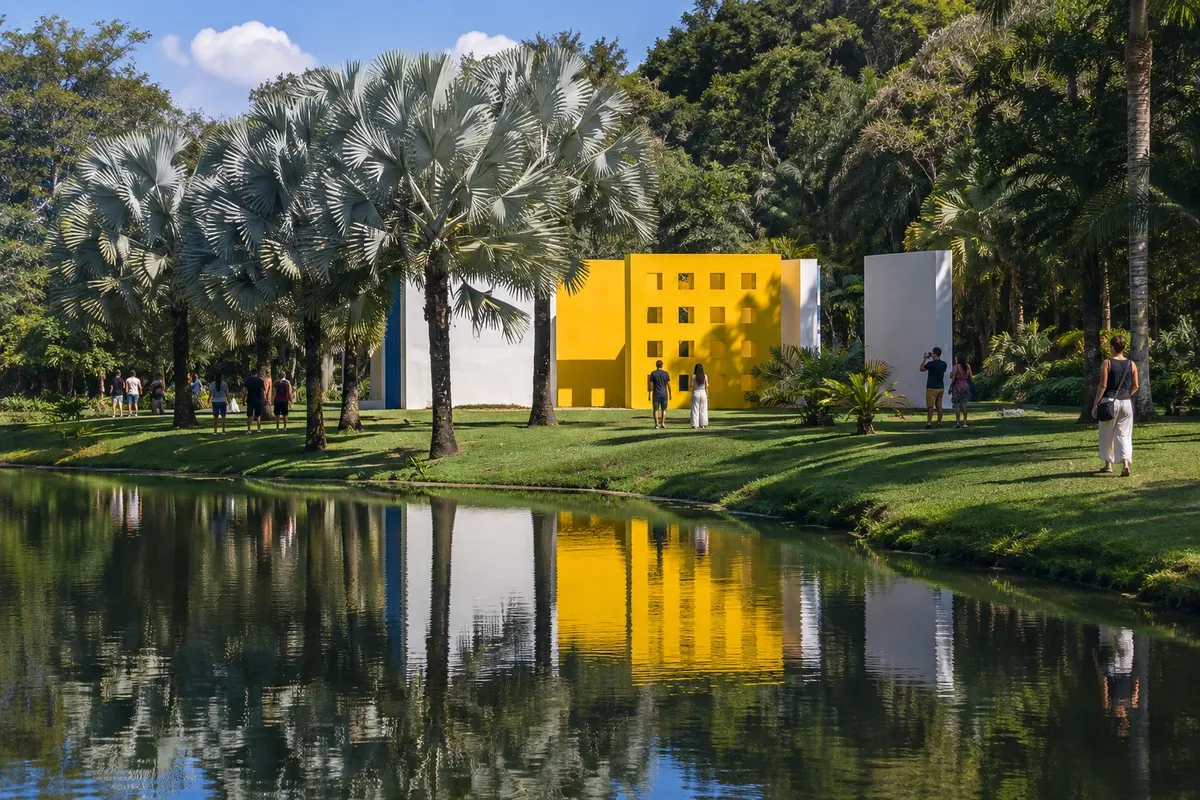
Inhotim brings together contemporary art and a botanical garden in Brumadinho, in an experience that alternates galleries and outdoor spaces.

 Search
Brazil
 Antarctica
 Argentina
 Bolivia
 Chile
 Colombia
 Ecuador
 Guyana
 French Guiana
 Falkland Islands (Malvinas)
 Paraguay
 Peru
 Suriname
 Uruguay
 Venezuela
 Germany
 Austria
 Belgium
 Croatia
 Denmark
 Slovakia
 Slovenia
 Spain
 Finland
 France
 Greece
 the Netherlands
 Hungary
 Ireland
 Iceland
 Italy
 Luxembourg
 Norway
 Poland
 Portugal
 the United Kingdom
 the Czech Republic
 Sweden
 Switzerland
 Turkey
 Bermuda
 Canada
 the United States
 Greenland
 Mexico
 Saint Pierre and Miquelon
 the Dominican Republic
 JapanTurkey
 South Africa
 Egypt
 Australia
 Fiji
 New Zealand
 Papua New Guinea
Minas Gerais · Brazil
In the state of Minas Gerais.
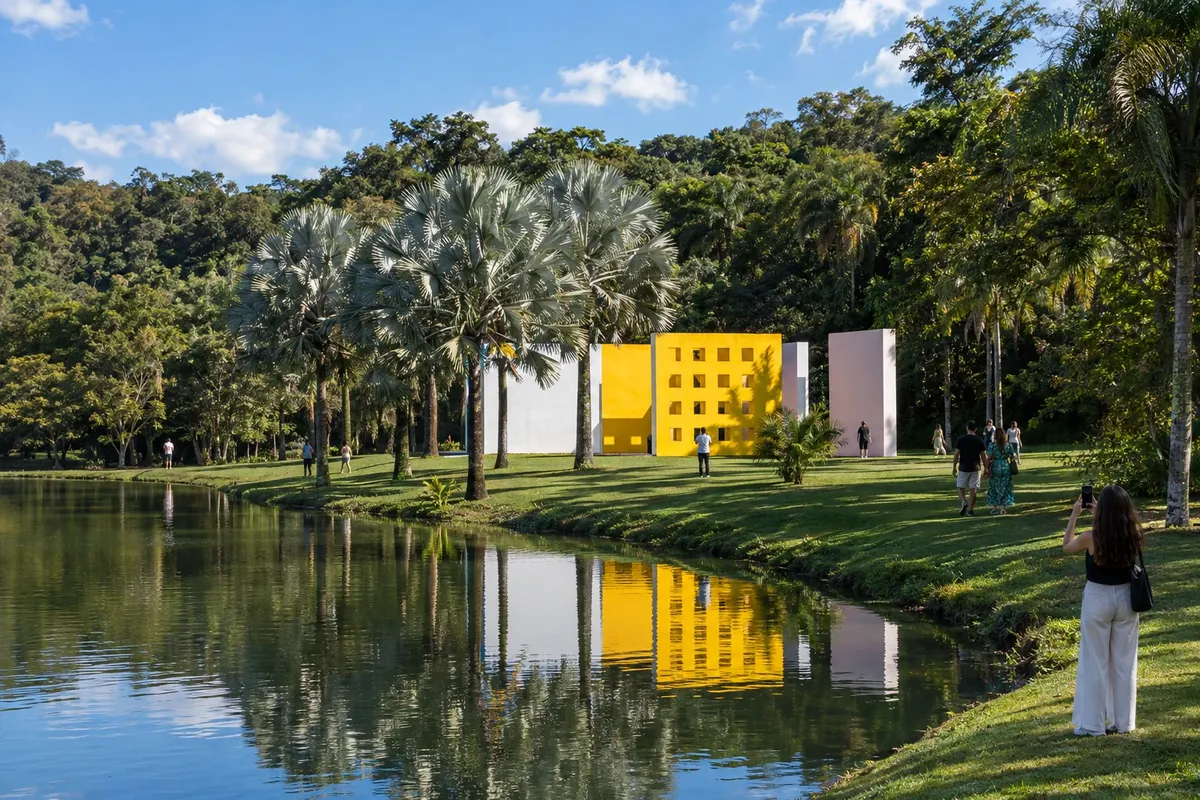
In the photo: Instituto Inhotim, Brumadinho - MG
Illustrative images. The pictures in this guide are illustrations based on the real place, not photographs, and may differ from it.
The city
Brumadinho combines contemporary art, gardens and mountain landscapes. Inhotim is the main landmark, while Piedade do Paraopeba, Casa Branca and Serra da Calçada broaden the trip through heritage and nature. Plan travel between the different sites.
Brumadinho lies in the Paraopeba Valley, about 60 km from Belo Horizonte, the capital of Minas Gerais. The name comes from the mists that cover the mountains in the morning. The municipality is large, with about 640 km², and its history is linked to mining. For travelers, the reason to visit is almost always Inhotim, a contemporary art museum and botanical garden opened in 2006 on a former farm, with 140 hectares of visiting area.
Inhotim is next to the municipal seat, a small town. Nearby are the Casa das Memórias, with photographs and objects from local history, and neighborhoods such as Conceição do Itaguá, where there are inns. Those who come only for the museum usually stay in the town, its outskirts or Belo Horizonte.
The rest of the municipality is mountains, villages and rural areas, and distances are large. Piedade do Paraopeba, a settlement from the late 17th century, preserves a mother church begun in 1713. On the slopes of the Serra da Moeda are the Topo do Mundo lookout, used for free flight, and ceramics and embroidery studios. Casa Branca, a village surrounded by Atlantic Forest next to the Parque Estadual da Serra do Rola-Moça, has inns, bars and restaurants that operate mainly on weekends. The Serra da Calçada preserves mining ruins from the 18th and 19th centuries. Four quilombola communities and dozens of farms and studios receive visitors by appointment.
In Córrego do Feijão, on January 25, 2019, the collapse of a mining tailings dam killed 272 people. Inhotim was not affected. On site, the Memorial Brumadinho, built at the request of the victims’ families, is open to visitors, and the community maintains a producers’ market and a cultural center.
The climate is tropical mountain, with two seasons. From May to August there is almost no rain; days are sunny, with highs around 23 °C to 25 °C, and mornings are cool, around 11 °C to 13 °C. From November to March it rains a lot, generally in heavy showers, with highs near 27 °C. April, September and October are transition months; at the end of the dry season the ipês bloom.
For a first visit, Inhotim requires at least a full day, and two days allow you to see the more distant galleries without rushing. With a third day you can include the Memorial, Piedade do Paraopeba and the sunset at Serra da Moeda. Note the calendar: Inhotim and the Memorial are closed on Mondays and, for much of the year, also on Tuesdays.
58 places to stay in Brumadinho.
6 places to eat in Brumadinho.
The local experience
Inhotim brings together contemporary art and a botanical garden in Brumadinho, in an experience that alternates galleries and outdoor spaces.
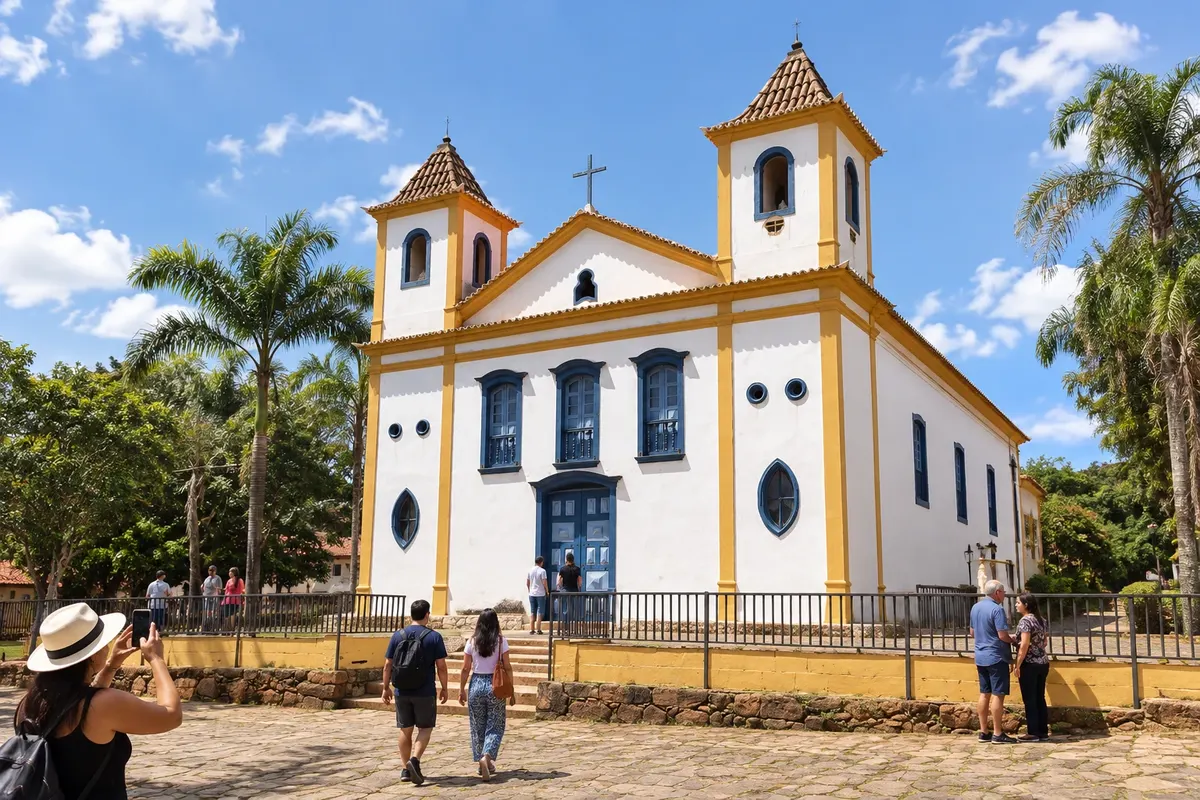
Piedade do Paraopeba is a historic district of Brumadinho, with religious heritage and buildings connected to the region's formation.
Discover Centro Histórico de Piedade do Paraopeba
Serra da Calçada is part of the set of natural landscapes sought by visitors to Brumadinho.
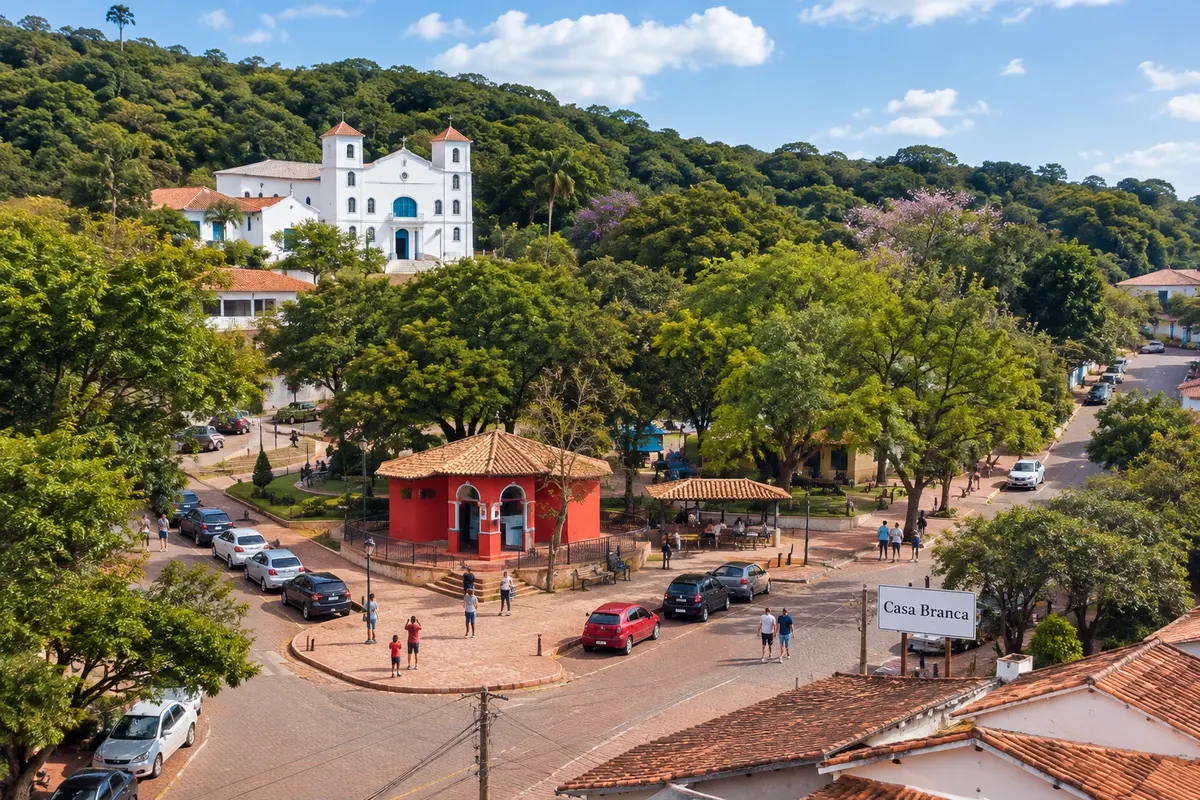
Casa Branca is a settlement in Brumadinho surrounded by mountains, with options related to gastronomy and nature tourism.
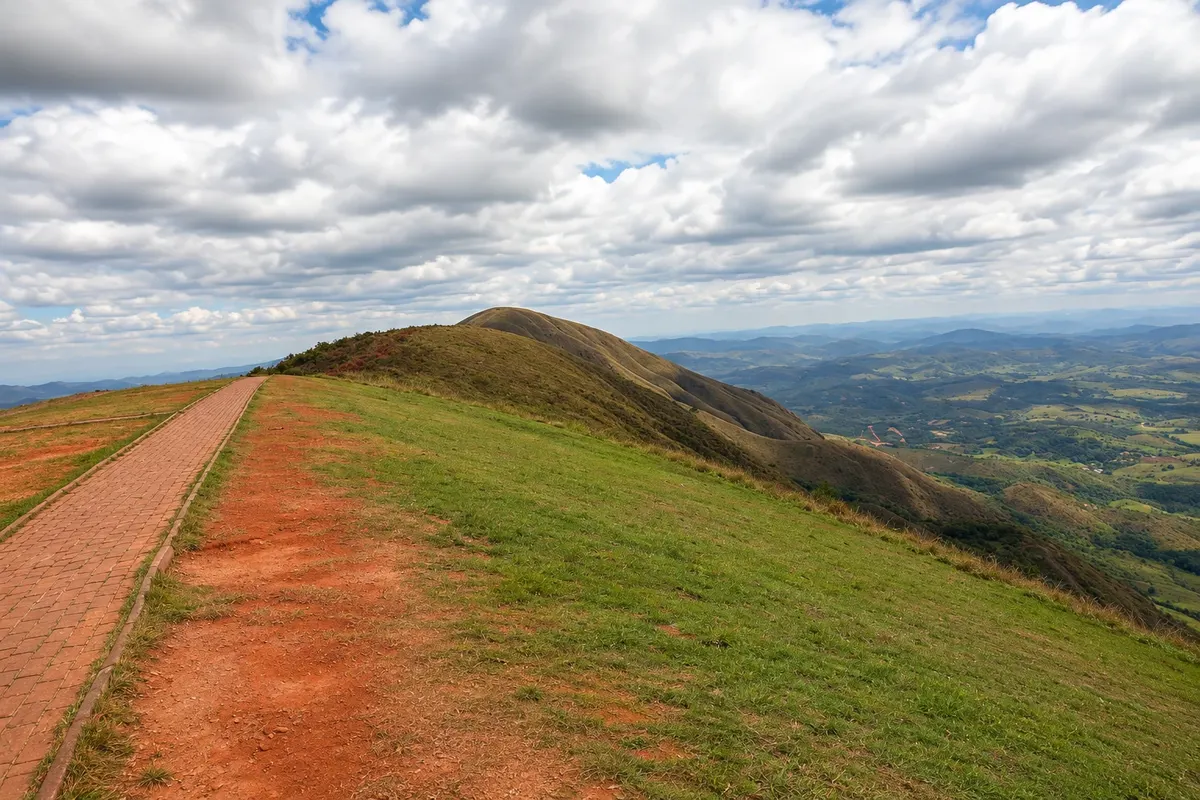
Viewpoint and free-flight takeoff ramp atop Serra da Moeda, in Brumadinho, at about 1,500 meters of altitude. On one side you can see the Paraopeba valley; on the other, Lagoa dos Ingleses. Paraglider and hang-glider pilots take off from there.
Discover Topo do Mundo Viewpoint
To choose before you go
Where each tour starts, how long it takes, how it is done, what is included and the price range.
Inhotim is both a contemporary art museum and a botanical garden. It was conceived by Minas Gerais entrepreneur Bernardo Paz starting in the 1980s and opened to the public in 2006. In the 140-hectare visiting area, more than 900 works by about 50 artists from over 18 countries are on display, in galleries spread across the grounds and outdoors, among lakes, palm trees, and forest. The visit is a walk. The map divides the park into three routes — Orange, Pink, and Yellow — and each gallery is usually dedicated to one artist: Adriana Varejão, Cildo Meireles, Lygia Pape, Miguel Rio Branco, Tunga, Claudia Andujar, Yayoi Kusama, Doris Salcedo, Matthew Barney. The Cosmococa Gallery brings together works by Hélio Oiticica and Neville D'Almeida. Outdoor works include pieces such as Beam Drop Inhotim, by Chris Burden, and Narcissus Garden, by Yayoi Kusama. The gardens are half the experience. There are themed gardens, such as the Jardim de Todos os Sentidos, the Jardim Desértico, the Jardim Veredas, the Largo das Orquídeas, and the Vandário, as well as a meliponary and an educational nursery. The park is open Wednesday through Sunday and on holidays; in January and July it also opens on Tuesdays. It is closed on Mondays. There are restaurants, cafés, and snack bars at various price points inside, and you are allowed to bring an individual snack. Pets, bicycles, and scooters are not allowed. There is a left-luggage service at reception.
Stops: Adriana Varejão Gallery, Cildo Meireles Gallery, Cosmococa Gallery, Lygia Pape Gallery, Miguel Rio Branco Gallery, Psicoativa Tunga Gallery, Yayoi Kusama Gallery, Claudia Andujar Gallery, Beam Drop Inhotim, Narcissus Garden, Jardim de Todos os Sentidos, Jardim Desértico, Largo das Orquídeas, Vandário.
Includes: The ticket grants access to the galleries, outdoor works, and the gardens. There is a half-price ticket and two- and three-day passports; children up to 5 years old enter free. On Wednesdays and on the last Sunday of each month there is no entrance fee, but you must reserve a ticket in advance. Internal transport, parking, and food are paid separately.
Tip: Arrive at opening and start with the galleries farthest from the reception, leaving the nearer ones for last. Some galleries close for maintenance seasonally: check the museum website the day before to see what’s open. The fixed-route electric cart saves the climbs and can be purchased with the ticket.
Best time: From May to September, with dry weather, the walk is more pleasant. From November to March, bring a rain poncho and use the galleries as shelter during downpours.
R$ 65 · per person, full price, 1-day ticket · official priceThe Memorial Brumadinho was built on the site where, on January 25, 2019, the tailings dam of the Córrego do Feijão mine collapsed. It was created through the mobilization of the families of the 272 victims, who chose architect Gustavo Penna’s project by vote. It is a museum and a place of remembrance; a visit requires silence and time. At the entrance to the main building there is a druse of crystals that represents the victims, referred to as jewels by the families. From there starts the Fenda, a 230-meter open-air corridor that leads to a viewpoint suspended over the valley. A sculpture-monument, from which water runs along the fissure, faces the point of the collapse. Two rooms house the long-term exhibitions. The Sala Testemunho presents the region, the events, the searches carried out by the Fire Department, and the families’ fight for justice. The Sala Memória gives name and face to each person, with photos, testimonies, and objects chosen by family members. Outside is a grove of 272 yellow ipê trees, one for each victim, open to the public. The memorial has ramps from the parking lot to the viewpoint, wheelchair access, a tactile model, and resources in Brazilian Sign Language (Libras), audio description, and English. In the same village, the central square of Córrego do Feijão, a settlement founded around 1760, hosts the Mercado Central Ipê-Amarelo, with a producers’ shop, bakery, and community kitchen-school, and the Centro de Cultura e Artesanato Laudelina Marcondes, with gardens and workshops. Buying there is a direct way to support local residents.
Stops: Memorial Brumadinho, Sala Testemunho, Sala Memória, Fenda, Viewpoint, Grove of ipê trees, Mercado Central Ipê-Amarelo, Centro de Cultura e Artesanato Laudelina Marcondes.
Includes: There is no entrance fee to the Memorial, but all visitors, including children, must pick up a ticket at the box office or online. There is an educational guided visit of about two hours.
Tip: The Memorial is open Wednesday through Sunday and on holidays, and is closed on some holidays such as Christmas and New Year’s Eve. For a self-guided visit, allow at least one hour. Guided visits in English must be requested in advance. Photography is not allowed in the room where the victims’ remains are kept. Visitors under 12 must be accompanied.
Best time: All year. The ipê trees in the grove usually bloom at the end of the dry season.
Piedade do Paraopeba is one of the oldest settlements in Minas Gerais: it arose at the end of the 17th century with the passage of bandeirantes, before Ouro Preto and Mariana. It is a district of Brumadinho and lies on the route for those arriving by BR-040, about 33 km from Inhotim. The village is small, with quiet streets, manor houses and the square where locals meet. The Mother Church of Our Lady of Mercy, whose construction dates to 1713, is the focus of the visit and one of the state’s oldest churches. It underwent a long restoration and has reopened to worshippers and visitors. It houses a carved wooden image of Our Lady of Mercy brought from Portugal in 1731. Every September 8, the Jubilee of Our Lady of Mercy, a centuries-old celebration, fills the village with devotees. The Church of Our Lady of the Rosary was built at the end of the 18th century by the region’s Black population, enslaved and freed. It is surrounded by a stone wall, sits at an open viewpoint, and is the site of the Rosary festivals and the Mozambique Guard of Piedade do Paraopeba. The exterior can be seen any day; to enter you need to arrange it with the parish. In the historic centre, the Way of the Seven Sorrows is a route of chapels with panels and mosaics that represent Mary’s sorrows. The village also has a collective of ceramists, mostly women, and restaurants serving Minas Gerais food cooked on a wood stove.
Stops: Mother Church of Our Lady of Mercy, Church of Our Lady of the Rosary, Way of the Seven Sorrows, Praça da Matriz, Piedade do Paraopeba Ceramists’ Collective.
Includes: Self-guided visit; there is no charge to see the churches from the outside or to walk the Way of the Seven Sorrows. Workshops with ceramists and meals are paid separately and are usually scheduled in advance.
Tip: Ask at the parish which days the churches are open before going just to see them. Combine the village with the Top of the World, in the same mountain range, for late afternoon.
Best time: All year. On September 8 the Jubilee of Our Lady of Mercy takes place.
Serra da Moeda marks one of the boundaries of the municipality of Brumadinho. According to historians, the name recalls a clandestine mint that may have operated in the region during the colonial period. At its top, above 1,400 meters of altitude, is Topo do Mundo, a natural lookout facing the Paraopeba Valley. The spot is a launch site for free flight, especially paragliding, and those who don’t fly come to walk, photograph and wait for the end of the day. Sunset is the most sought-after moment; in the dry months, from April to August, the sky is usually clear and the outline of the mountains sharp. Early in the morning, mist often covers the valley. The ridge also attracts mountain bikers, motorcyclists and hikers. The slope below the lookout has a life of its own made up of studios and backyard tables. Brumadinho is a hub for ceramicists, and some studios welcome visitors to watch work with clay, shape a piece or attend a raku firing in the late afternoon. The Associação das Bordadeiras da Serra da Moeda, a collective of local women, offers a short embroidery workshop with coffee on the porch. Farm restaurants serve Minas Gerais fare and trout smoked onsite. These experiences are part of the municipality’s community-based tourism catalogue and operate by direct booking with each host.
Stops: Mirante Topo do Mundo, Serra da Moeda, Pottery studios, Associação das Bordadeiras da Serra da Moeda.
Includes: There is no fee to visit the lookout. Tandem paragliding flights, pottery and embroidery workshops, and meals are paid separately: check current pricing with each operator or host.
Tip: Bring a warm layer: it’s windy on the ridge and the temperature drops quickly after sunset. To fly, look for a licensed school or instructor and book in advance. Schedule workshops a few days ahead.
Best time: From April to August, when there is little rain and the horizon is clear. From November to March, afternoons often have clouds and showers.
Casa Branca is Brumadinho’s village for weekend rest. It lies among mountains covered in Atlantic Forest, adjacent to the Serra do Rola-Moça State Park, and brings together small inns, cafés, bars and restaurants. The direct access does not pass through the municipal seat. Coming via BR-040, enter through the Jardim Canadá neighborhood in Nova Lima and follow the road that crosses the park. The route is part of the experience because of the scenery. The state park has trails through native vegetation and natural viewpoints; from Morro dos Veados you get a wide view of the valley. Activities open to the public are announced by park management: check before planning a hike. In the village, the plan is to walk without hurry. The stretch of the center where bars, restaurants and live music concentrate has been nicknamed Savassinha by locals, referencing a bohemian neighborhood in the capital; at night on weekends it’s the meeting point. During the day, cafés serve Minas Gerais baked goods, such as broa, rosca and polvilho biscuits, and local craftswomen sell seed jewelry and garden pieces. Some inns offer canopy courses and zipline. On weekdays many bars and restaurants do not open.
Stops: Casa Branca, Serra do Rola-Moça State Park, Morro dos Veados, Savassinha.
Includes: Self-guided visit. Meals, adventure activities and craft experiences are paid separately.
Tip: Go Friday to Sunday if you want to find bars and restaurants open. In fog or heavy rain, drive slowly on the park road. Casa Branca has separate access from the town: leave the village for another day, not the day you visit Inhotim.
Best time: All year, preferably on weekends. From May to August the nights are cold.
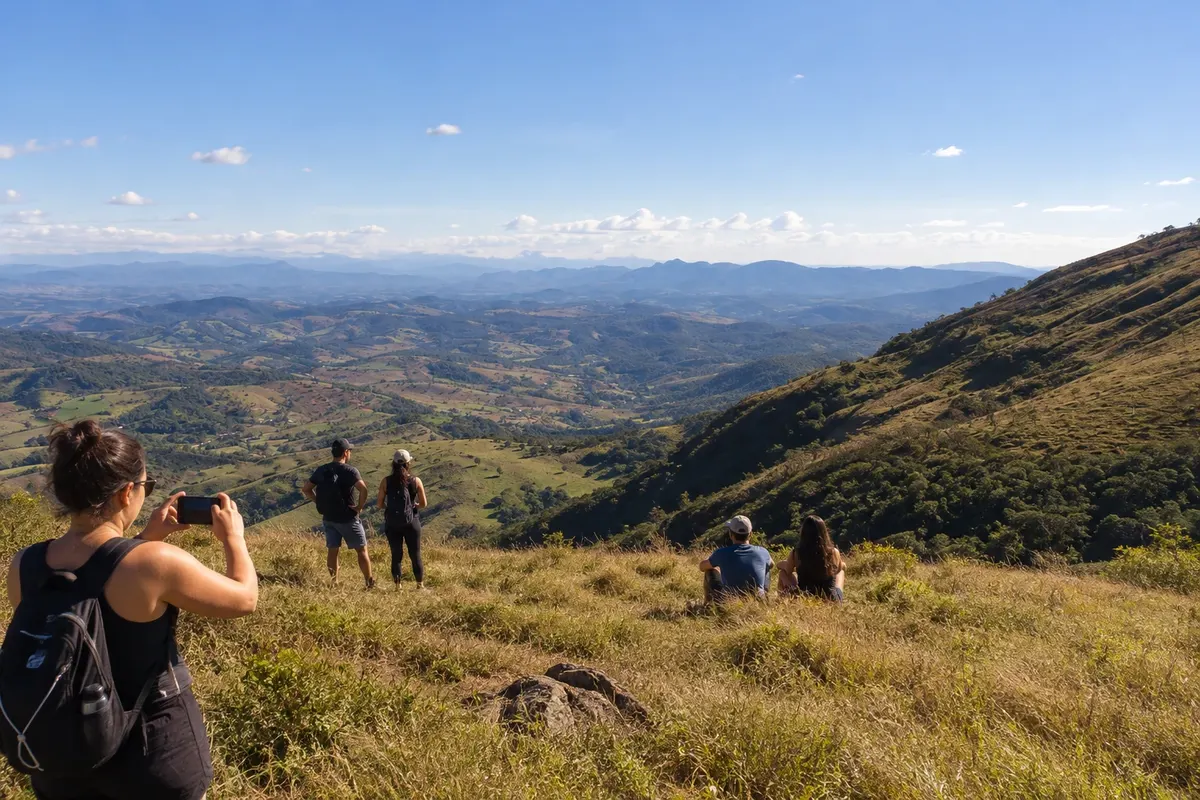
Serra da Calçada is a section of the Serra da Moeda between Brumadinho and Nova Lima. The name comes from a path paved with stone slabs that connected the Paraopeba Valley to the high part of the ridge, where it met the Estrada Real network. The historical and landscape complex was listed by the state of Minas Gerais in 2008. What you see there is the memory of 18th- and 19th-century mining: stretches of the old pavement, ruins and stone walls. The best-known structure is the so-called Forte de Brumadinho, a large stone construction. Despite its name, studies link it to a gold-mining complex, not a military fortification. The most common hike follows a dirt road and trail along the ridge to a lookout from which you can see the Forte and the Rola-Moça Range; guided routes total about 8 km round trip. The terrain is open, with low vegetation and endemic species. Access is free, but it is recommended to go with someone who knows the way. Local guides and agencies from Belo Horizonte run the route and tell the history of the ruins.
Stops: Serra da Calçada, Forte de Brumadinho, Caminho calçado de pedra.
Includes: No entrance fee. The guide, when hired, is paid separately.
Tip: Start early and bring water, a hat and sunscreen. Do not climb on ruins or remove stones. In heavy fog or thunderstorm, postpone.
Best time: From April to September, with dry conditions and cool mornings. In the rainy season, prefer mornings and postpone on days with thunderstorms.
Brumadinho has four quilombola communities certified by the Fundação Cultural Palmares, the government body that recognizes territories formed by descendants of enslaved Africans: Sapé, Rodrigues, Ribeirão and Marinhos. They receive visitors in gatherings organized by the residents themselves, where food, music and faith tell the history of the place. Each community offers its own experience. In Sapé the group hosts a breakfast with local recipes, including a biscuit called João Deitado, beside one of the municipality’s historic churches. At Quilombo Rodrigues the visit goes by the community church and includes a workshop making bracelets from the beads of the plant known as lágrima-de-nossa-senhora, harvested there. In Ribeirão lunch is a feijoada with music. In Marinhos the meeting centers on hymns and religious traditions, and craftswomen sell the Maria do Quilombo dolls. The Congado and Moçambique guard groups—devotional groups to Nossa Senhora do Rosário with drums, songs and dance—are part of these communities’ life. Visits are not spontaneous: you must arrange the day, group and price with each community or with a Brumadinho tour operator. From time to time the four join in a one-day circuit, with dates published by the municipality’s tourism catalog.
Stops: Quilombo de Sapé, Quilombo Rodrigues, Quilombo Ribeirão, Quilombo de Marinhos.
Includes: Each experience has its own price, which usually includes the meal or the coffee described. Transport is the visitor’s or the tour operator’s responsibility. Check the current rates when booking.
Tip: Bring cash for crafts and farm products. Ask before photographing people and moments of prayer. Wear light clothing, closed shoes and insect repellent.
Best time: Year round, according to community schedules.
Besides the museum, Brumadinho organized a network of rural and community-based tourism: 37 enterprises, communities, and associations are gathered in a catalog, offering experiences in gastronomy, ceramics, embroidery, crafts, and farm life. These are not open-door attractions. Each host receives visitors by appointment, at their house or on their farm. Some places give a sense of the whole. At the Assentamento das Pastorinhas, a reference for family farming with organic and agroforestry cultivation, the visit walks through vegetable beds, orchard and forest and ends with a coffee of products picked there, accompanied by the settlers’ stories. At a goat farm you follow animal care and cheese production. In Piedade do Paraopeba, a backyard serves a homemade lunch under a mango tree, with vegetables, fruits and coffee grown on the property. On the slope of the Serra da Moeda, a small farm cooks traditional Minas Gerais food on a wood stove and shows the keeping of stingless bees. There are also visits to an agroforest, picnics in the woods, a herbal foot-soak workshop and, in Córrego do Feijão, a women’s collective that makes natural soap. Since the places are in different parts of the municipality, it’s practical to choose one area per day and combine two nearby experiences. Brumadinho tour operators put together the itinerary and provide transport.
Stops: Assentamento das Pastorinhas, Slope of the Serra da Moeda, Piedade do Paraopeba, Córrego do Feijão.
Includes: Each experience has its own price and generally includes the meal or coffee described. Transportation is the visitor’s responsibility. Check current pricing with the host.
Tip: Book a few days in advance and confirm the day before. Inform about food restrictions when booking. Many rural roads are unpaved: allow extra travel time.
Best time: All year. From May to September, dirt roads are in firmer condition.
Day by day
Suggestions to plan the trip. Change the order of the days according to the weather and tour availability.
Arrive when the park opens. With the map in hand, choose one of the three morning routes and go first to the galleries farthest from the reception; if you want to spare your legs, buy the fixed-route electric cart. Have lunch inside the park: there is a buffet-by-weight restaurant, set menus and snack bars, and you can also bring your own packed lunch. In the afternoon, do a second route at a slower pace, stopping at the thematic gardens and the outdoor works, such as Beam Drop Inhotim and Narcissus Garden. Leave the galleries near the exit for last. You can’t see everything in one day: pick the galleries that interest you most beforehand and accept leaving the rest for another visit. Check the weekday in advance, because Inhotim is closed on Mondays and, outside January and July, also on Tuesdays.
A full day at Inhotim, with a two-day passport. Cover two of the three map routes, alternating galleries and gardens. Spend unhurried time in the Cosmococa Gallery rooms and reserve time for single-artist galleries, such as those of Adriana Varejão, Cildo Meireles and Claudia Andujar. At night, dine in Brumadinho town; there is a craft brewery and restaurants serving Minas Gerais cuisine.
Return to Inhotim in the morning for the route you missed and for the thematic gardens, such as the Desert Garden and the Orchid Square. Have lunch at the park. In the early afternoon, go to Córrego do Feijão and visit the Memorial Brumadinho, with tickets collected beforehand; allow at least one hour, or two for a guided visit. Then stop by the Mercado Central Ipê-Amarelo, in the community square. If you prefer to spend the whole day at the museum, leave the Memorial for the morning of another day: it opens on the same weekdays as Inhotim.
A full day at Inhotim, from opening to closing. Do two routes, have lunch inside the park, and save the third for the next morning if you bought the two-day passport.
Morning to finish Inhotim or, for those who have already seen enough, to visit the Casa das Memórias in downtown Brumadinho, which tells the municipality’s story through photographs, objects and testimonies. In the afternoon, go to Córrego do Feijão: Memorial Brumadinho and then the community square, with the Mercado Central Ipê-Amarelo and the Centro de Cultura e Artesanato Laudelina Marcondes. If you have a reservation, fit in a late-afternoon coffee at the Assentamento das Pastorinhas or another rural experience near the town center.
Leave the town center toward BR-040. In Piedade do Paraopeba, about 33 km from Inhotim, see the Matriz de Nossa Senhora da Piedade, the Igreja do Rosário and the Via das Sete Dores, and have a wood-stove home-cooked lunch in the village. In the afternoon, climb the slope of the Serra da Moeda. With a reservation, visit a ceramics studio or the embroiderers. Finish at Topo do Mundo for sunset, with warm clothing. From there, BR-040 returns you to Belo Horizonte. Anyone with an extra day who likes hiking can swap the afternoon for the Serra da Calçada trail early in the morning, or spend the weekend in Casa Branca.
Best time to go
The seasons shown are the most usual ones; nature doesn't always follow the calendar.
Heavy rain · Inhotim also opens on Tuesdays · Day 25 at Memorial Brumadinho
Month of heavy rain, around 230 mm, with lows near 18 °C and highs near 27 °C. Showers are frequent: at Inhotim, use the galleries as shelter and bring a rain poncho. In January the museum also opens on Tuesdays. On the 25th, Memorial Brumadinho remembers the 2019 victims; the crystal druse at the entrance is lit by an opening in the ceiling.
Summer showers · Carnival in February or March
Remains hot and rainy, about 130 mm, lows near 18 °C and highs near 27 °C. The forest and gardens are at their greenest. During Carnival, in February or March depending on the year, Inhotim operates like on a holiday, and the municipality is sought by those who prefer to spend the date away from the festivities. Rural dirt roads require caution after rain.
End of summer · Holy Week, in March or April
Still fairly rainy, around 155 mm, with temperatures between 18 °C and 26 °C; showers become less frequent at the end of the month. It’s a good month for visiting Inhotim on weekdays, with fewer people. When Holy Week falls in March, buy the museum ticket in advance, because the holiday increases demand. In the high mountains, afternoons still bring clouds.
Start of the dry season · Clear skies in the mountains
Rain falls to about 60 mm, with lows near 16 °C and highs near 25 °C. Days are sunny, with good light for photography, and nights begin to cool. This is when the sunset at Topo do Mundo more often has a clear horizon. April holidays increase activity at Inhotim: buy tickets beforehand.
Dry weather · Cold nights
Little rain, about 40 mm, with lows near 13 °C and highs near 23 °C. It’s one of the most comfortable times to walk all day at Inhotim and to hike the Serra da Calçada trail. Bring a jacket for morning and night, especially in Casa Branca and Serra da Moeda. Outside holiday periods, activity is moderate.
Drought · Cold nights · Corpus Christi
Dry month, with about 14 mm of rain, lows near 12 °C and highs around 23 °C. Mornings bring valley mist and the sky clears during the day. On long holidays, such as Corpus Christi, demand for tickets and lodging increases. It’s time for wood-burning stoves and generous country meals at farms that welcome visitors; book rural experiences in advance.
Driest and coldest month · Inhotim also opens on Tuesdays · School holidays
The driest month, with about 7 mm of rain, and the coldest: lows near 11 °C and highs around 23 °C. The sky stays clear and the air is dry. In July, Inhotim also opens on Tuesdays, and Brazil’s school holidays bring many families: arrive at opening time. At Topo do Mundo, the late-afternoon wind calls for a real sweater or jacket.
Dry season · End of the dry spell, ipê flowering
Rain still rare, around 14 mm, with lows near 12 °C and highs around 25 °C. Days warm a bit and vegetation remains dry. At the end of the dry spell, the ipês bloom: among them the yellow trees in the Memorial Brumadinho grove. Good month for mountain walks—go early, with water and a hat.
Jubilee of Our Lady of Piedade, on the 8th · Ipês in bloom
Rain starts to return, about 60 mm, with lows near 15 °C and highs around 26 °C. Yellow, purple, pink and white ipês color streets and yards. On the 8th, Piedade do Paraopeba celebrates the Jubilee of Our Lady of Piedade, a centennial festival that attracts devotees. The September 7 holiday, Brazil’s Independence Day, increases visitor numbers at Inhotim.
First showers · Holiday on the 12th
Rains set in, about 100 mm, lows near 17 °C and highs near 27 °C. Afternoons can have showers with thunder; leave the mountain hikes for the morning. Inhotim’s gardens return to being lush. The October 12 holiday brings families with children to the museum and to pousadas offering outdoor activities.
Frequent rain · Holidays
Rainy month, about 205 mm, lows near 17 °C and highs near 26 °C. Plan Inhotim with a raincoat and footwear that can get wet, and use the cafés and galleries during downpours. The month’s holidays increase demand for tickets and accommodation. In the mountains, fog is common in the morning: drive slowly.
Rainiest month · Christmas and New Year
The wettest month, around 265 mm, with lows near 18 °C and highs near 26 °C. There are fully overcast days. Memorial Brumadinho closes on some holidays, such as Christmas and New Year, and Inhotim may operate differently on those dates: confirm before you go. The last week of the year requires advance booking at pousadas.
Plan the journey
Brumadinho has no airport. The gateway is Belo Horizonte International Airport, in the municipality of Confins, north of the capital. Inhotim is about 60 km from downtown Belo Horizonte and about 90 km from the airport.
There are no direct buses from the airport to Brumadinho or to Inhotim. Options are to rent a car at the airport, book a transfer or taxi, or take an executive bus to downtown Belo Horizonte and continue from there the next day.
For travelers arriving by flight who want to spend the full day at the museum, the most practical choice is to sleep the first night in Belo Horizonte or in Brumadinho. Confirm routing and connections with the airline before buying tickets.
From Belo Horizonte’s bus station, in the city center, regular buses to Brumadinho depart daily; the trip takes about 1h30. From Brumadinho’s bus station to Inhotim the distance is short and is made by taxi.
On days when the museum is open there is also a bus that goes from Belo Horizonte’s bus station to Inhotim’s parking lot, leaving in the morning and returning at park closing. The museum also lists shuttle services by bus and van from the capital, sold by the official agency.
Departures are limited: buy round-trip tickets in advance, especially on weekends, on Wednesdays and on the last Sunday of the month, when admission is free and demand is higher. Check companies and schedules before traveling.
For mountain villages, such as Casa Branca, Piedade do Paraopeba and Topo do Mundo, don’t count on buses from the town center: you’ll need a car.
From Belo Horizonte to downtown Brumadinho is about 60 km, roughly an hour’s drive, by two routes.
Via BR-381, heading toward São Paulo, you leave the highway and pass through Mário Campos to Brumadinho’s town center. This is the usual route to Inhotim.
Via BR-040, heading toward Rio de Janeiro, you descend Serra da Moeda by Piedade do Paraopeba or by the Topo do Mundo road. This serves those visiting the mountains or staying there. With fog, common in the morning, the descent requires caution.
Casa Branca has its own access without passing through the town center: from BR-040, enter through the Jardim Canadá neighborhood in Nova Lima and cross the Serra do Rola-Moça State Park.
Inhotim has paid parking that can be reserved online in advance; there are rates for cars, motorcycles, vans and buses. Visitor vehicles are not allowed inside the park.
Inhotim’s official agency sells round-trip shuttles from Belo Horizonte in shared vehicles, leaving in the morning and returning at park closing. On weekdays the service may depend on a minimum number of passengers: reserve and confirm.
Taxis and rideshare cars make the trip from the capital and the airport, with fares agreed beforehand; some drivers wait at the park for the return. Agencies in Belo Horizonte sell day trips to Inhotim with transport and sometimes admission included.
In Brumadinho, local receptives arrange itineraries around the municipality, with transportation, to the Memorial, quilombola communities, ateliers and farms that welcome visitors. This is the way to see the rural area without a car.
Always agree on the price, what is included and the return time.
The municipality is large and points of interest are far apart. Inhotim is next to the town center. From there, Conceição de Itaguá is about 5 km away, Piedade do Paraopeba about 33 km and the top of Serra da Moeda about 37 km. Córrego do Feijão, where the Memorial is located, is in the rural area. Casa Branca has its own access via the BR-040, without passing through the town center.
For that reason, plan your itinerary by area: one day for Inhotim, another for the mountains, and don’t mix Casa Branca with the museum.
In town, taxis connect the bus station, pousadas and Inhotim. For everything else, a car is the practical option. Some rural roads are unpaved: check conditions with your host before leaving.
Inside Inhotim you walk. The park has slopes, and the more distant galleries are a long walk from the reception. Electric carts, paid separately, run fixed routes with stops; there are also carts reserved by period for groups.
Get your questions answered
Start with Inhotim and the Centro Histórico de Piedade do Paraopeba. On a longer trip, include Serra da Calçada and Casa Branca, dividing activities according to travel times and visiting conditions.
We suggest three days to alternate the main outings without rush. In one day, choose a single area and avoid excessive travel; two days already allow a more comfortable distribution.
To combine distant points, a car or hired transport makes it easier. In urban stretches, walking can be a good choice. Confirm local options and the return before leaving.
Check the weather forecast, access conditions, and local guidance. Adjust the route to the group's pace and respect restricted areas, signage, and visitation rules.
Yes, especially for spaces with reservations, entry control or religious programming. Check availability for your dates and avoid relying on a single outing.
One full day lets you see part of the galleries, some outdoor works and part of the gardens. To walk the three routes on the map without rushing, you need two days; that is why the museum sells two- and three-day passports. The visit area covers 140 hectares and more than 900 works are on display. If you have only one day, arrive at opening and choose beforehand what you don’t want to miss.
From Wednesday to Sunday and on holidays. In January and July, vacation months, it is also open on Tuesdays. It is closed on Mondays year-round. On weekends and holidays the park closes a bit later than on weekdays. Since the schedule can change on special dates, check the museum’s website before you go.
On Wednesdays and the last Sunday of each month there is no admission fee, but you must reserve the ticket in advance and demand is high. Children up to 5 years old do not pay on any day, and residents of Brumadinho registered in a specific program are also exempt. On those days parking has a discount. Internal transport and food remain charged separately.
There are three ways. By regular bus from Belo Horizonte bus station to Inhotim parking lot, on the days the museum is open, with a morning departure and return at closing. By shuttle in a shared vehicle sold by the museum’s official agency. Or by regular bus to Brumadinho bus station, completing the trip by taxi. In any case, buy round-trip tickets in advance and confirm schedules.
Yes. Much of the collection is in enclosed galleries, and the cafés and restaurants can offer shelter. What you lose are the walks between galleries and the outdoor works. From November to March, when downpours are frequent, bring a rain poncho and footwear that can get wet, and consider the electric cart for long stretches.
In Brumadinho, for those who want to get to the museum early, visit two consecutive days or see the Memorial and the rural area: there are pousadas in the town, in neighborhoods a few kilometers from Inhotim, and farm hotels in the surroundings. In Belo Horizonte, about 60 km away, stay those who prefer the capital’s hotel and restaurant offerings and come for just one day. Up on Serra da Moeda, about 37 km from the museum, and in Casa Branca, the pousadas are for rest and relaxation.
The Brumadinho Memorial, in Córrego do Feijão. Piedade do Paraopeba, a settlement from the late 17th century, with the parish church begun in 1713. Topo do Mundo, a free-flight viewpoint on Serra da Moeda for sunset. Casa Branca, a village of pousadas and bars next to Parque Estadual da Serra do Rola-Moça. The Serra da Calçada hike. And scheduled experiences in quilombos, ceramic studios and farms.
The Memorial is in Córrego do Feijão, at the site of the 2019 dam collapse, and honors the 272 victims. The visit goes through two exhibition rooms, a 230-meter open-air corridor that ends at a viewpoint, and a grove of yellow ipês. There is no entrance fee, but you must pick up a ticket. It is open from Wednesday to Sunday and on holidays. Allow at least one hour; guided visits last about two hours.
Yes. Casa Branca is a district of Brumadinho, but it has separate access from the town center and from Inhotim, adjacent to Parque Estadual da Serra do Rola-Moça. Direct access is via BR-040, entering through the Jardim Canadá neighborhood in Nova Lima and crossing the park. Bars and restaurants mostly operate from Friday to Sunday.
At the Top of the World, a viewpoint high on the Serra da Moeda, accessed via BR-040. The place is used for paragliding takeoffs and offers open views over the Paraopeba Valley. From April to August, the sky is often clear in the late afternoon. Bring a warm layer because it gets windy. Some studios and pousadas on the slopes also host visitors at that time by appointment.
From May to September there is little rain and mostly sunny days, which helps for visiting Inhotim, where you walk all day, and for the mountain areas; nights are cold, around 11 °C to 13 °C in June and July. From November to March it rains a lot, but the museum remains visitable with greener gardens. July and long holiday weekends are the busiest periods.
You may bring an individual snack, and eating outdoors is allowed following the park rules. Pets are not allowed, except for guide dogs. Bicycles, scooters, rollerblades and skateboards are also not permitted. There is a luggage storage at the reception. Check the museum’s visitation rules on its website before you go.
Midyear, yes, by Brazilian standards. From May to August, nights and mornings range between 11 °C and 13 °C, and sunny afternoons reach 23 °C to 25 °C. In Casa Branca and atop the Serra da Moeda, wind increases the feeling of cold. From November to March, daytime highs are around 27 °C. Bring a jacket at any time for nights in the mountains.
Beyond the guide