

 Brazil
 Antarctica
 Argentina
 Bolivia
 Chile
 Colombia
 Ecuador
 Guyana
 French Guiana
 Falkland Islands (Malvinas)
 Paraguay
 Peru
 Suriname
 Uruguay
 Venezuela
 Germany
 Austria
 Croatia
 Denmark
 Slovakia
 Slovenia
 Spain
 Finland
 France
 Greece
 the Netherlands
 Hungary
 Ireland
 Iceland
 Italy
 Luxembourg
 Norway
 Poland
 Portugal
 the United Kingdom
 the Czech Republic
 Sweden
 Switzerland
 Turkey
 Bermuda
 Canada
 the United States
 Greenland
 Mexico
 Saint Pierre and Miquelon
 the Dominican Republic
 Japan
 South Africa
 Egypt
 Australia
 Fiji
 New Zealand
 Papua New Guinea
Illustrative images. The pictures in this guide are illustrations based on the real place, not photographs, and may differ from it.

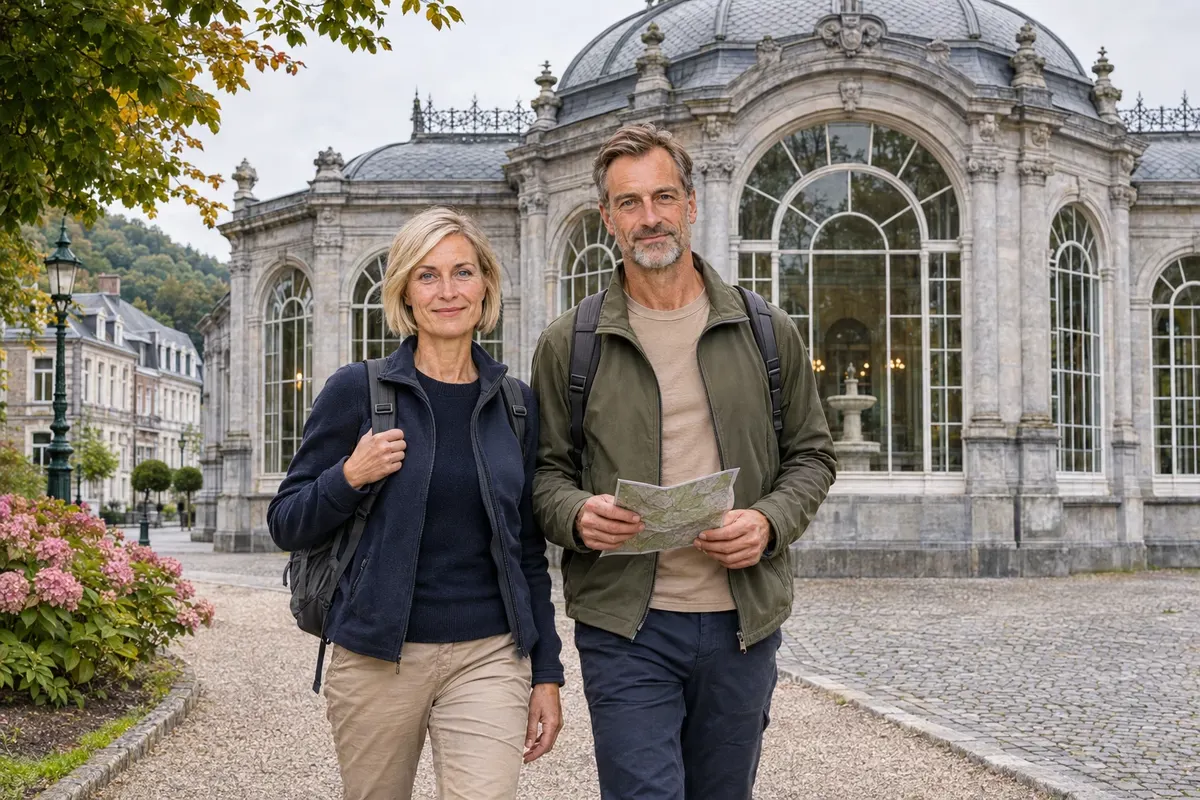
Hot springs
Thermal heritage of Spa
Visit the Pouhon Pierre-le-Grand spring and walk the spaces where the resort’s visitors used to meet.
On Rue du Marché, in the centre of Spa, a spring has an entire building around it. The Pouhon Pierre-le-Grand houses both the place where visitors used to drink the water and the hall where they could pass part of the day. Just walking those few metres shows how a spring helped shape the town.
The walk starts at the bottom of an Ardennes valley. You can stay in the central streets, between pavilion, gallery and park, or extend the walk along the wooded slopes. The spa tradition brought together precisely these two habits: taking the waters and going for a walk between one visit to the spring and another.
The spring beneath the eight-sided pavilion
First look for the eight-sided volume of the Pouhon Pierre-le-Grand. That is where the spring is. Tall arched windows light the interior, and a glazed opening at the top of the roof brings daylight to the centre. The current building opened in 1880. Peter the Great’s visit, after whom the spring is named, took place much earlier, in 1717.
Pouhon is a local word linked to the act of drawing water. At the Pouhon Pierre-le-Grand the water contains iron and natural gas. If you want to taste it, ask at the tourist office located in the building how access works that day. The experience helps make sense of the old expression “taking the waters,” which in Spa included drinking from the spring.
From the winter garden to the Golden Book
Next to the spring, the former winter garden changes the scale of the visit. Notice the columns and the large openings facing the town. The hall offered visitors to the resort a sheltered place where they could walk and find company. Today it hosts exhibitions, and its architecture remains interesting even for those who mainly came to see the source.
It’s worth looking for the Livre d’Or, or Golden Book. The name might make a visitor expect a volume of signatures, but what you find is a painting by Antoine Fontaine, nine metres long. It brings together 92 people who passed through Spa. The figures are from different eras. Walking along the painting from one end to the other is like leafing through several centuries of visits in the space of a single room.
Through the park and the Léopold II gallery
From the Pouhon, follow the central streets toward the Parc de Sept-Heures. The Léopold II gallery, with its iron structure, is a good place to perceive what made the water season a social occasion. Under the roof, people could continue their stroll even if it started to rain. Beside it, the tree-lined paths return the walker to the shade of the trees.
In the centre, the short distances leave time to look at the roofs and to walk around the pavilions. On the slopes, paths led guests through the woods to more remote springs. For that stretch, take the change in elevation into account when choosing your route.
How to choose the end of the walk
If you have little time, start the visit inside the Pouhon and leave the park for last. That way you can shorten the return without missing the spring. Those who want to continue to the woods can get a reference at the tourist office to choose the route and confirm the return point. In rain, it’s worth taking advantage of the gallery and the pavilion and leaving the climb for another occasion.
To finish with a bath, locate the Thermes de Spa on the Annette et Lubin hill and time your walk to match the pool entrance. If you prefer to stay in the valley, the spring, the hall and the gallery already give a good idea of how visitors spent the day at the resort.
Frequently asked questions
Where to start a walking itinerary of historic Spa?
At the Pouhon Pierre-le-Grand on Rue du Marché. The visit begins by the spring, can include the former winter garden and continues through the centre to the Parc de Sept-Heures.
Do you need to reserve a bath to visit the spring?
The spring has its own access in the central pavilion. Check with the tourist office to learn the visiting conditions. The pool entrance is for a different address, the Thermes de Spa on the hill.
Where to go: Thermal heritage
Pick a region or type what you are looking for to see the cities and who offers it in each.
-
Spa LG
At Pouhon Pierre-le-Grand, you can visit one of the springs that shaped the history of the spa town.

Beyond the guide


