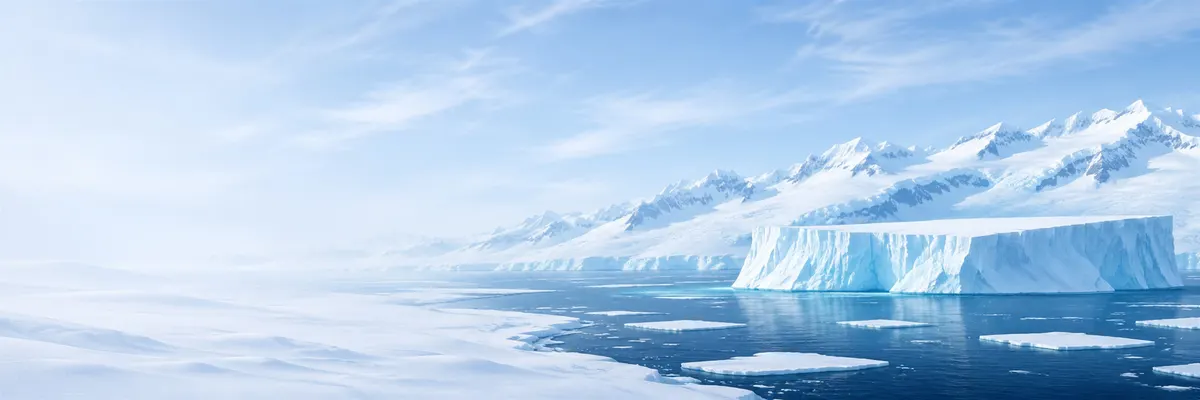
Illustrative images. The pictures in this guide are illustrations based on the real place, not photographs, and may differ from it.

Antarctica

Brazil in Antarctica

How Brazil joined the Antarctic Treaty, built a station on King George Island, rebuilt it after the 2012 fire, and why the southern ice affects the country’s climate.

Share: WhatsApp

Why Brazil is in Antarctica

The polar air masses that bring cold fronts to southern and southeastern Brazil, and sometimes cold snaps as far as the Amazon, form at high southern latitudes over the ocean around Antarctica. Understanding what happens there helps explain the country’s weather and climate.

The ocean also links the two regions. Cold waters from the Southern Ocean flow along the deep South Atlantic, and Antarctic krill feed whales that often migrate to the Brazilian coast in winter, such as humpbacks and southern right whales.

There is also a diplomatic reason: only countries with substantial scientific research on the continent have a say in decisions under the Antarctic Treaty. Maintaining research is what secures Brazil that place, as explained in The Antarctic Treaty.

Accession to the Treaty and PROANTAR

Brazil was not among the twelve countries that signed the Antarctic Treaty in 1959. It acceded on May 16, 1975, initially as a non-consultative Party, without decision-making rights.

The Brazilian Antarctic Program, PROANTAR, was created on January 12, 1982 by decree 86.830. It is run by the Interministerial Commission for Marine Resources (CIRM), coordinated by the Brazilian Navy, which handles logistics; research is funded and evaluated by the Ministry of Science, Technology and Innovation and by CNPq.

The first expedition, Operation Antártica I, took place in the summer of 1982–1983, with the Navy support ship Barão de Teffé and the oceanographic vessel Professor Wladimir Besnard from the University of São Paulo. Both reached Antarctica in January 1983 and helped choose the site for the future station.

With that scientific activity, Brazil was accepted as a consultative Party in September 1983, with voice and vote. Since then, each year an Antarctic Operation, OPERANTAR, departs from Rio de Janeiro, usually in October, and returns in April.

Comandante Ferraz Antarctic Station

Comandante Ferraz Antarctic Station was inaugurated on February 6, 1984 on Keller Peninsula, in Admiralty Bay, King George Island, in the South Shetlands, at about 62 degrees south. It was small, for 12 people, and began to be occupied year-round from 1986.

The name honors frigate captain Luiz Antônio de Carvalho Ferraz, a naval hydrographer and one of the pioneers of Brazil’s presence on the continent, who had been to Antarctica aboard British ships before the country had its own program.

The station is located within the Admiralty Bay Antarctic Specially Managed Area, proposed by Brazil and Poland, which maintains Arctowski Station on the other side of the bay. There, research, logistics and visitation activities follow a common plan.

The 2012 fire

In the early hours of February 25, 2012, a fire that started in the engine room, where the generators were located, destroyed about 70% of the station. Two Navy personnel died while trying to fight the blaze: Petty Officer Carlos Alberto Vieira Figueiredo and First Sergeant Roberto Lopes dos Santos, posthumously promoted to second lieutenants.

The other occupants were evacuated with support from neighboring stations and Chilean aircraft, and one injured service member was taken to the Chilean base Frei.

In February 2013 Emergency Antarctic Modules were set up on Keller Peninsula; they served as a temporary station for the core Navy team and for part of the research. Ships and summer camps maintained other projects while the Navy prepared the reconstruction.

The new 2020 station

The new Comandante Ferraz Station was inaugurated on January 15, 2020, on the same site as the old one. It has about 4,500 square meters of area, nearly twice the previous size, 17 laboratories planned in the project and capacity for 64 people.

The architectural design, by Estúdio 41 of Curitiba, won a 2013 competition held by the Institute of Architects of Brazil with the Navy. The construction, contracted to the Chinese company CEIEC, began in 2016 and could only progress during the few summer months when ships reach the bay.

The station was divided into separate blocks so that a fire cannot spread from one block to another; the partitions resist fire for about two hours, time to fight the flames and evacuate people.

A core Navy team remains at the station year-round, handling operations and maintenance. Researchers arrive mainly in summer, when ships and aircraft rotate personnel.

Criosfera 1 and inland research

On January 12, 2012, an expedition from the National Institute of Science and Technology of the Criosphere installed Criosfera 1, the first Brazilian scientific module inland on the continent, at 84° South and 79.5° West, on the ice sheet of West Antarctica. It is about 670 kilometers from the South Pole and 2,500 kilometers south of Ferraz.

The module operates unmanned, powered by solar panels and small wind turbines, and sends temperature, wind, humidity and air composition data by satellite. It is a joint initiative of UFRGS, UERJ and INPE.

The Criosphere INCT, created in 2008 and coordinated by UFRGS with FURG, brings together researchers who study ice, the Southern Ocean and their connection to South American climate. Brazilian teams have already made crossings of hundreds of kilometers on the ice sheet and carried out ice-core drilling to retrieve cores.

What Brazilians research

PROANTAR’s research covers the atmosphere and climate, the Southern Ocean, ice, marine and terrestrial life, geology and human health in cold conditions. Much of it departs from Ferraz, from ships and from camps set up in summer on the islands and the Peninsula.

In Admiralty Bay, decades of measurements of weather, water and wildlife allow tracking regional changes. Fiocruz and university researchers study fungi and bacteria that exist only there, searching for substances that could have medicinal uses.

Brazil is a member of SCAR, the international Antarctic scientific committee, and glaciologist Jefferson Cardia Simões (UFRGS) served as SCAR vice president from 2016 to 2024.

The results help understand cold fronts, coastal storms and rainfall in southern Brazil and show how the changes discussed in Antarctica and Earth’s climate reach the country.

Frequently asked questions

Does Brazil have a base in Antarctica?

Yes. The Comandante Ferraz Antarctic Station, run by the Brazilian Navy on King George Island, has been operating since 1984. There is also the automatic Criosfera 1 module inland on the continent.

Where is Comandante Ferraz Station located?

On Keller Peninsula, in Admiralty Bay, King George Island, in the South Shetland Islands archipelago, near the northern tip of the Antarctic Peninsula, at about 62 degrees south.

When did Brazil join the Antarctic Treaty?

On May 16, 1975. In September 1983, after the first scientific expedition, Brazil became a Consultative Party with decision-making rights over the continent.

What is PROANTAR?

It is the Brazilian Antarctic Program, created on January 12, 1982. The Navy handles logistics, and research is carried out by universities and institutes across the country.

What happened to the Brazilian station in Antarctica in 2012?

On February 25, 2012, a fire destroyed about 70% of Comandante Ferraz Station, and two Navy servicemen died fighting the blaze. The new station was inaugurated on January 15, 2020.

How many people can the new Comandante Ferraz Station accommodate?

Up to 64 people, in about 4,500 square meters, nearly double the area of the old station.

Which ships does Brazil use in Antarctica?

The oceanographic support ship Ary Rongel, the Red Giant, and the polar ship Almirante Maximiano, both of the Brazilian Navy.

What is Criosfera 1?

It is an automatic Brazilian scientific module, installed in 2012 at 84° South on the ice sheet of West Antarctica, that measures weather and air and sends the data by satellite.

Does Brazil claim territory in Antarctica?

No. Brazil does not claim territory and participates on the continent under the rules of the Antarctic Treaty, as a Consultative Party.

Why does Antarctica influence Brazil’s climate?

Because the polar air masses that bring cold fronts form at high southern latitudes, and the waters and winds of the Southern Ocean affect the South Atlantic and the country’s weather.