

 Brazil
 Antarctica
 Argentina
 Bolivia
 Chile
 Colombia
 Ecuador
 Guyana
 French Guiana
 Falkland Islands (Malvinas)
 Paraguay
 Peru
 Suriname
 Uruguay
 Venezuela
 Germany
 Austria
 Belgium
 Croatia
 Denmark
 Slovakia
 Slovenia
 Spain
 Finland
 France
 Greece
 the Netherlands
 Hungary
 Ireland
 Iceland
 Luxembourg
 Norway
 Poland
 Portugal
 the United Kingdom
 the Czech Republic
 Sweden
 Switzerland
 Turkey
 Bermuda
 Canada
 the United States
 Greenland
 Mexico
 Saint Pierre and Miquelon
 the Dominican Republic
 Japan
 South Africa
 Egypt
 Australia
 Fiji
 New Zealand
 Papua New Guinea
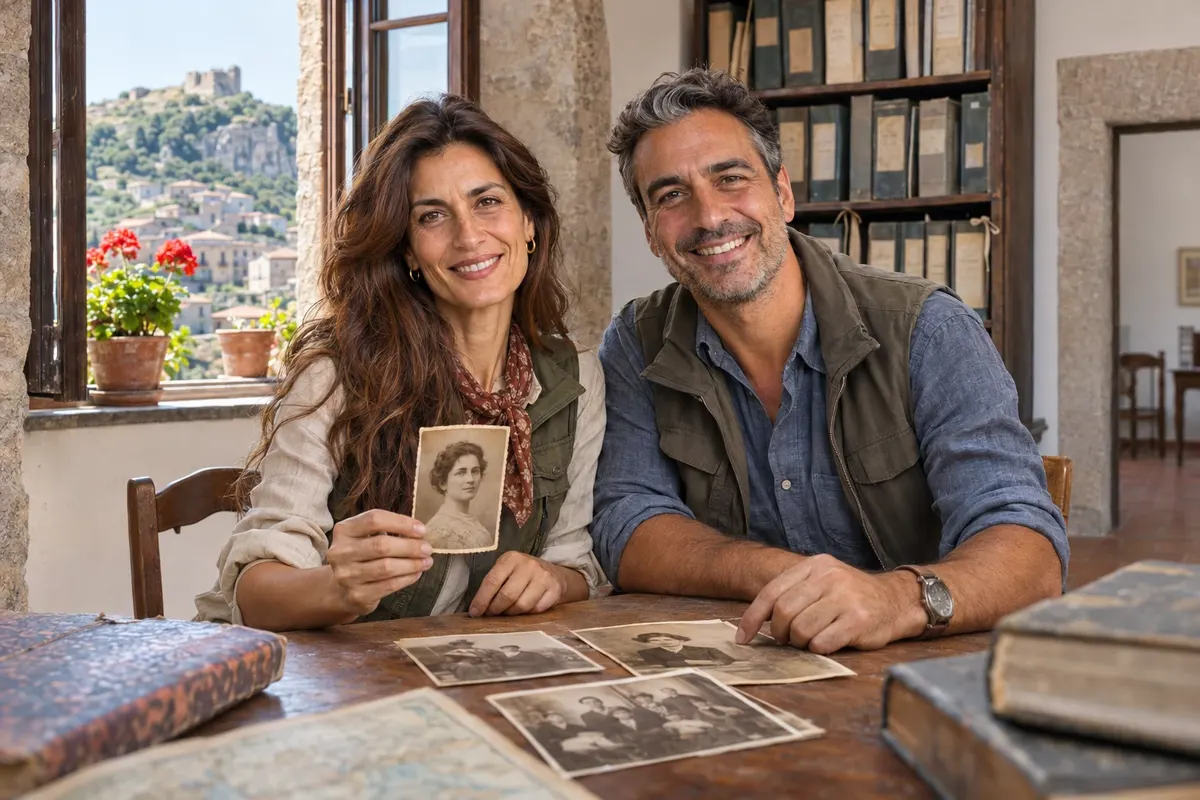
Illustrative images. The pictures in this guide are illustrations based on the real place, not photographs, and may differ from it.

Immigration and heritage
Researching your family history
Follow clues about a birth or marriage through the historical records of Genoa and Naples.
On the back of a photograph, someone wrote “to my sister” and signed with a nickname. The photo alone may not tell you much. But if the family also kept the envelope, the recipient’s address and the date of the postmark can help place the two sisters in time and place. Many trips to trace family roots in Italy begin this way, with a question small enough to fit in a single document.
In Genoa and Naples, the state archives offer guidance on consulting historical civil records. Before planning your trip, try to sum up what you know about your family in one sentence. Who was born, got married, or died, in which municipality, and around what year? Whatever is missing tells you what to look for first.
How to tell if you’ve found the right person in a record
If you know of a marriage, start there. Write down each spouse’s name and, if listed, their age, parents’ names, and birthplace. A pair of names is usually a better clue than a surname alone. If you’re trying to tell apart two people named Giuseppe who lived around the same time, a match with the parents’ names can make all the difference.
Copy the spelling as best you can and mark the letter you’re unsure of. Compare it with the same letter in another word on the page, preferably one written by the same person. Note the spelling your family uses alongside your transcription. That way, when you look at the image again with a relative, you can still discuss whether that mark was really an “n” or a “u.”
Which registers to look for in Genoa
The guide to the State Archives of Genoa organizes civil records by period and geographic area. The collections it describes include registers from the Napoleonic era and records from 1866 to 1915 for municipalities under the jurisdiction of the Genoa court. Check the inventory for the period you’re interested in and make sure the municipality is listed before looking for the surname.
If the register is available on Antenati, open the image and look for an index. The entry number may appear beside the name. Use that number to find the right page and read the full record. The archives explain which materials you can view online and how to access the rest. Knowing the difference helps you decide whether to include a visit to the reading room in your itinerary.
How to look up records in Naples
For civil records from Naples and its province, the local archives direct you to the digitized registers on the Antenati portal. When searching by location, distinguish between the name of the municipality and the broader reference to the province. Select the place where the event occurred and the type of register. Nati means births, matrimoni means marriages, and morti means deaths.
If you estimated the year from an age mentioned in a letter, check the years on either side as well. Keep a simple list of the registers you’ve opened and the dates each one covers. If a name search turns up nothing, check whether there are images you can browse. Knowing exactly what you’ve already checked saves work if you need to ask the archives for guidance.
From a family record to a family walk
When you find a record, save its reference along with the image. Note the municipality, year, entry number, and collection name. If an address appears, copy the entire phrase so you’ll remember whose address it was. A witness may have lived on the same street as the family but in a different house.
Choose one of your discoveries to take along on a walk. With a copy of the document and a city map, find the street and take in the route to the next address your family recognizes. When you share the discovery, use one caption with the date of the record and another with the date of your visit. That helps distinguish the place as you saw it from the place your ancestor knew.
Frequently asked questions
I only know my family’s surname. Where do I start?
Ask a relative for the names of a couple in the family, and look for a letter, a photograph with a note on it, or a record that mentions at least one place. Knowing the municipality and an approximate date makes it easier to choose the right register.
Do I need to go to Italy to start my research?
You can start with the images available on Antenati. Save the trip for research that requires a visit to the archives or for exploring the places you’ve been able to identify.
Where to go: Research your family history
Pick a region or type what you are looking for to see the cities and who offers it in each.
More activities in Immigration and heritage

Beyond the guide


