1 city

 Search
 Brazil
 Argentina
 Bolivia
 Chile
 Colombia
 Ecuador
 Guyana
 French Guiana
 Falkland Islands (Malvinas)
 Paraguay
 Peru
 Suriname
 Uruguay
 Venezuela
 Germany
 Austria
 Belgium
 Croatia
 DenmarkSlovakia
 Spain
 Finland
 France
 Greece
 the Netherlands
 Hungary
 Ireland
 Iceland
 Italy
 Luxembourg
 Norway
 Poland
 Portugal
 the United Kingdom
 the Czech Republic
 Sweden
 Switzerland
 Turkey
 Canada
 the United States
 Mexico
 the Dominican RepublicTurkey
 South Africa
 Australia
 Fiji
 New Zealand
 Papua New Guinea
Region · Bratislava and Western Slovakia
Nitra, considered the oldest city in the country, the Komárno fortress, the bridge to Esztergom at Štúrovo, the lowland thermal baths and the vineyards of the south.
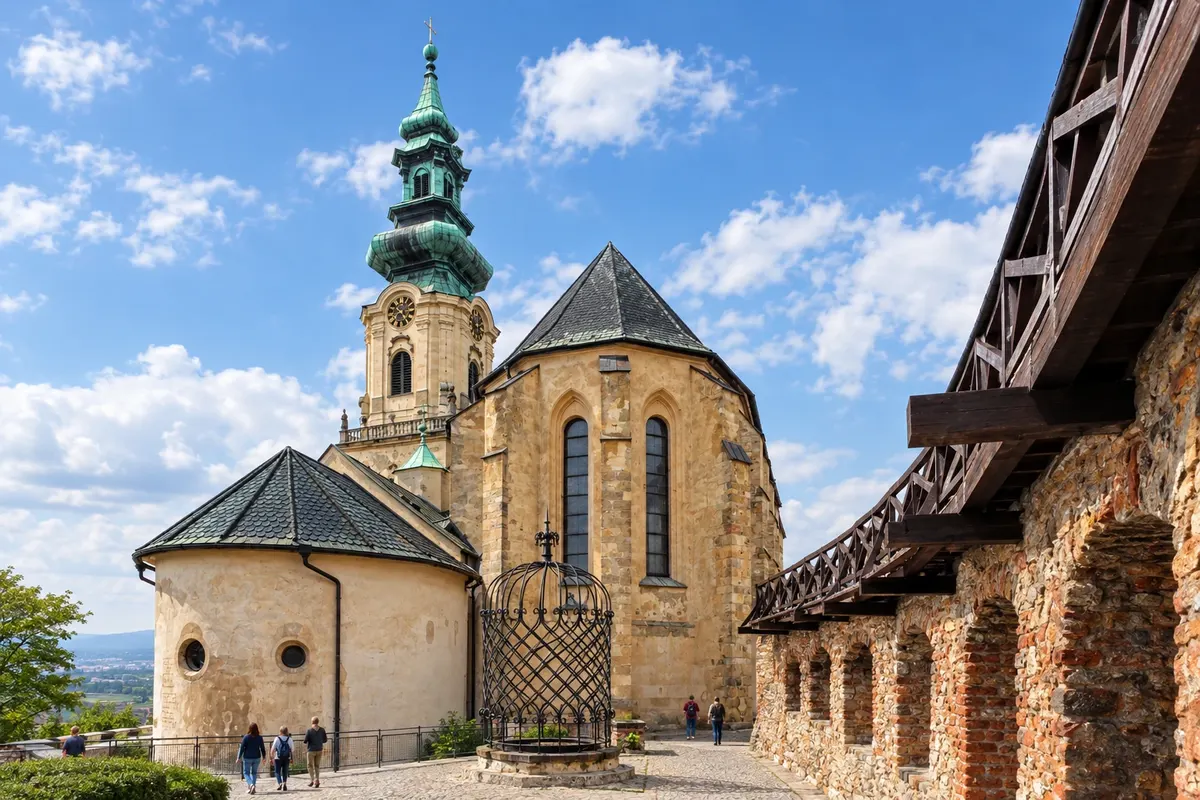
In the photo: Cathedral of Saint Emeram, at Nitra Castle.
Illustrative images. The pictures in this guide are illustrations based on the real place, not photographs, and may differ from it.

The region
The Nitra region occupies the plain of southwest Slovakia, between the Váh, Nitra and Hron rivers and the Danube, which forms the border with Hungary. It is the country’s most agricultural area, with fields, vineyards and thermal baths, and in the south, in towns such as Komárno and Štúrovo, Hungarian is the everyday language.
Nitra is considered the oldest city in Slovakia. In the 9th century it was the seat of Prince Pribina’s principality, where, around 828, one of the region’s first Christian churches was consecrated. On the castle hill stand the Cathedral of Saint Emeram and the bishop’s palace, and nearby the Zobor hill, with trails and viewpoints, rises beside the town.
Komárno, at the confluence of the Váh and the Danube, has one of the largest fortification systems in Central Europe, built between the 16th and 19th centuries, and the Europe Courtyard, a square with facades inspired by the architecture of several countries. On the other side of the bridge is the Hungarian town of Komárom. Nearby, at Iža, the remains of the Roman fort Kelemantia are inscribed by UNESCO along with other sites of the ancient Roman frontier along the river.
At Štúrovo, the Maria Valéria Bridge crosses the Danube to Esztergom and its basilica in Hungary. The thermal baths of Štúrovo, Patince and Komárno use hot springs from the plain. In Topoľčianky, a castle and a stud farm of purebred horses lie at the foot of the Tribeč hills.
Destinations
Summer is long and warm, and from June to August the outdoor pools of the Štúrovo and Patince thermal baths are usually fully open. In August, Nitra hosts the Agrokomplex agricultural fair. Spring and September, with the grape harvest, are good times for walks on Zobor and for visiting towns. Winter is cold and damp, with little snow on the plain.
From Bratislava to Nitra it is about 90 km via the D1 and R1 roads, with regular trains and buses. Komárno and Štúrovo have rail connections to Bratislava and sit on the border with Hungary, with bridges to Komárom and Esztergom; Štúrovo also has trains to Budapest. Bratislava Airport (BTS) is the most convenient for those arriving by plane.
Your questions
Historians commonly point to it that way. The castle hill has remains dating back to prehistory, and in the 9th century Nitra was one of the centers of Great Moravia. The castle, the cathedral and the diocesan museum tell that history.
The fortress, with bastions and passages from the 16th to 19th centuries, the Europe Courtyard and the riverside centre. The bridge leads to Komárom in Hungary, which has forts from the same defensive system. The fortress offers guided tours on set days, so it is advisable to check schedules.
Yes. The Maria Valéria Bridge over the Danube connects the two towns and is used by pedestrians, cyclists and cars. Esztergom Basilica is close to the bridge on the Hungarian side, and both countries are part of the Schengen area.
In Štúrovo, the Vadaš complex sits by the Danube; Patince, a few kilometres from Komárno, and Komárno itself also have thermal baths. There are indoor and outdoor pools; the outdoor pools usually operate from June to August. Confirm each facility’s opening before you go.