

 Brazil
 Argentina
 Bolivia
 Chile
 Colombia
 Ecuador
 Guyana
 French Guiana
 Falkland Islands (Malvinas)
 Paraguay
 Peru
 Suriname
 Uruguay
 Venezuela
 Germany
 Austria
 Belgium
 Croatia
 Denmark
 Spain
 Finland
 France
 Greece
 the Netherlands
 Hungary
 Ireland
 Iceland
 Italy
 Luxembourg
 Norway
 Poland
 Portugal
 the United Kingdom
 the Czech Republic
 Sweden
 Switzerland
 the Dominican Republic
 Fiji
Province · Mar Negro Ocidental
Karabük
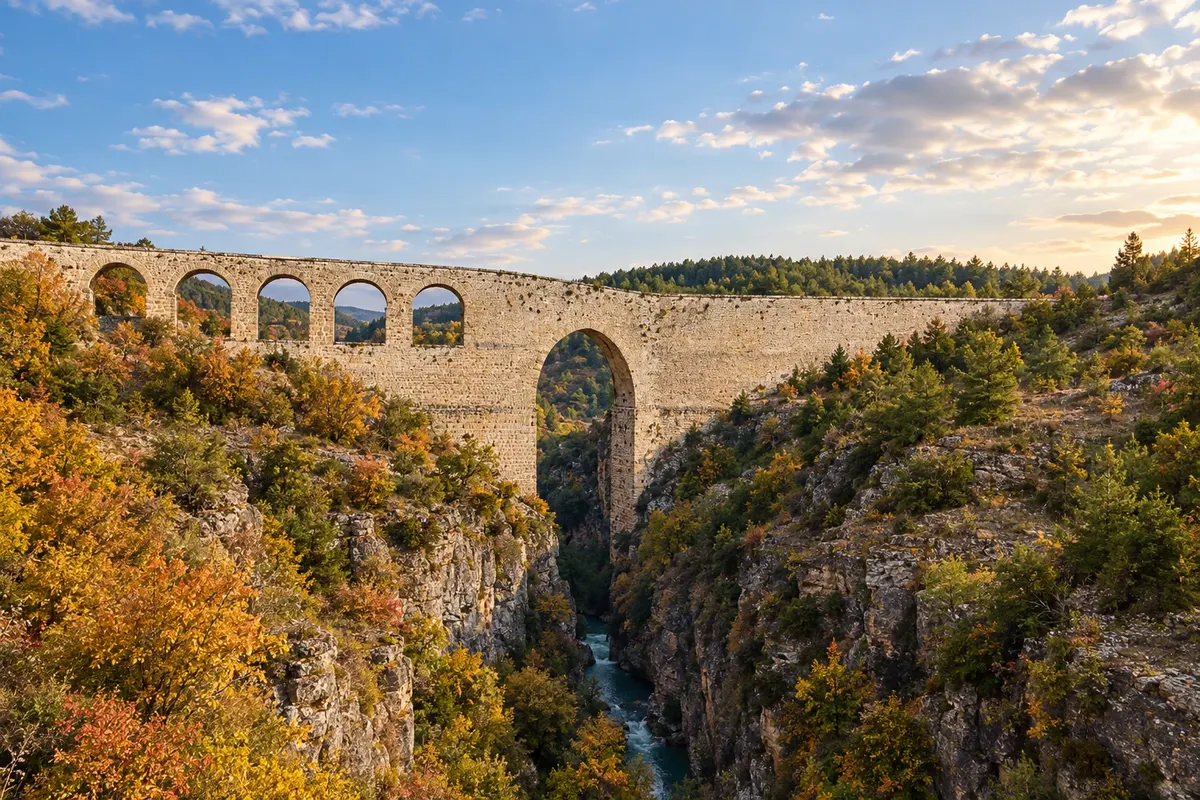
The province of Safranbolu, an Ottoman World Heritage town, with the Tokatlı canyon, the İncekaya aqueduct and the historic village of Yörük.
In the photo: İncekaya aqueduct over the Tokatlı canyon, Karabük
Illustrative images. The pictures in this guide are illustrations based on the real place, not photographs, and may differ from it.

The province
Get to know Karabük
Karabük grew as an industrial city around a steelworks, but for the traveller the province is Safranbolu, about 10 km from the capital. The ensemble of Ottoman houses in Safranbolu has been on UNESCO’s World Heritage list since 1994.
In Safranbolu, timber and adobe houses climb the slopes, with wide eaves and windows facing the street. The Kaymakamlar House operates as a house-museum, the old Çarşı quarter concentrates traditional commerce, and the Hıdırlık Tepesi viewpoint gives views over the roofs. The name comes from saffron (safran), cultivated in the region, which appears in sweets such as zerde and saffron lokum sold in the bazaar.
North of the town, the Tokatlı canyon cuts through the limestone of the Hızar river. Spanning it is the İncekaya aqueduct, from the 18th century, restored by order of Grand Vizier İzzet Mehmet Paşa to bring water to Safranbolu. A glass terrace 80 metres high allows you to look down on the canyon, and there is a trail along the river.
About 7 km from Safranbolu, the Bulak (Mencilis) cave has an illuminated section open to visitors, with an underground river and small lakes. The village of Yörük, protected since 1997, preserves old houses and mansions, such as the Sipahioğlu Mansion.
When to go
April to June and September to October are usually the most pleasant months for walking the slopes of Safranbolu. Summer is hotter and busier. From December to February it is cold and it may snow.
Getting there
Karabük has no airport. The nearest are Zonguldak (ONQ) and Kastamonu (KFS); farther away is Ankara Esenboğa (ESB). Buses depart from Istanbul and Ankara to Karabük and Safranbolu; from Safranbolu bus terminal you continue by local transport or taxi to the old quarter.
Your questions
Frequently asked questions about Karabük
How many days to stay in Safranbolu?
A full day covers the old quarter, the Kaymakamlar House and the Hıdırlık viewpoint. Two nights allow you to include the Tokatlı canyon, the Bulak cave and the village of Yörük.
How to go from Istanbul to Safranbolu?
By bus, with departures from Istanbul to Karabük and Safranbolu; the trip takes much of the day. Those who prefer to fly can go to Zonguldak or Kastamonu and continue by road. Check schedules and routes in advance.
What to see near Safranbolu?
The Tokatlı canyon, with the İncekaya aqueduct and the glass terrace; the Bulak cave, about 7 km away; and the village of Yörük, with protected old houses. Amasra, on the coast, lies in the neighbouring province of Bartın.
Why is the town called Safranbolu?
The name comes from saffron (safran in Turkish), cultivated in the region. The spice appears in sweets sold in the bazaar, such as zerde and saffron lokum.