

 Brazil
 Antarctica
 Argentina
 Bolivia
 Chile
 Colombia
 Ecuador
 Guyana
 French Guiana
 Falkland Islands (Malvinas)
 Paraguay
 Peru
 Suriname
 Uruguay
 Venezuela
 Germany
 Austria
 Belgium
 Croatia
 Denmark
 Slovakia
 Slovenia
 Spain
 Finland
 France
 Greece
 the Netherlands
 Hungary
 Ireland
 Iceland
 Italy
 Luxembourg
 Norway
 Poland
 Portugal
 the United Kingdom
 the Czech Republic
 Sweden
 Switzerland
 Turkey
 Bermuda
 Canada
 Greenland
 Mexico
 Saint Pierre and Miquelon
 the Dominican Republic
 South Africa
 Egypt
 Australia
 Fiji
 New Zealand
 Papua New Guinea
Historic site · Dodge City, Kansas
Santa Fe Trail Tracks
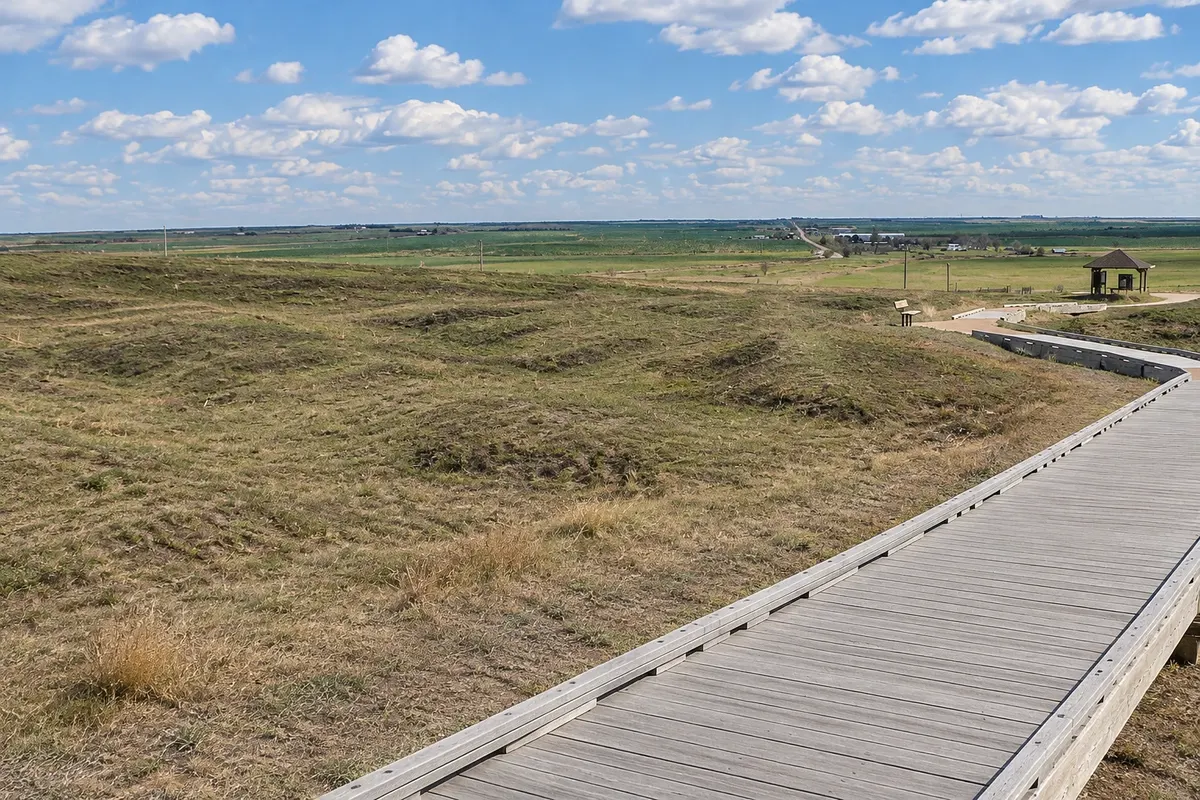
A stretch of prairie west of Dodge City where the ruts made by 19th-century Santa Fe Trail wagons are still visible, with a lookout and interpretive panels.
Illustrative images. The pictures in this guide are illustrations based on the real place, not photographs, and may differ from it.




Discover
About Santa Fe Trail Tracks
From 1821 to 1880 the Santa Fe Trail was the main trade route between Missouri and Santa Fe, then Mexican territory and later American. Ox- and mule-drawn wagons crossed the plains in convoys for about 1,400 km, carrying cloth and tools and bringing back silver, furs and mules.
About 14 km west of Dodge City, a prairie section that was never plowed preserves the ruts left by passing wagons. They are wide, parallel depressions in the ground that stand out when the sun is low. The site is a National Historic Landmark.
A platform with panels explains the route and what you can see in the landscape. There is no admission fee, and the area is open to visitors. The wind is often strong and there is no shade.
Before you go
Practical information
Cidade Turismo reviews its information regularly, but something may have changed. Check with the place before planning your trip.
How much time to set aside
30 minutes to an hour.
Best time
In the early hours of the day or near sunset, when the low sun highlights the grass and ruts.
How to get there
Located next to Highway 50, about 14 km west of Dodge City, with parking beside the viewing platform.
Tip
Spend a few minutes looking across the field: the ruts are subtle and become clearer as your eyes adjust.
Official website
Get your questions answered
Frequently asked questions about Santa Fe Trail Tracks
Where can you see the Santa Fe Trail ruts near Dodge City?
At a prairie section beside Highway 50, about 14 km west of the city.
Is there an admission fee to see the Santa Fe Trail ruts?
There is no entry fee.
What is the best time to see the Santa Fe Trail ruts?
Shortly after sunrise or in the last hours of daylight, when shadows reveal the depressions.