

 Brazil
 Antarctica
 Argentina
 Bolivia
 Chile
 Colombia
 Ecuador
 Guyana
 French Guiana
 Falkland Islands (Malvinas)
 Paraguay
 Peru
 Suriname
 Uruguay
 Venezuela
 Germany
 Austria
 Belgium
 Croatia
 Denmark
 Slovakia
 Slovenia
 Spain
 Finland
 France
 Greece
 the Netherlands
 Hungary
 Ireland
 Iceland
 Italy
 Luxembourg
 Norway
 Poland
 Portugal
 the United Kingdom
 the Czech Republic
 Sweden
 Switzerland
 Turkey
 Bermuda
 Canada
 Greenland
 Mexico
 Saint Pierre and Miquelon
 the Dominican Republic
 South Africa
 Egypt
 Australia
 Fiji
 New Zealand
 Papua New Guinea
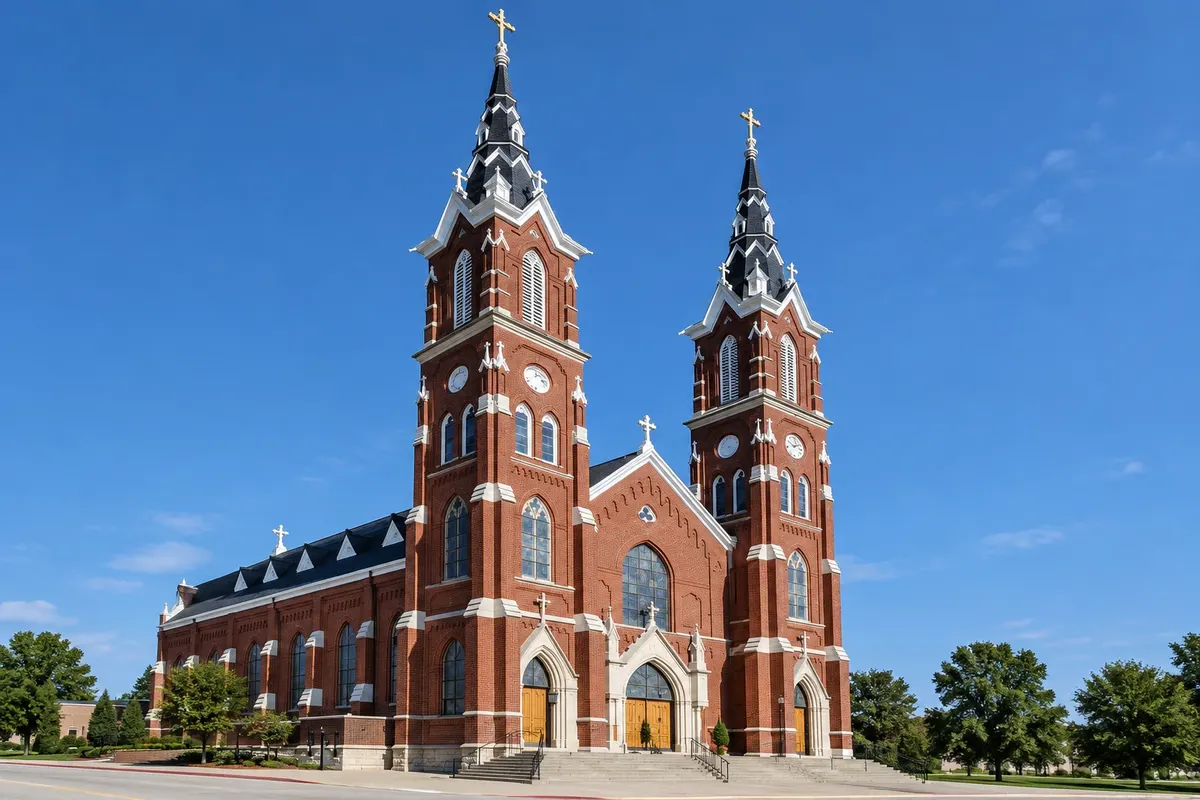
Church · Dyersville, Iowa
Basilica of St. Francis Xavier
Gothic church from 1889 in downtown Dyersville, with two tall towers, stained glass, and a carved wooden altar; it is one of the country’s minor basilicas.
Illustrative images. The pictures in this guide are illustrations based on the real place, not photographs, and may differ from it.




Discover
About Basilica of St. Francis Xavier
The Basilica of St. Francis Xavier was built between 1887 and 1889 by Dyersville’s German immigrant community. The style is Gothic, with two towers rising over 60 meters that can be seen for miles across the surrounding fields. In 1956, Pope Pius XII gave it the title of minor basilica, uncommon for a rural town church.
Inside, the nave is high, with columns, painted vaults, and about sixty stained-glass windows. The main altar is carved wood, and statues of the saints were brought from Europe. The organ is used at Mass and in concerts.
The church is open during the day for visits outside Mass times, and guided tours are available by appointment. Respect for services is part of the visit.
Before you go
Practical information
Cidade Turismo reviews its information regularly, but something may have changed. Check with the place before planning your trip.
How much time to set aside
30 minutes to an hour.
Best time
On sunny days, in the morning or mid-afternoon, when light shines through the stained glass.
How to get there
It’s in downtown Dyersville on First Avenue, a few minutes’ drive from the movie field and the toy museum.
Tip
Check Mass times first so you don’t arrive during a service.
Official website
Get your questions answered
Frequently asked questions about Basilica of St. Francis Xavier
Can you visit the Dyersville basilica?
Yes, during the day outside Mass times. Guided tours require an appointment.
When was the Basilica of Saint Francis Xavier built?
Between 1887 and 1889, by the city’s community of German immigrants.
Why is the Dyersville church a basilica?
In 1956 Pope Pius XII granted it the title of minor basilica because of its historical and architectural importance.