

 Brazil
 Argentina
 Bolivia
 Chile
 Colombia
 Ecuador
 Guyana
 French Guiana
 Falkland Islands (Malvinas)
 Paraguay
 Peru
 Suriname
 Uruguay
 Venezuela
 Germany
 Austria
 Belgium
 Croatia
 Denmark
 Spain
 Finland
 France
 Greece
 the Netherlands
 Hungary
 Ireland
 Iceland
 Italy
 Luxembourg
 Norway
 Poland
 Portugal
 the United Kingdom
 the Czech Republic
 Sweden
 Switzerland
 the Dominican Republic
 Fiji
Province · Pamukkale e Região dos Lagos
Kütahya
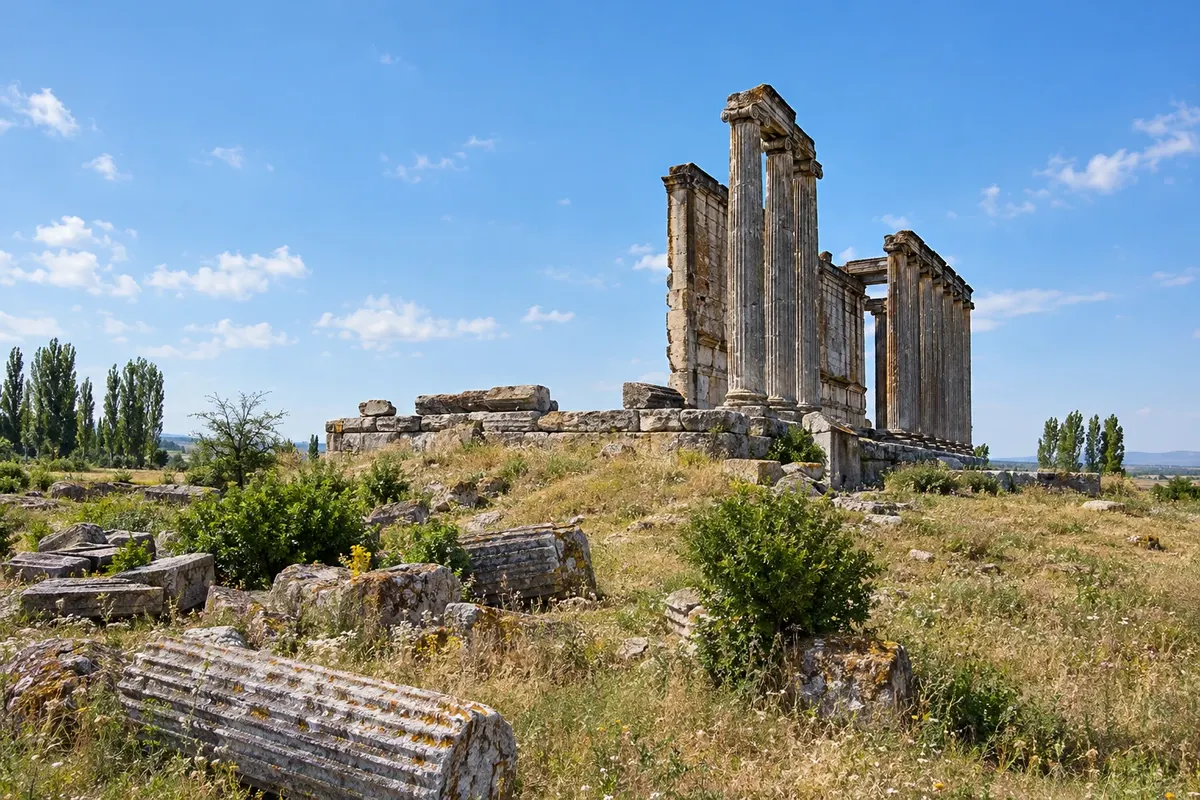
Kütahya is the city of tiles and hand-painted ceramics, with the Temple of Zeus at Aizanoi, one of the best-preserved Roman temples in Anatolia, and thermal springs.
In the photo: Temple of Zeus, Aizanoi (Çavdarhisar)
Illustrative images. The pictures in this guide are illustrations based on the real place, not photographs, and may differ from it.

The province
Get to know Kütahya
Kütahya lies in western Anatolia, between Eskişehir and Afyonkarahisar. The city keeps alive the tradition of tiles and hand-painted ceramics, alongside İznik: there are studios in the streets of the center, the Tile Museum (Çini Müzesi), and pieces decorating facades and fountains, as well as a large ceramic vase that has become a city symbol.
The old center has wooden Ottoman houses, the Ulu Camii and a fortress on the hill, with views over the rooftops. Germiyan Street concentrates restored mansions.
To the southwest, in Çavdarhisar, are the ruins of Aizanoi. The Temple of Zeus, from the 2nd century, has standing columns and a crypt beneath the sanctuary. The site also includes a theater connected to a stadium, baths, Roman bridges over the river and a market with the inscription of Emperor Diocletian’s price edict.
The province has well-known thermal springs, such as Yoncalı and Ilıca (Harlek). Part of the Phrygian Valley, with rock-cut monuments, is also in Kütahya, on the border with Eskişehir and Afyonkarahisar.
When to go
April to June and September to October are usually the best months for Aizanoi and for walking around the center. Summers are hot during the day, with cool nights. Winters are generally cold, with snow on some days, and it is the season when the thermal baths are most visited.
Getting there
Zafer Airport (KZR), in Altıntaş, is about 40 km from the city and has domestic flights, mainly from Istanbul. Kütahya has a station on the rail line between Eskişehir, Balıkesir and İzmir, and buses to Istanbul, Ankara, Bursa and Eskişehir. For Aizanoi, a car is the most practical option.
Your questions
Frequently asked questions about Kütahya
Where to buy ceramics in Kütahya?
In the center there are studios that sell hand-made and hand-painted pieces, and in some you can see the work up close. Larger pieces are usually packed for travel on request.
How long does a visit to Aizanoi take?
Two to three hours for the Temple of Zeus, the theatre-stadium, the market and the baths. The ruins are spread across the village of Çavdarhisar, and some parts can be seen on foot along the main street.
Do Kütahya and İznik make the same type of tiles?
Both cities were the great tile centers of the Ottoman Empire. İznik became known for pieces from the 16th and 17th centuries; Kütahya maintained uninterrupted production, with its own colours and designs.
Does Kütahya pair well with Eskişehir on the same trip?
Yes. The two cities are close to each other, and you can combine Kütahya’s ceramics, Aizanoi and the Odunpazarı district in Eskişehir in two or three days, by car or by train.