

 Brazil
 Argentina
 Bolivia
 Chile
 Colombia
 Ecuador
 Guyana
 French Guiana
 Falkland Islands (Malvinas)
 Paraguay
 Peru
 Suriname
 Uruguay
 Venezuela
 Germany
 Austria
 Belgium
 Croatia
 Denmark
 Spain
 Finland
 France
 Greece
 the Netherlands
 Hungary
 Ireland
 Iceland
 Italy
 Luxembourg
 Norway
 Poland
 Portugal
 the United Kingdom
 the Czech Republic
 Sweden
 Switzerland
 Turkey
 the United States
 Mexico
 the Dominican Republic
 South Africa
 Australia
 Fiji
 New Zealand
 Papua New Guinea
Province · Atlantic Canada
Nova Scotia
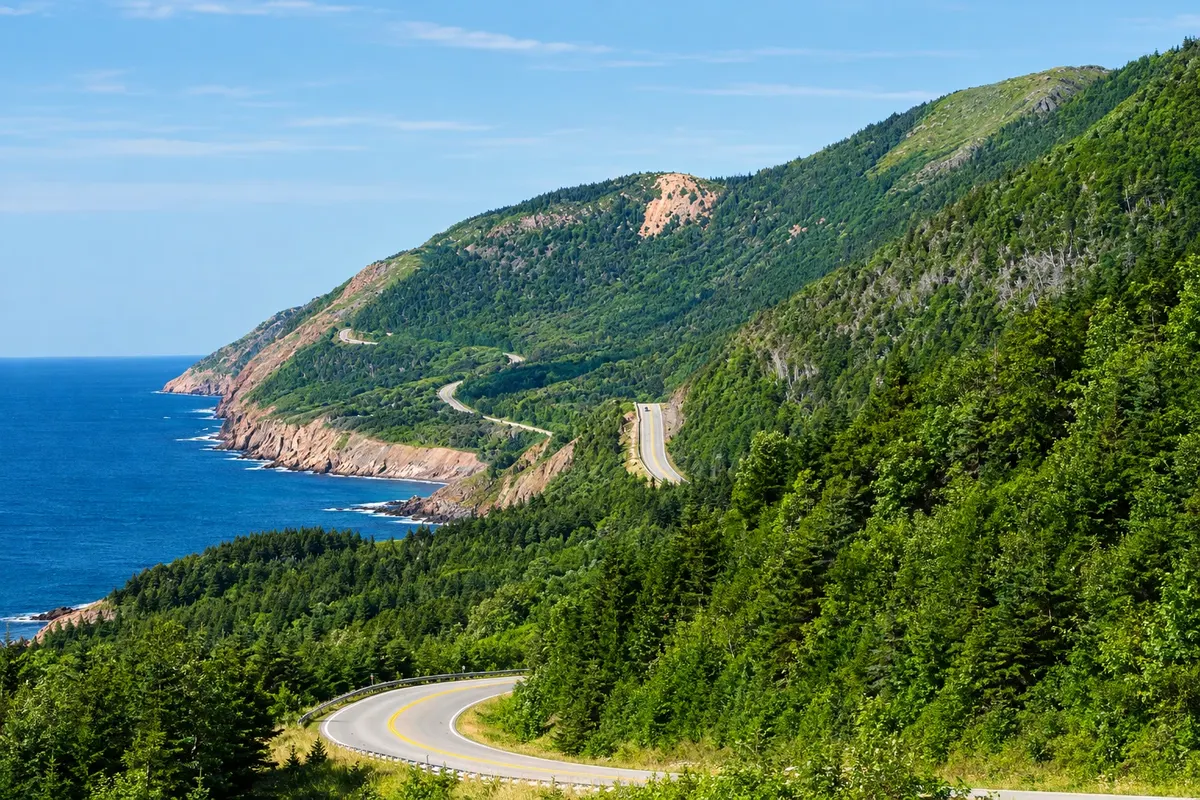
Halifax and its harbour, the Peggy's Cove lighthouse, Lunenburg (a World Heritage site), and the Cabot Trail, Cape Breton Island’s coastal road.
In the photo: Cabot Trail, Nova Scotia
Illustrative images. The pictures in this guide are illustrations based on the real place, not photographs, and may differ from it.

The province
Get to know Nova Scotia
Nova Scotia is almost entirely surrounded by the sea: a peninsula connected to the mainland by a narrow isthmus and the island of Cape Breton to the north. Nowhere in the province is far from the ocean. Halifax is the capital and the largest city in the Atlantic region.
Halifax has one of the world’s largest natural harbours. Along the waterfront, the boardwalk connects the Maritime Museum of the Atlantic, which tells the story of the 1917 explosion and the rescue of Titanic victims, to Pier 21, through which about a million immigrants arrived. High above the city, the Citadel preserves the port’s military history.
On the southern coast, Peggy’s Cove is a fishing village with a lighthouse set on granite rocks. Lunenburg, founded in 1753, is a UNESCO World Heritage site for its British colonial layout and colorful wooden houses, and it is the home port of the schooner Bluenose II.
On Cape Breton, the Cabot Trail makes a roughly 300 km loop along the coast and through Cape Breton Highlands National Park, with viewpoints over the Gulf of Saint Lawrence and the Atlantic. Chéticamp has an Acadian community, and Celtic music—heritage of Scottish immigrants—features in an October festival, Celtic Colours.
The Bay of Fundy borders the province’s west, with the Annapolis Valley and its wineries, Grand-Pré, a landscape of Acadian memory listed by UNESCO, and the fossil cliffs of Joggins, also a World Heritage site. Lobster, Digby scallops and the white wine Tidal Bay are local specialties.
When to go
From June to September days are mild and the coast is busier; sea water is cold for most of the year. The Cabot Trail usually shows fall colours from late September to mid-October, the time of the Celtic Colours festival. Winters are wet and snowy, and many tourist-area services open only for the season, generally from May to October.
Getting there
Halifax Stanfield International Airport (YHZ) is the main airport in the Atlantic region, with flights to other provinces, the United States and Europe. Sydney, on Cape Breton, has an airport with domestic flights. The Trans-Canada Highway arrives from New Brunswick, the long-distance train links Montreal to Halifax, and ferries operate to Prince Edward Island in season and to Newfoundland from North Sydney.
Your questions
Frequently asked questions about Nova Scotia
How many days should I allow for the Cabot Trail?
The loop can be driven in one day, but two to three days are ideal to allow time for hikes, viewpoints and stops in Chéticamp, Ingonish and Baddeck. A Parks Canada pass is required for the national park. In October accommodations often sell out because of the foliage and the festival.
How do I get from Halifax to Peggy’s Cove?
Peggy’s Cove is about 45 km from Halifax, roughly a one-hour drive along the coastal road. There are day tours that combine Peggy’s Cove and Lunenburg.
What is there to see in Lunenburg?
The old town, with its grid streets on the hill and painted wooden houses; the Fisheries Museum of the Atlantic by the harbour; and, when she is in port, the schooner Bluenose II. Boat tours of the bay depart from Lunenburg. The town is about an hour and a half from Halifax.
Do you need a car to travel around Nova Scotia?
For Halifax, no: the downtown is walkable and there are organized tours to the southern coast. For the Cabot Trail, the Annapolis Valley and coastal villages, a car is the most practical option because public transport between towns is limited.