

 Brazil
 Argentina
 Bolivia
 Chile
 Colombia
 Ecuador
 Guyana
 French Guiana
 Falkland Islands (Malvinas)
 Paraguay
 Peru
 Suriname
 Uruguay
 Venezuela
 Germany
 Austria
 Belgium
 Croatia
 Denmark
 Spain
 Finland
 France
 Greece
 the Netherlands
 Hungary
 Ireland
 Iceland
 Italy
 Luxembourg
 Norway
 Poland
 Portugal
 the United Kingdom
 the Czech Republic
 Sweden
 Switzerland
 Turkey
 the United States
 Mexico
 the Dominican Republic
 South Africa
 Australia
 Fiji
 New Zealand
 Papua New Guinea
Province · Atlantic Canada
New Brunswick
The tides of the Bay of Fundy, the Hopewell Rocks, Fundy National Park and Acadian culture in Canada’s only officially bilingual province.
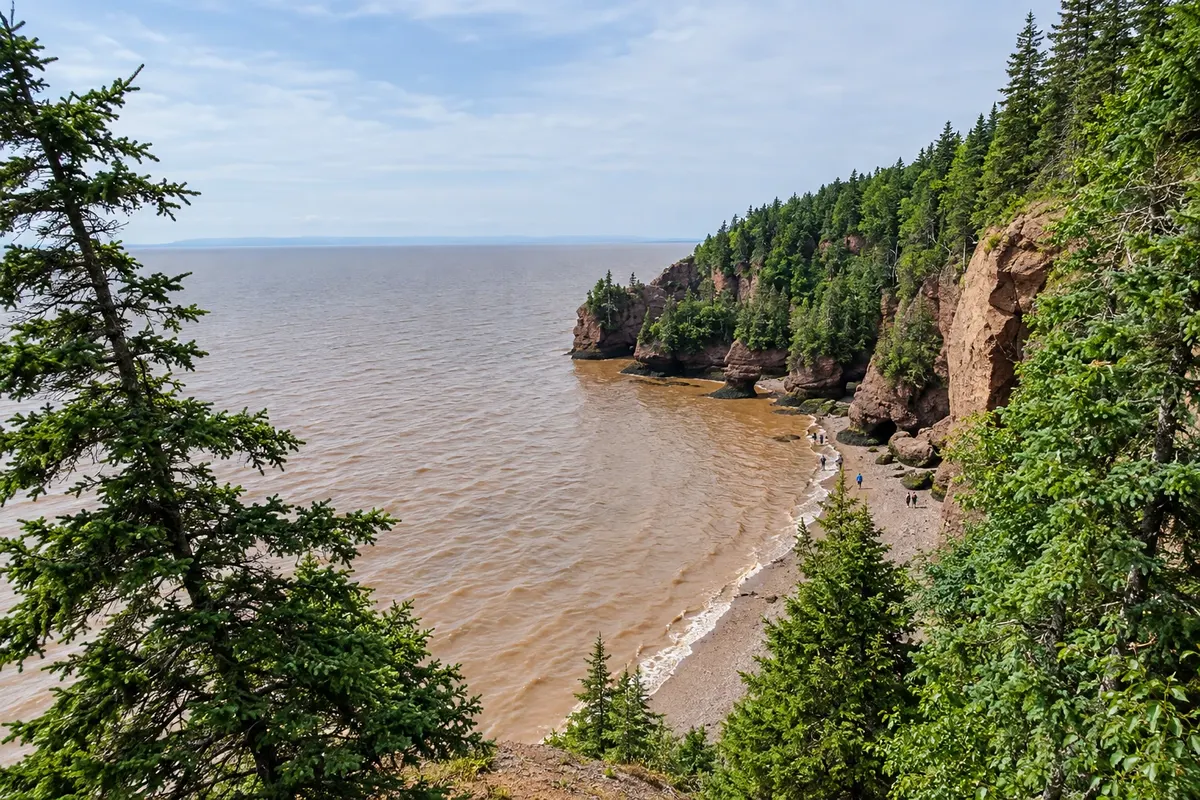
In the photo: Hopewell Rocks and the Bay of Fundy, New Brunswick
Illustrative images. The pictures in this guide are illustrations based on the real place, not photographs, and may differ from it.

The province
Get to know New Brunswick
New Brunswick lies on the Atlantic coast, between Quebec, Nova Scotia and the U.S. state of Maine. It is the country’s only officially bilingual province: about one third of the population speaks French, mainly in the north and east, in the Acadia region. Fredericton is the capital; Moncton and Saint John are the largest cities.
The Bay of Fundy, between New Brunswick and Nova Scotia, has the highest tides in the world: in some spots the difference between high and low tide exceeds 15 meters. At the Hopewell Rocks, near Moncton, sea-sculpted rock formations can be seen from below by walking on the dry seabed, and hours later by kayak.
Fundy National Park, near the village of Alma, has forest trails, waterfalls and tidal beaches. On the southern shore, St. Andrews by-the-Sea is a seaside village with historic houses, from where whale-watching boats depart in season. In Saint John, at the mouth of the river of the same name, the tide creates the Reversing Falls, rapids that change direction.
Acadian culture, from the descendants of 17th-century French settlers, marks the north and the east coast. On August 15, National Acadian Day is celebrated with the tintamarre, a noisy street parade, as in Caraquet. Fredericton, the capital, has a historic riverside neighbourhood on the Saint John River.
When to go
From mid-May to mid-October, the Hopewell Rocks and the tidal beaches of Fundy National Park receive visitors; access to the seabed depends on the low-tide schedule, which changes daily. Whale watching typically runs from June to October. Autumn foliage colors the interior in late September and early October. Winters are cold, with snow.
Getting there
Moncton (YQM), Fredericton (YFC) and Saint John (YSJ) have airports with domestic flights, mainly from Toronto and Montreal. The Trans-Canada Highway connects the province to Quebec and Nova Scotia, and the 12.9 km Confederation Bridge leads to Prince Edward Island. The train between Montreal and Halifax stops in Moncton and other towns in the province, and ferries connect Saint John to Digby, Nova Scotia.
Your questions
Frequently asked questions about New Brunswick
How can you see the tides at the Hopewell Rocks?
Ideally visit twice in the same day: at low tide, to descend the stairs and walk on the seabed among the rocks, and at high tide, to see them surrounded by water or go kayaking. The park publishes the tide table with the day’s times; check it before you go.
How many days should you allow for the Bay of Fundy?
Two or three days let you see the Hopewell Rocks at both tides, hike the trails of Fundy National Park from Alma and follow the coast to St. Andrews by-the-Sea. With more time you can take a ferry across to Nova Scotia.
Is French spoken in New Brunswick?
Yes. New Brunswick is officially bilingual, and provincial services are offered in both English and French. French predominates in Acadian communities in the north and on the east coast, such as Caraquet and Shediac, while English is more common in the south.
Can you combine New Brunswick with Nova Scotia and Prince Edward Island?
Yes, it’s a common road trip. From Moncton, the Confederation Bridge leads to Prince Edward Island, and the Trans-Canada Highway continues to Halifax. A tour of the three provinces typically takes ten to fourteen days.