

 Brazil
 Argentina
 Bolivia
 Chile
 Colombia
 Ecuador
 Guyana
 French Guiana
 Falkland Islands (Malvinas)
 Paraguay
 Peru
 Suriname
 Uruguay
 Venezuela
 Germany
 Austria
 Belgium
 Croatia
 Denmark
 Spain
 Finland
 France
 Greece
 the Netherlands
 Hungary
 Ireland
 Iceland
 Italy
 Luxembourg
 Norway
 Poland
 Portugal
 the United Kingdom
 the Czech Republic
 Sweden
 Switzerland
 Turkey
 the United States
 Mexico
 the Dominican Republic
 South Africa
 Australia
 Fiji
 New Zealand
 Papua New Guinea
Province · Alberta and the Prairies
Manitoba
Winnipeg, at the confluence of the Red and Assiniboine rivers, and Churchill, on Hudson Bay, with polar bears in autumn and belugas in summer.
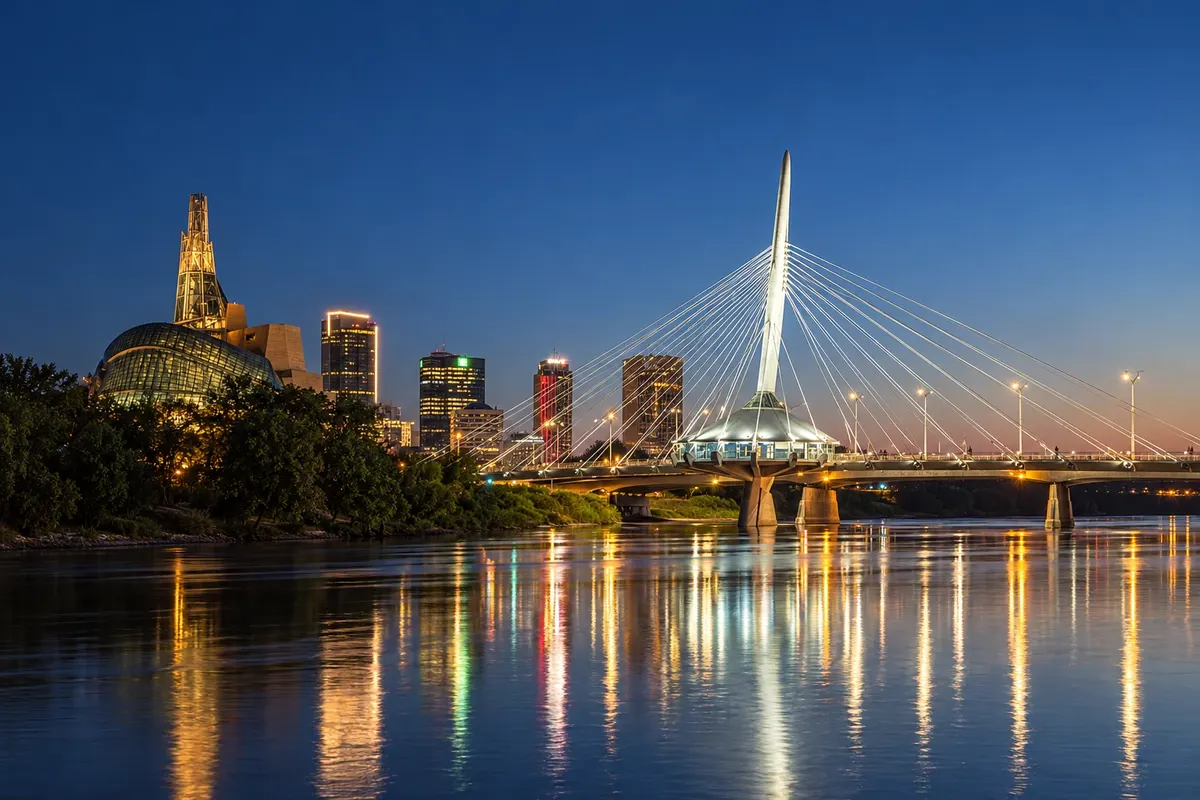
In the photo: Esplanade Riel, Winnipeg, Manitoba
Illustrative images. The pictures in this guide are illustrations based on the real place, not photographs, and may differ from it.

The province
Get to know Manitoba
Manitoba is in central Canada, between Saskatchewan and Ontario, stretching from the southern prairies to the Hudson Bay coast in the north. It has thousands of lakes, including Lake Winnipeg, one of the country’s largest. Winnipeg, the capital, holds more than half the province’s population.
Winnipeg began at The Forks, where the Red and Assiniboine rivers meet, a meeting place for Indigenous peoples and later for fur traders. There you’ll find a market, riverside walkways and the Canadian Museum for Human Rights. The city also has the Exchange District, with early 20th-century buildings, and Assiniboine Park, with the zoo and an area dedicated to northern animals.
The history of the Métis, a people of Indigenous and European descent, is tied to the region. In February, the Festival du Voyageur celebrates the Francophone and Métis heritage in Saint-Boniface, Winnipeg’s French-speaking neighbourhood, with snow sculptures, music and food.
Churchill, on Hudson Bay, has no road connection: it’s reached by plane or by train. In autumn, usually in October and November, polar bears wait for the sea to freeze before resuming hunting, and tundra vehicles offer opportunities to observe them. Between July and August, thousands of belugas often enter the Churchill River estuary.
In the south, Riding Mountain National Park combines forests, lakes and a herd of bison, and the beaches on Lake Winnipeg, such as Grand Beach, attract swimmers in summer.
When to go
Summer, from June to August, is warm with long days: it’s the season for lake beaches and for belugas in Churchill. October and November are the months for polar bears. Winter is very cold, with frequent temperatures below −20 °C in Winnipeg; in Churchill, the aurora borealis often appears from January to March and on the dark nights at the end of summer.
Getting there
James Armstrong Richardson International Airport (YWG), in Winnipeg, has flights to other provinces and to the United States. The Trans-Canada Highway crosses the southern part of the province. There is no road to Churchill: it’s reached by plane from Winnipeg or by the train that departs Winnipeg and takes about two days. tours to see bears and belugas are often sold as packages including flights and accommodation.
Your questions
Frequently asked questions about Manitoba
When to see polar bears in Churchill?
The season usually runs from October to mid-November, when polar bears concentrate along the coast awaiting the Hudson Bay ice. Tours are done in tall tundra vehicles with guides. Spaces are limited and often sell out far in advance.
How to get to Churchill?
There is no road to Churchill. From Winnipeg there are regular flights and a passenger train that takes about two days and crosses forests and tundra. Many visitors buy packages with flights, accommodation and tours included, especially during the polar bear season.
When to see belugas in Churchill?
Generally from July to August, when thousands of belugas enter the Churchill River estuary to feed and calve. There are boat, kayak and stand-up paddleboard tours to observe them up close.
What to see in Winnipeg?
The Forks, with its market and riverside walkways; the Canadian Museum for Human Rights; the Exchange District, with early 20th-century buildings; Saint-Boniface, the Francophone neighbourhood; and Assiniboine Park. Two days are usually enough for the city.