

 Brazil
 Argentina
 Bolivia
 Chile
 Colombia
 Ecuador
 Guyana
 French Guiana
 Falkland Islands (Malvinas)
 Paraguay
 Peru
 Suriname
 Uruguay
 Venezuela
 Germany
 Austria
 Belgium
 Croatia
 Denmark
 Slovakia
 Slovenia
 Spain
 Finland
 France
 Greece
 the Netherlands
 Hungary
 Ireland
 Iceland
 Italy
 Luxembourg
 Norway
 Poland
 Portugal
 the United Kingdom
 the Czech Republic
 Sweden
 Switzerland
 Turkey
 the United States
 Mexico
 the Dominican Republic
 South Africa
 Australia
 Fiji
 New Zealand
 Papua New Guinea
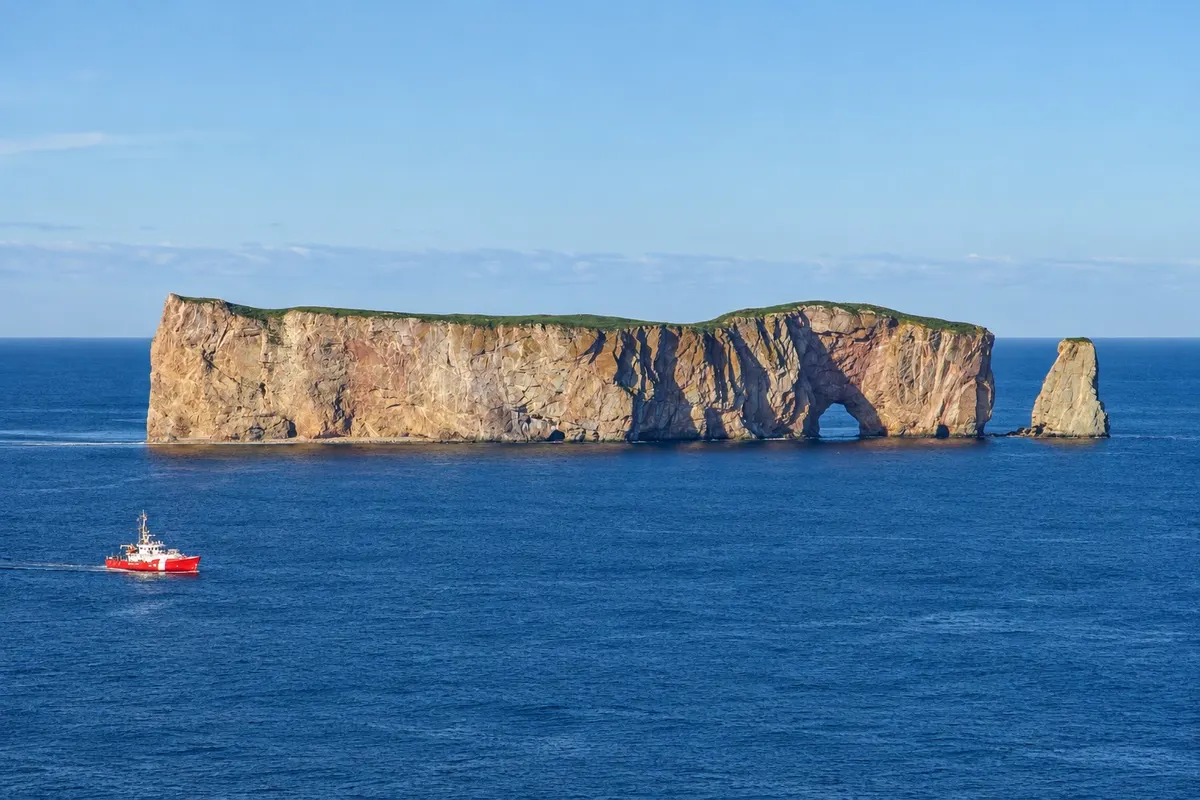
Rock formation · Percé, Quebec
Perce Rock
Limestone rock about 88 meters high and more than 400 meters long in front of Percé, with an arch opened by the sea.
Illustrative images. The pictures in this guide are illustrations based on the real place, not photographs, and may differ from it.


Discover
About Perce Rock
The Rocher Percé is a limestone rock in front of the village of Percé, connected to the shore by a sandbar that appears at low tide. It stands about 88 meters high and more than 400 meters long, and the sea has carved an arch at the tip through which water passes — the origin of the place’s name: percé means pierced in French.
The tilted rock layers preserve fossils hundreds of millions of years old. On the summit, in areas without public access, gulls and great black-backed gulls nest. The rock sheds stones year-round, and a second arch collapsed in the 19th century, leaving a separate pillar.
The rock is part of the Parc national de l’Île-Bonaventure-et-du-Rocher-Percé, managed by Sépaq. It can be seen from the village, from the Cap Mont-Joli viewpoints and from the top of mont Sainte-Anne, or up close from boats that circle the rock en route to the island.
Before you go
Practical information
Cidade Turismo reviews its information regularly, but something may have changed. Check with the place before planning your trip.
How much time to set aside
About one hour along the waterfront; plus the boat time.
Best time
At sunrise, when the light hits the east face of the rock, and at low tide to see the sandbar.
How to get there
In front of downtown Percé, visible from the waterfront and Cap Mont-Joli, a few minutes’ walk from the village.
Tip
Do not walk near the faces of the rock or Cap Mont-Joli: stones fall year-round.
Official website
Get your questions answered
Frequently asked questions about Perce Rock
How tall is the Rocher Percé?
About 88 meters.
Why is it called Rocher Percé?
Percé means pierced in French: the sea opened an arch at the tip of the rock.
Is it safe to walk to the Rocher Percé?
The park advises against walking next to the cliffs, because rocks fall year-round. The waterfront and boats offer the recommended viewpoint.