

 Brazil
 Argentina
 Bolivia
 Chile
 Colombia
 Guyana
 French Guiana
 Falkland Islands (Malvinas)
 Paraguay
 Peru
 Suriname
 Uruguay
 Venezuela
 Germany
 Austria
 Belgium
 Croatia
 Denmark
 Slovakia
 Slovenia
 Spain
 Finland
 France
 Greece
 the Netherlands
 Hungary
 Ireland
 Iceland
 Italy
 Luxembourg
 Norway
 Poland
 Portugal
 the United Kingdom
 the Czech Republic
 Sweden
 Switzerland
 Turkey
 Canada
 the United States
 Mexico
 the Dominican Republic
 South Africa
 Australia
 Fiji
 New Zealand
 Papua New Guinea
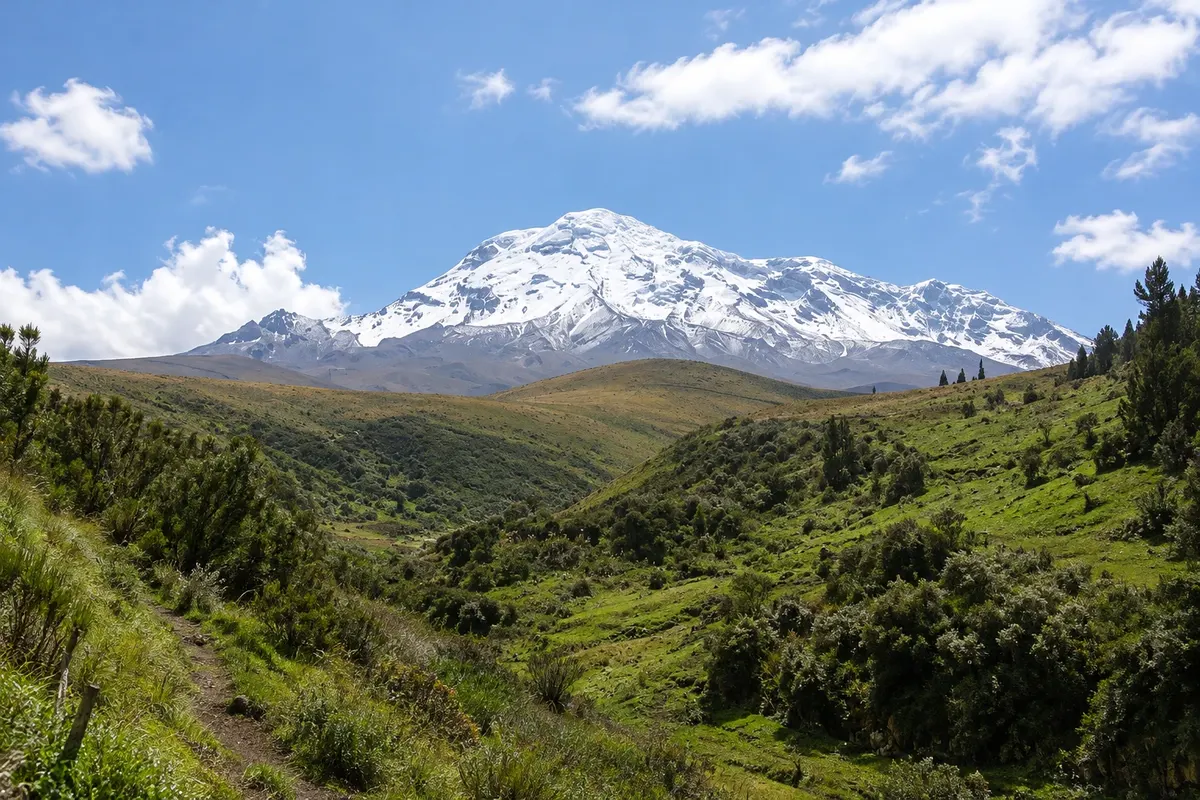
Volcano · Riobamba, Chimborazo
Chimborazo Volcano
The highest peak in Ecuador, over 6,200 meters, and the point on Earth’s surface farthest from the planet’s center. Vicuñas live in the páramo around it, and a dirt road leads to mountain refuges.
Illustrative images. The pictures in this guide are illustrations based on the real place, not photographs, and may differ from it.



Discover
About Chimborazo Volcano
Chimborazo is an ice-covered volcano in the high western Andes, northwest of Riobamba. At about 6,260 meters (published measurements vary between 6,263 and 6,268 meters), it is Ecuador’s tallest mountain. Because the Earth bulges more at the equator than at the poles, the summit lies about 6,384 km from the planet’s center — roughly 2 km farther than Everest’s summit — making it the point on the Earth’s surface farthest from the center. In the region it is called Taita Chimborazo, father Chimborazo.
The volcano lies inside the Chimborazo Faunal Production Reserve, about 58,560 hectares of páramo spanning the provinces of Chimborazo, Bolívar and Tungurahua. The reserve was created to reintroduce vicuñas, brought back starting in 1988 with support from Bolivia, Peru and Chile. They are often seen in groups in the grasslands near the road, alongside llamas and alpacas from local communities.
From the gate, an unpaved road climbs to the Hermanos Carrel refuge, at about 4,850 meters, with parking, viewpoints, a restaurant and craft stalls. From there a trail of about 1.5 km leads to the Whymper refuge, at roughly 5,000 meters, a slow walk because of the thin air. A short trail departs to Laguna Condorcocha. Above the refuges the high mountain begins, and climbing to the summit requires authorization from the reserve administration.
The Englishman Edward Whymper reached the summit on January 4, 1880, and the higher refuge bears his name. In Riobamba the volcano appears on the horizon on clear mornings, and the poem “Mi delirio sobre el Chimborazo,” attributed to Simón Bolívar, helped make it a national symbol, present on the national coat of arms.
Before you go
Practical information
Cidade Turismo reviews its information regularly, but something may have changed. Check with the place before planning your trip.
How much time to set aside
Half a day to reach the Hermanos Carrel refuge and return; a full day with the hike to the Whymper refuge and Laguna Condorcocha.
Best time
From morning to early afternoon, before fog usually covers the summit. From June to September it tends to rain less. Bring warm and waterproof clothing in any month: at the refuges temperatures are often near zero.
How to get there
Leave Riobamba on the road to Guaranda until the entrance to the reserve, about 45 km away. At the gate, visitors register entry with an ID. From the gate to the first refuge, the route is on a dirt road. Tours and taxis depart from Riobamba; buses to Guaranda stop at the entrance, but the hike up to the refuge is long and steep.
Tip
Spend at least one night in Riobamba before the visit and walk slowly above 4,800 meters, stopping whenever you need to. There is no admission fee to the reserve; registration is done at the gate. Confirm before you go whether the road and the refuges are open.
Get your questions answered
Frequently asked questions about Chimborazo Volcano
How high is Chimborazo?
Relative to sea level, between 6,263 and 6,268 meters, depending on the measurement. Measured from the center of the planet, the summit reaches about 6,384 km, more than any other mountain.
Can you reach Chimborazo by car?
Yes. A dirt road leaves from the park entrance and ends at the Hermanos Carrel refuge parking area; the Whymper, about 150 meters higher, is only reached on foot.
Where can you see vicuñas on Chimborazo?
In the páramo fields of the reserve, especially along the road between the entrance and the Hermanos Carrel refuge. They usually travel in groups and move away when people approach.
Do you need a guide to visit Chimborazo?
Not to reach the refuges and short trails; visits are registered at the park entrance. To climb above the refuges, into the high mountain, you need authorization from the reserve administration, and ascents are usually done with a mountain guide.