

 Brazil
 Argentina
 Bolivia
 Chile
 Colombia
 Ecuador
 Guyana
 French Guiana
 Falkland Islands (Malvinas)
 Paraguay
 Peru
 Suriname
 Uruguay
 Venezuela
 Germany
 Austria
 Belgium
 Croatia
 Denmark
 Spain
 Finland
 Greece
 the Netherlands
 Hungary
 Ireland
 Iceland
 Italy
 Luxembourg
 Norway
 Poland
 Portugal
 the United Kingdom
 the Czech Republic
 Sweden
 Switzerland
 Turkey
 the United States
 Mexico
 the Dominican Republic
 South Africa
 Australia
 Fiji
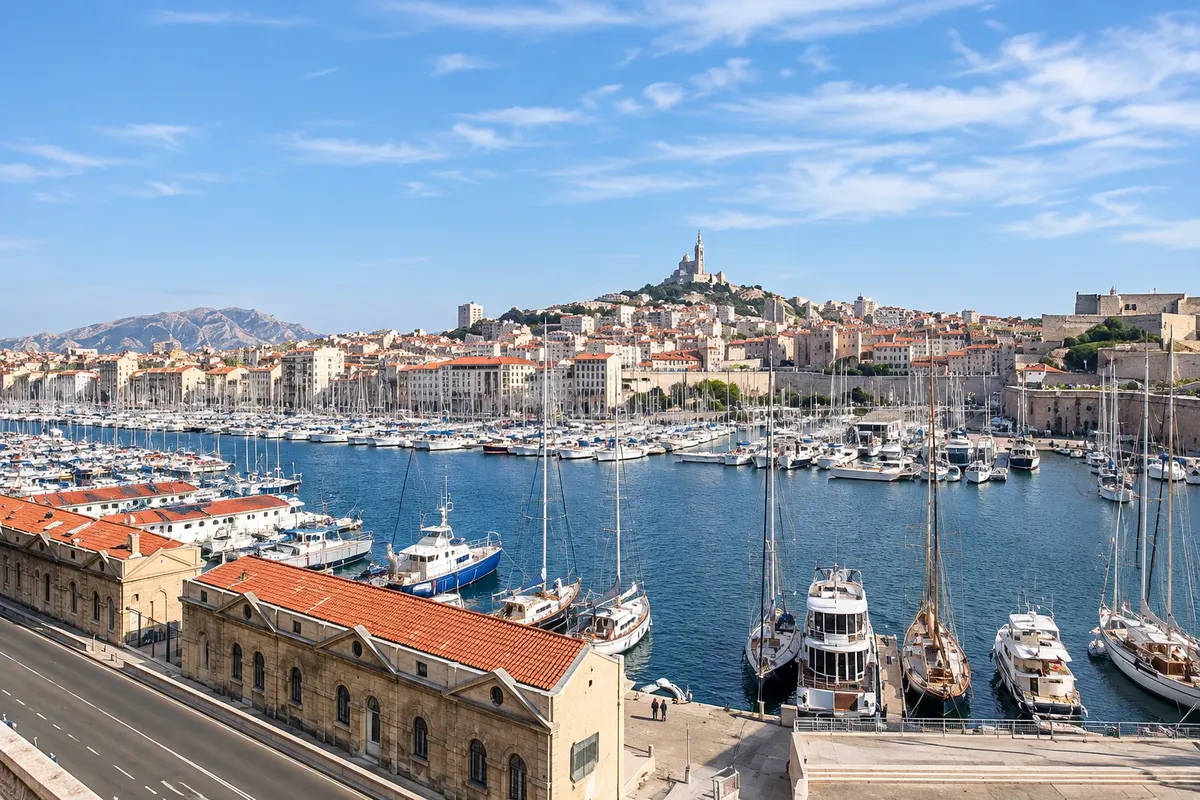
Harbor · Marselha, Provence-Alpes-Côte d'Azur
Vieux-Port
The old port where the Greeks founded the city around 600 BC. Today it is Marselha's central square, with fishing boats, a morning fish market, Norman Foster's mirrored Ombrière and the departure point for boats to Château d'If and Frioul.
Illustrative images. The pictures in this guide are illustrations based on the real place, not photographs, and may differ from it.

Discover
About Vieux-Port
The Vieux-Port (Porto Velho) is where Marselha began. Around 600 B.C., Greeks from Phocaea, in present-day Turkey, entered this natural bay, which they called Lacydon, and founded Massalia. For more than two thousand years the port was the commercial heart of the city; today large ships dock farther north, and the Vieux-Port is used by fishing boats, sailing boats and pleasure craft.
The entrance to the port is guarded by two forts: Fort Saint-Jean, to the north, now linked to the MuCEM, and Fort Saint-Nicolas, to the south. On the Quai du Port stands the Hôtel de Ville, the 17th-century town hall, one of the few buildings on the north bank that survived the demolition of the neighborhood carried out by German troops in 1943.
On the Quai de la Fraternité, facing the water, is the Ombrière, a polished stainless-steel canopy 48 m by 22 m, supported on slender pillars, which reflects those who walk beneath it. It was designed by Norman Foster's firm when Marselha was European Capital of Culture in 2013, as part of the renovation that turned much of the quays into pedestrian areas.
In the morning, fishermen sell the day's catch at stalls on the quay itself. A small ferry-boat, operating since the late 19th century, crosses the port between the town hall and the Place aux Huiles. Boats to the Château d'If and the Îles du Frioul depart from the Quai de la Fraternité.
Before you go
Practical information
Cidade Turismo reviews its information regularly, but something may have changed. Check with the place before planning your trip.
How much time to set aside
One to two hours to walk along the quays, go under the Ombrière and cross on the ferry-boat. It is also the natural starting point for the Panier, the MuCEM and the boats.
Best time
Early in the morning, to see the fish being sold on the quay. In the late afternoon, when the light hits the façades and the basilica atop the hill is lit up. In summer (June to August) it is busy all day.
How to get there
Vieux-Port station on metro line 1, which exits at the tip of the port near the Ombrière. From Gare Saint-Charles it's about a 20-minute walk downhill along Boulevard d'Athènes and the Canebière, or two metro stops.
Tip
Walk along both sides of the port: the Quai du Port, to the north, leads to the Panier and the MuCEM; the Quai de Rive Neuve, to the south, leads to the Abbaye Saint-Victor and the climb up to the Notre-Dame de la Garde. Keep an eye on your belongings in crowded places.
Get your questions answered
Frequently asked questions about Vieux-Port
What is the Ombrière of the Vieux-Port?
It is a polished stainless-steel canopy, 48 m by 22 m, on the Quai de la Fraternité. It works like a giant mirror: people passing underneath see their reflection. It was designed by Norman Foster's firm and inaugurated in 2013.
Can you cross the harbour by boat?
Yes. A small ferry makes the short crossing between the town hall (Quai du Port) and the Place aux Huiles (Quai de Rive Neuve). Check schedules before you go.
Where do the boats to the Château d'If and the Frioul depart from?
From the Quai de la Fraternité, at the far end of the Vieux-Port, near the Ombrière. Confirm schedules and operation before going, as sea and wind can suspend departures.
Does the Vieux-Port have a fish market?
Yes, in the morning fishermen sell the catch of the day at stalls on the Quai de la Fraternité. It's small and finishes early.