

 Brazil
 Argentina
 Bolivia
 Chile
 Colombia
 Ecuador
 Guyana
 French Guiana
 Falkland Islands (Malvinas)
 Paraguay
 Peru
 Suriname
 Uruguay
 Venezuela
 Germany
 Austria
 Belgium
 Croatia
 Denmark
 Spain
 Finland
 France
 Greece
 the Netherlands
 Hungary
 Ireland
 Iceland
 Italy
 Luxembourg
 Norway
 Poland
 Portugal
 the United Kingdom
 the Czech Republic
 Sweden
 Switzerland
 Turkey
 the Dominican Republic
 South Africa
 Fiji
State · Bajío e cidades coloniais
San Luis Potosí
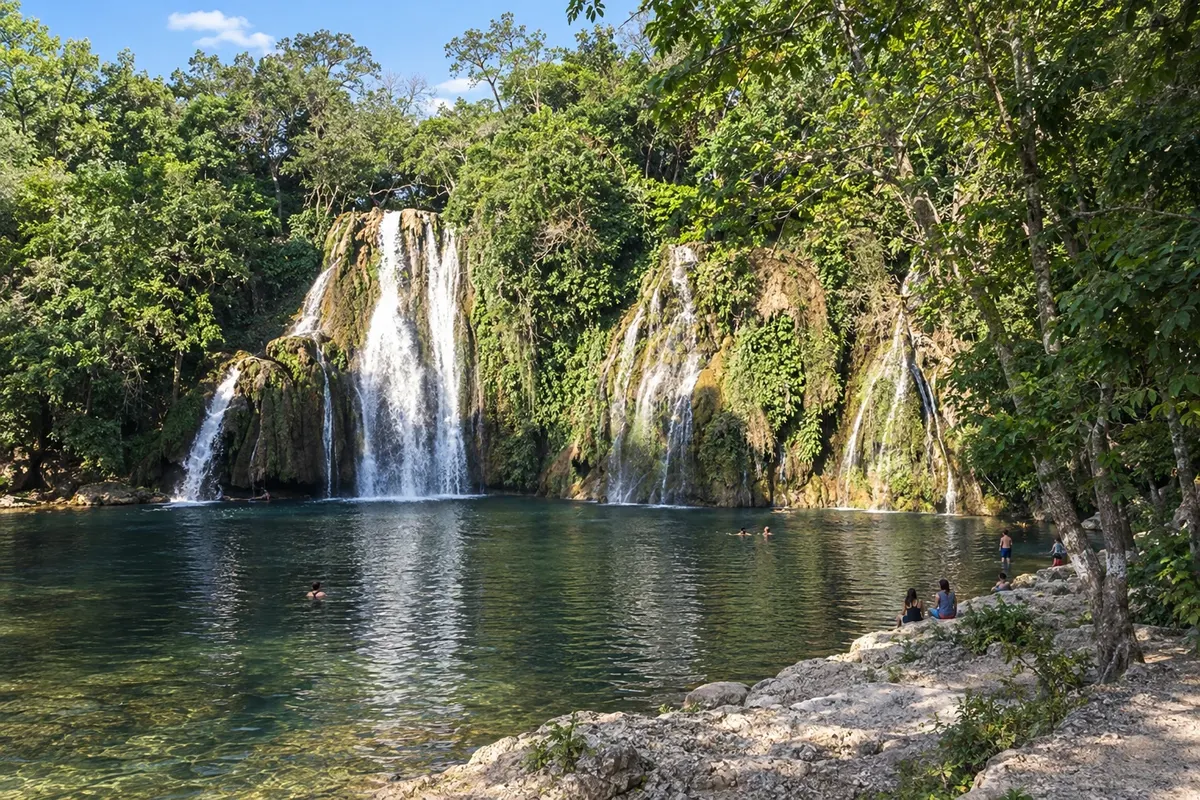
San Luis Potosí: the Huasteca Potosina, with turquoise-water rivers, the Tamul waterfall and the surrealist garden of Xilitla, and the colonial capital on the plateau.
In the photo: Cascadas de Tamasopo
Illustrative images. The pictures in this guide are illustrations based on the real place, not photographs, and may differ from it.

The state
Get to know San Luis Potosí
San Luis Potosí crosses Mexico from the dry plateau to the green mountains that descend toward the Gulf. The state has two faces: the colonial capital and the desert in the west, and the Huasteca Potosina in the east, a region of jungle, rivers and turquoise waterfalls that has become one of the country's most sought-after nature destinations.
In the Huasteca, the base is Ciudad Valles. Nearby are the Tamul waterfall, which drops about 100 meters into the Santa María River and is reached by canoe; the Micos and Minas Viejas cascades; and the Tampaón River. In Aquismón, the Sótano de las Golondrinas is a vertical sinkhole in the forest, from which flocks of birds usually emerge at dawn and return in the late afternoon.
Xilitla, in the mountains, preserves Las Pozas, the surrealist garden created by the English artist Edward James between the 1940s and 1980s, with staircases that lead nowhere, columns and natural pools amid the jungle.
The capital, San Luis Potosí, has a historic center of plazas and baroque churches, connected to the Camino Real de Tierra Adentro, a World Heritage Site. In the desert, Real de Catorce is a former mining town accessed through a tunnel. On the table, enchiladas potosinas made with red dough, and zacahuil, a large Huasteca tamal.
When to go
From November to April little rain falls, and the water in the Huasteca rivers usually becomes clearer and more turquoise. From June to October there is more rain, and after heavy storms the rivers can become muddy and some tours are suspended. On the plateau, nights are cold from December to February. San Luis Potosí is 3 hours behind Brasília.
Getting there
San Luis Potosí airport (SLP) serves the capital. For the Huasteca, the nearest airports are Tampico (TAM) and the capital's airport, about 4 hours from Ciudad Valles. From Mexico City, Ciudad Valles is about 7 hours by bus. In the Huasteca, a car or tours from Ciudad Valles are the most practical way to reach the waterfalls.
Your questions
Frequently asked questions about San Luis Potosí
How many days should I set aside for the Huasteca Potosina?
Three to four days allow time for the Tamul waterfall, one or two cascades, the Sótano de las Golondrinas and Xilitla.
When is the Huasteca water most blue?
It is usually clearer and more turquoise in the dry season, from November to April. After heavy rains, the rivers become muddy.
How do you get to the Tamul waterfall?
By rowing canoe along the Santa María River from Tanchachín, in a several-hour trip, or by trail to the top of the fall.
What is Las Pozas?
A garden created by the English artist Edward James in Xilitla, with sculptures and concrete constructions in the middle of the jungle and natural pools.