

 Brazil
 Argentina
 Bolivia
 Chile
 Colombia
 Ecuador
 Guyana
 French Guiana
 Falkland Islands (Malvinas)
 Paraguay
 Peru
 Suriname
 Uruguay
 Venezuela
 Germany
 Austria
 Croatia
 Denmark
 Spain
 Finland
 France
 Greece
 the Netherlands
 Hungary
 Ireland
 Iceland
 Italy
 Luxembourg
 Norway
 Poland
 Portugal
 the United Kingdom
 the Czech Republic
 Sweden
 Switzerland
 Turkey
 the United States
 Mexico
 the Dominican Republic
 South Africa
 Australia
 Fiji
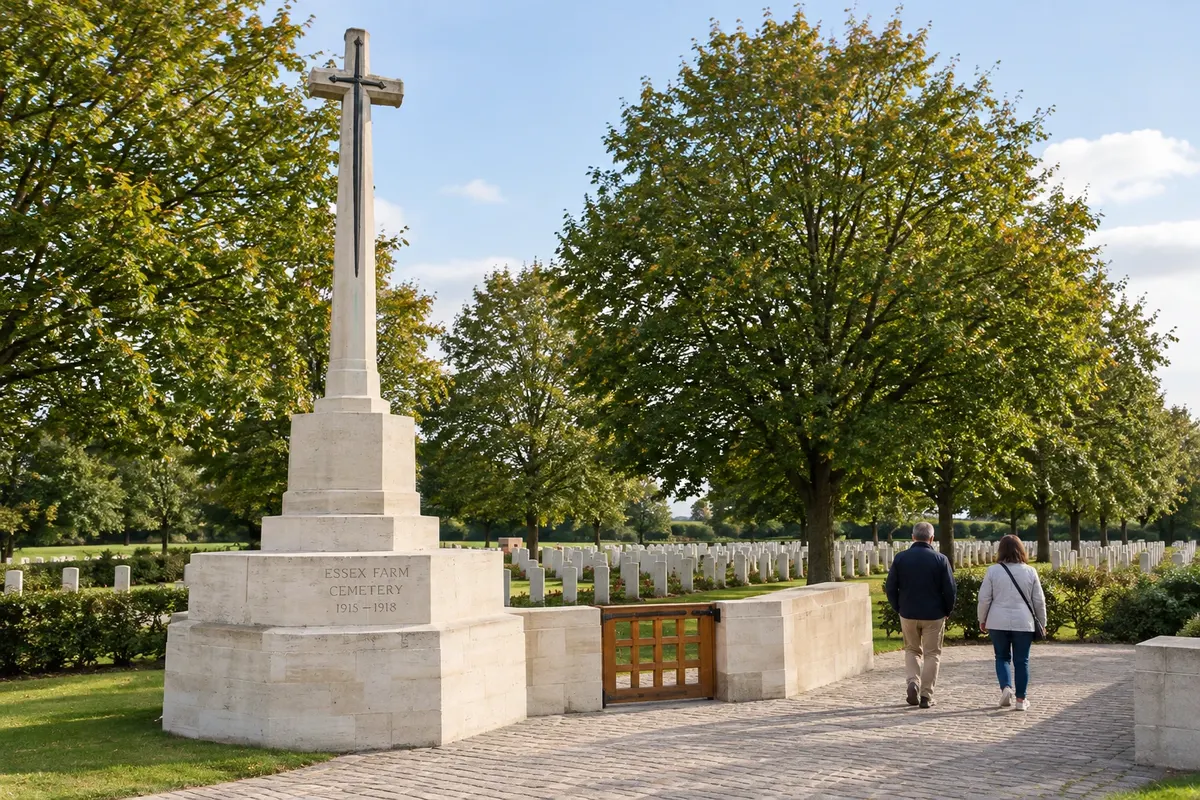
Cemetery · Ypres, West Flanders
Essex Farm Cemetery
British military cemetery beside a former dressing station, near the canal north of Ypres. It was there that physician John McCrae wrote the poem In Flanders Fields in May 1915.
Illustrative images. The pictures in this guide are illustrations based on the real place, not photographs, and may differ from it.

Discover
About Essex Farm Cemetery
Essex Farm Cemetery is about two and a half kilometres north of Ypres town centre, between the road to Boezinge and the Ieperlee canal. During the war it served as an advanced dressing station receiving casualties from the nearby lines from April 1915 to August 1917.
In May 1915, during the Second Battle of Ypres, Lieutenant-Colonel John McCrae, a Canadian army doctor, wrote the poem In Flanders Fields there after burying his friend Alexis Helmer. The poem, which speaks of poppies among the crosses, turned the flower into the symbol of remembrance for the war dead.
The cemetery contains about 1,200 graves. One of them is that of Valentine Strudwick, who enlisted by lying about her age and died in January 1916, aged 15. Beside the graves are the concrete shelters of the dressing station, some used for operations, and a memorial to McCrae.
The site is small and quiet, on the bank of the canal embankment. It is a natural first stop for those leaving Ypres heading north towards Langemark.
Before you go
Practical information
Cidade Turismo reviews its information regularly, but something may have changed. Check with the place before planning your trip.
How much time to set aside
From half an hour to forty minutes, including the concrete shelters.
Best time
Early in the morning or late in the afternoon, when there are fewer tour buses. In May and June poppies often bloom in the region’s fields.
How to get there
Leave Ypres via the N369 road towards Boezinge. By car it is only a few minutes; by bike about ten to fifteen minutes along the canal bank. There is a small car park beside the site.
Tip
Read the poem In Flanders Fields before you go. It is engraved on a plaque beside the memorial, and the words take on another meaning when seen against the shelters where McCrae worked.
Get your questions answered
Frequently asked questions about Essex Farm Cemetery
Is John McCrae buried at Essex Farm?
No. McCrae died in 1918 in France and is buried in Wimereux. At Essex Farm there is the memorial associated with the poem.
Why did the poppy become a symbol of the war?
Because of the poem In Flanders Fields, which describes poppies growing among the crosses of the dead. After the war, the flower came to be used in tributes to soldiers.