

 Brazil
 Argentina
 Bolivia
 Chile
 Colombia
 Ecuador
 Guyana
 French Guiana
 Falkland Islands (Malvinas)
 Paraguay
 Peru
 Suriname
 Uruguay
 Venezuela
 Germany
 Austria
 Croatia
 Denmark
 Spain
 Finland
 France
 Greece
 the Netherlands
 Hungary
 Ireland
 Iceland
 Italy
 Luxembourg
 Norway
 Poland
 Portugal
 the United Kingdom
 the Czech Republic
 Sweden
 Switzerland
 Turkey
 the United States
 Mexico
 the Dominican Republic
 South Africa
 Australia
 Fiji
Memorial · Ypres, West Flanders
Canadian Memorial Sint-Juliaan
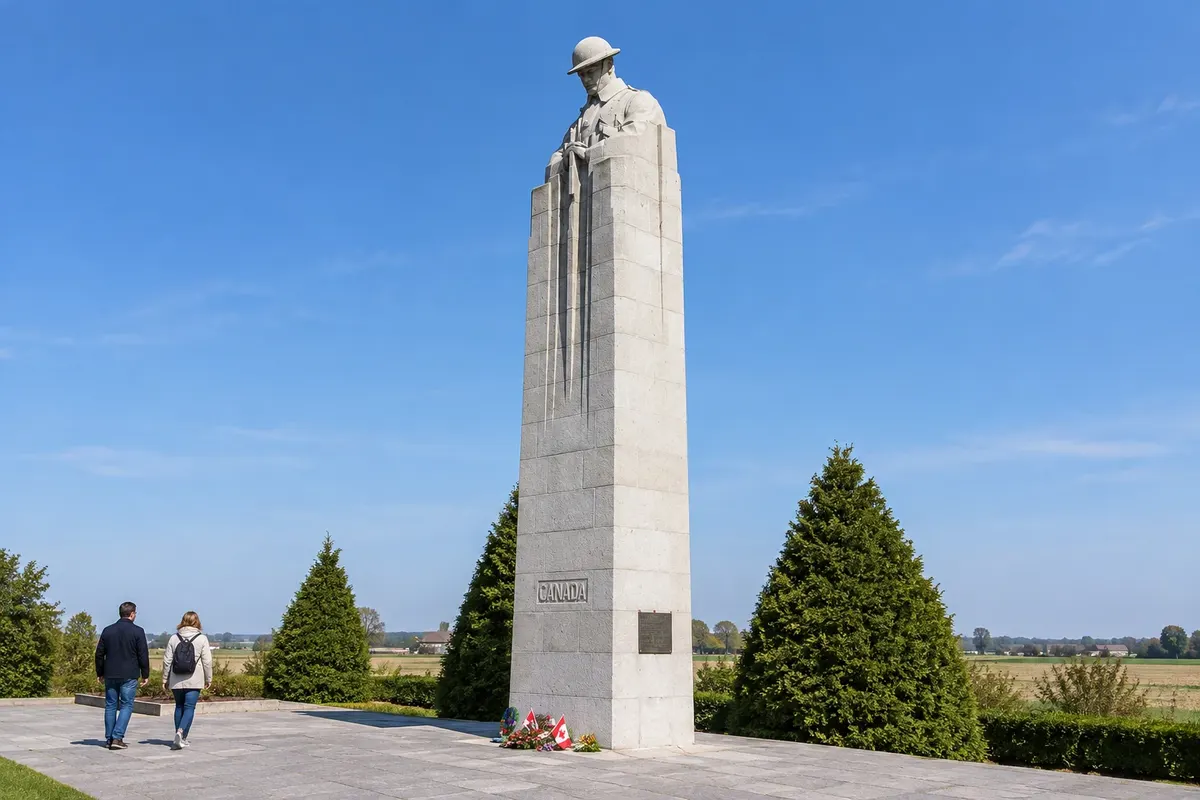
Canadian memorial nearly 11 meters high in Sint-Juliaan, northeast of Ypres, topped by the figure of a soldier with his head bowed, the Brooding Soldier. It commemorates the Canadians who faced the first gas attack in April 1915.
Illustrative images. The pictures in this guide are illustrations based on the real place, not photographs, and may differ from it.

Discover
About Canadian Memorial Sint-Juliaan
The memorial stands at the former Vancouver Corner, a junction on the north exit of the village of Sint-Juliaan, about 6 kilometers from Ypres, beside the road to Bruges. It marks the spot where the 1st Canadian Division held the line between April 22 and 24, 1915, during the Second Battle of Ypres, when the German army used chlorine gas for the first time on the Western Front.
The granite column, nearly 11 meters high, is topped by the bust of a Canadian soldier wearing a helmet, his head bowed and his hands resting on the rifle pointed down—an attitude of military mourning. The figure became known as The Brooding Soldier. The design is by Frederick Chapman Clemesha, an architect who served with the Canadian forces and was wounded in the war.
The inscription records that 18,000 Canadians withstood the first gas attack and that about 2,000 died there. The memorial was unveiled on July 8, 1923, in the presence of Marshal Foch, and is one of eight battlefield memorials ceded to Canada by Belgium and France.
The monument stands in a stone courtyard, surrounded by a garden with cedar trees clipped in a conical shape. It is visible from the road at a distance, and the silence of the place contrasts with the traffic beside it.
Before you go
Practical information
Cidade Turismo reviews its information regularly, but something may have changed. Check with the place before planning your trip.
How much time to set aside
15 to 30 minutes.
Best time
During the day, year-round. In clear weather the column appears from afar on the plain, and late-afternoon light enhances the granite.
How to get there
By car or bicycle, leaving Ypres to the northeast via the Sint-Juliaan and Poelkapelle road, about 10 minutes. Guided tours of the salient usually include the stop.
Tip
Combine it with the German cemetery at Langemark and with Tyne Cot, which are in the same area, on a half-day itinerary. Cross the road carefully, because traffic is fast.
Get your questions answered
Frequently asked questions about Canadian Memorial Sint-Juliaan
Why is the soldier’s head bowed?
The pose, with the head bowed and the hands on the rifle pointed down, is the mourning position used in military funerals. The sculptor intended to represent respect for the dead.
Are there graves at the memorial?
There are no burials in the courtyard. The inscription commemorates the roughly 2,000 Canadians who died in the battle, buried in regional cemeteries or with no known grave.