

 Brazil
 Argentina
 Bolivia
 Chile
 Colombia
 Ecuador
 Guyana
 French Guiana
 Falkland Islands (Malvinas)
 Paraguay
 Peru
 Suriname
 Uruguay
 Venezuela
 Germany
 Austria
 Croatia
 Denmark
 Spain
 Finland
 France
 Greece
 the Netherlands
 Hungary
 Ireland
 Iceland
 Italy
 Luxembourg
 Norway
 Poland
 Portugal
 the United Kingdom
 the Czech Republic
 Sweden
 Switzerland
 Turkey
 the United States
 Mexico
 the Dominican Republic
 South Africa
 Australia
 Fiji
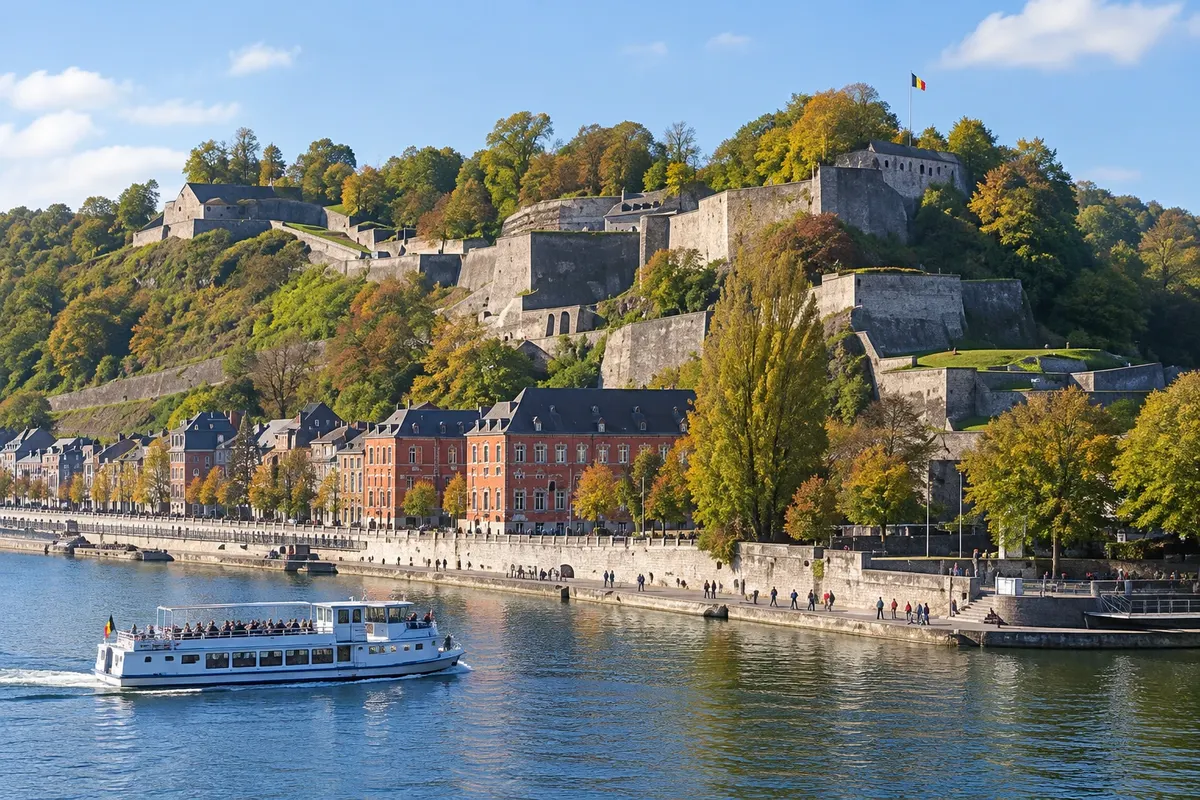
Fortress · Namur, Namur
Citadel of Namur
Fortress on the rocky spur between the Sambre and the Meuse, with about two thousand years of history. It houses the Terra Nova visitor centre, guided underground galleries, a tourist train and viewpoints over the city.
Illustrative images. The pictures in this guide are illustrations based on the real place, not photographs, and may differ from it.

Discover
About Citadel of Namur
The Citadelle de Namur occupies the rocky hill separating the Sambre from the Meuse, well above the point where the two meet. There is evidence of occupation since Roman times, and in the Middle Ages the hilltop was the residence of the counts of Namur. Its current form dates from the 17th and 18th centuries: the Dutch engineer Menno van Coehoorn designed much of the defences, and the Frenchman Vauban altered them after the 1692 siege.
The part known as Terra Nova was built between 1631 and 1675 under Dutch rule, to distinguish it from the older Médiane fort. In the former Terra Nova barracks is the visitor centre, with an audio guide that tells the military and urban history of Namur. The fortress ceased to be a military post at the end of the 19th century, and King Leopold II turned the hilltop into a leisure area.
The highlight of the visit is the Grands Souterrains. Napoleon is said to have called the network of tunnels the termite mound of Europe. The guided route is about 500 metres long, with roughly 350 steps, sound and light effects and projections showing how the galleries were excavated. Inside the temperature stays between 12 and 14 degrees all year round.
Besides the tunnels, there is a guided tour of the medieval citadel, with the old well and the Tour des Chartes, a little train offering a panoramic circuit and trails along the ramparts. The Esplanade at the top houses the Pavillon de arte digital and the cable car arrival. From the viewpoints near the Château des Comtes you can see the confluence, the Jambes bridge and the rooftops of the centre.
Before you go
Practical information
Cidade Turismo reviews its information regularly, but something may have changed. Check with the place before planning your trip.
How much time to set aside
Half a day for the visitor centre, the underground galleries and the little train. If you only want to walk the ramparts and see the viewpoints, you can do it in about an hour and a half.
Best time
From April to September the site is open daily and there are more guided tour times. In winter it usually closes on Mondays and has reduced hours; check before you go. Late afternoon light is best for photos of the confluence. Bring a jacket even in summer, as the underground galleries are cold.
How to get there
The simplest way is the Téléphérique de Namur, which departs from Place Maurice Servais in the center and reaches the Esplanade in about four minutes. On foot, ramps and stairways climb up from the Sambre riverbank in a steep ascent. There is also a city bus to the top of the hill and parking for those arriving by car.
Tip
The underground tunnels can only be visited with a guide and at fixed times: first stop at the Terra Nova reception to book the time and plan the rest of your visit around it. There are packages that combine tunnels, the little train and the visitor centre. Wear closed-toe shoes, as the gallery floors are uneven and there are many steps.
Official website
Get your questions answered
Frequently asked questions about Citadel of Namur
Can the underground galleries be visited without a guide?
No. The galleries of the Citadelle of Namur only open on guided tours, with set times throughout the day. The route is about 500 metres long and has many steps. Book a time at the Terra Nova reception or online.
In what language are the guided tours?
The region speaks French, and guided tours are usually in French and Dutch, with other languages at specific times. Ask at reception which session offers English and confirm before you go.
Can you go up to the citadel without paying for a tour?
Yes. The walls, paths and viewpoints on the hilltop are open to the public. Fees apply for guided tours, the little tourist train, the visitor centre and the cable car.