

 Brazil
 Argentina
 Bolivia
 Chile
 Colombia
 Ecuador
 Guyana
 French Guiana
 Falkland Islands (Malvinas)
 Paraguay
 Peru
 Suriname
 Uruguay
 Venezuela
 Germany
 Austria
 Croatia
 Denmark
 Spain
 Finland
 France
 Greece
 the Netherlands
 Hungary
 Ireland
 Iceland
 Italy
 Luxembourg
 Norway
 Poland
 Portugal
 the United Kingdom
 the Czech Republic
 Sweden
 Switzerland
 Turkey
 the United States
 Mexico
 the Dominican Republic
 South Africa
 Australia
 Fiji
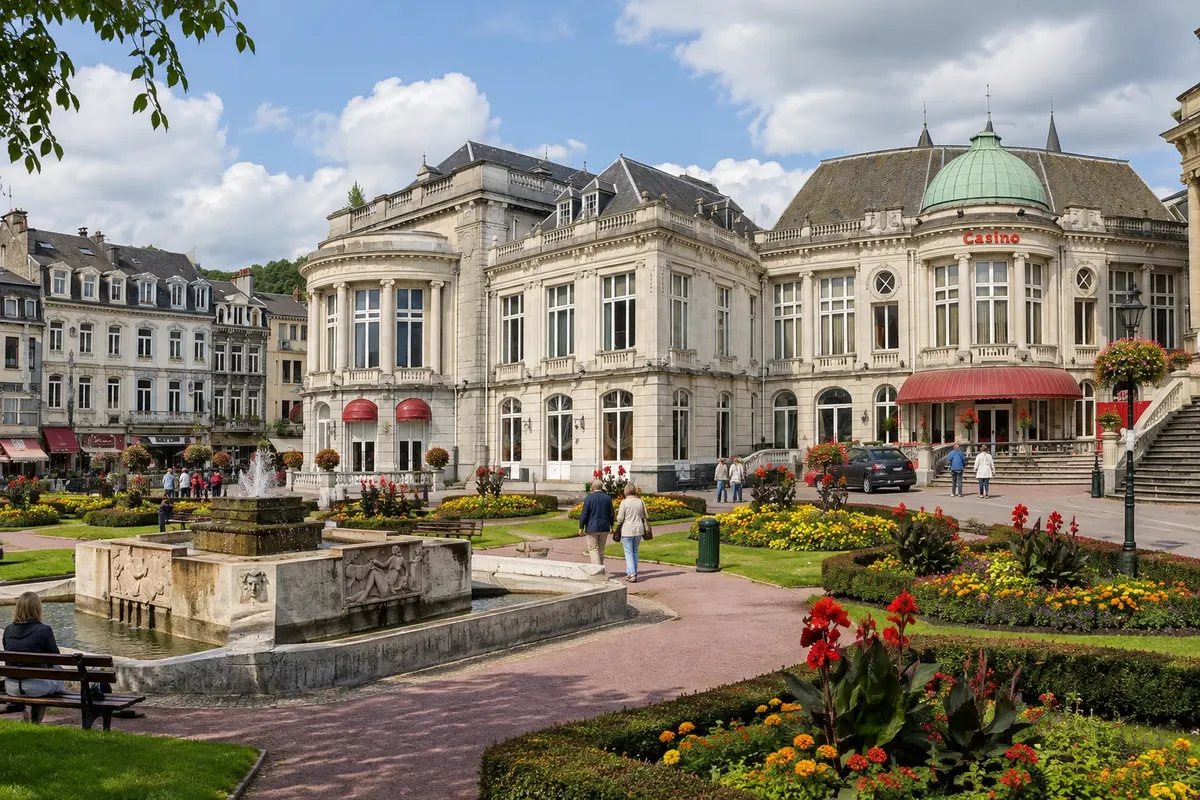
Monument · Spa, Liège
Casino de Spa
Historic building in the centre of Spa, successor to the Redoute opened in the 18th century for the aristocrats who came to take the waters. The façade and the halls date from the early 20th century, the work of architect Alban Chambon, and the complex is listed as a monument.
Illustrative images. The pictures in this guide are illustrations based on the real place, not photographs, and may differ from it.

Discover
About Casino de Spa
The Casino de Spa occupies a block on the Rue Royale, a few steps from the Place Royale and the Pouhon Pierre-le-Grand. Its history begins in the 1760s, when the prince-bishop of Liège authorised the construction of the Redoute, a building with a ballroom and gaming room for wealthy visitors spending the season in Spa. The architect was Barthélémy Digneffe of Liège, and the Redoute opened in 1771.
What is seen today results from 20th-century renovations and fires. After Belgium restricted gambling at the end of the 19th century, the town invested in a new centre for festivities and shows, the Kursaal, designed by Alban Chambon, the same architect as Ostend’s casino. A fire destroyed the festival hall in 1909, and it was rebuilt shortly afterwards using reinforced concrete.
In 1917, during the German occupation, another fire destroyed the theatre and the ballroom. Reconstruction, led by architects Hansen and Paes, lasted until 1929 and created the Rose and Bleu halls and the small 18th‑century–style theatre now named Jacques Huisman. The dome of the oval hall is one of the building’s most studied features.
The complex belongs to the city and was listed by Wallonia, protecting façades, roofs, halls, theatre and festival hall. In addition to the gaming rooms, it houses a cultural space with shows, concerts and exhibitions, and helped Spa join the Great Spas of Europe, a UNESCO World Heritage Site.
Before you go
Practical information
Cidade Turismo reviews its information regularly, but something may have changed. Check with the place before planning your trip.
How much time to set aside
About 15 minutes to see the façade and gardens. A performance in the theatre or festival hall will take up the evening.
Best time
By day, to photograph the façade in good light. At night, when there is programming in the theatre or festival hall; check the city’s cultural calendar before you go.
How to get there
It is on the Rue Royale in the centre of Spa, about a five-minute walk from Spa-Géronstère station and next to the Jardins du Casino and Galerie Léopold II.
Tip
The building’s interest lies in its architecture and in the history of the spa town. The gaming rooms have their own entry rules, with a minimum age of 21 and ID required; it is not necessary to enter them to appreciate the building, since the theatre and festival hall host cultural events. The Musée de la Ville d'eaux displays posters and objects from the old Redoute.
Get your questions answered
Frequently asked questions about Casino de Spa
Is the Casino de Spa the oldest in the world?
The town often presents it that way because the Redoute opened in the 18th century. The current building, however, is almost entirely from the early 20th century, rebuilt after fires. It's more accurate to say it is one of the oldest casinos in Europe still operating on the same site.
Can you see the building without gambling?
Yes. The façade and gardens face the street, and the theatre and ballroom host performances and exhibitions. The gaming rooms are separate and require a minimum age of 21 and ID.
Who frequented the Redoute in the 18th century?
Aristocrats and wealthy people from across Europe who went to Spa to take the waters. Balls and gambling tables were part of the spa season.