

 Brazil
 Argentina
 Bolivia
 Chile
 Colombia
 Ecuador
 Guyana
 French Guiana
 Falkland Islands (Malvinas)
 Paraguay
 Peru
 Suriname
 Uruguay
 Venezuela
 Germany
 Austria
 Croatia
 Denmark
 Spain
 Finland
 France
 Greece
 the Netherlands
 Hungary
 Ireland
 Iceland
 Italy
 Luxembourg
 Norway
 Poland
 Portugal
 the United Kingdom
 the Czech Republic
 Sweden
 Switzerland
 Turkey
 the United States
 Mexico
 the Dominican Republic
 South Africa
 Australia
 Fiji
Museum · Liège, Liège
Grand Curtius
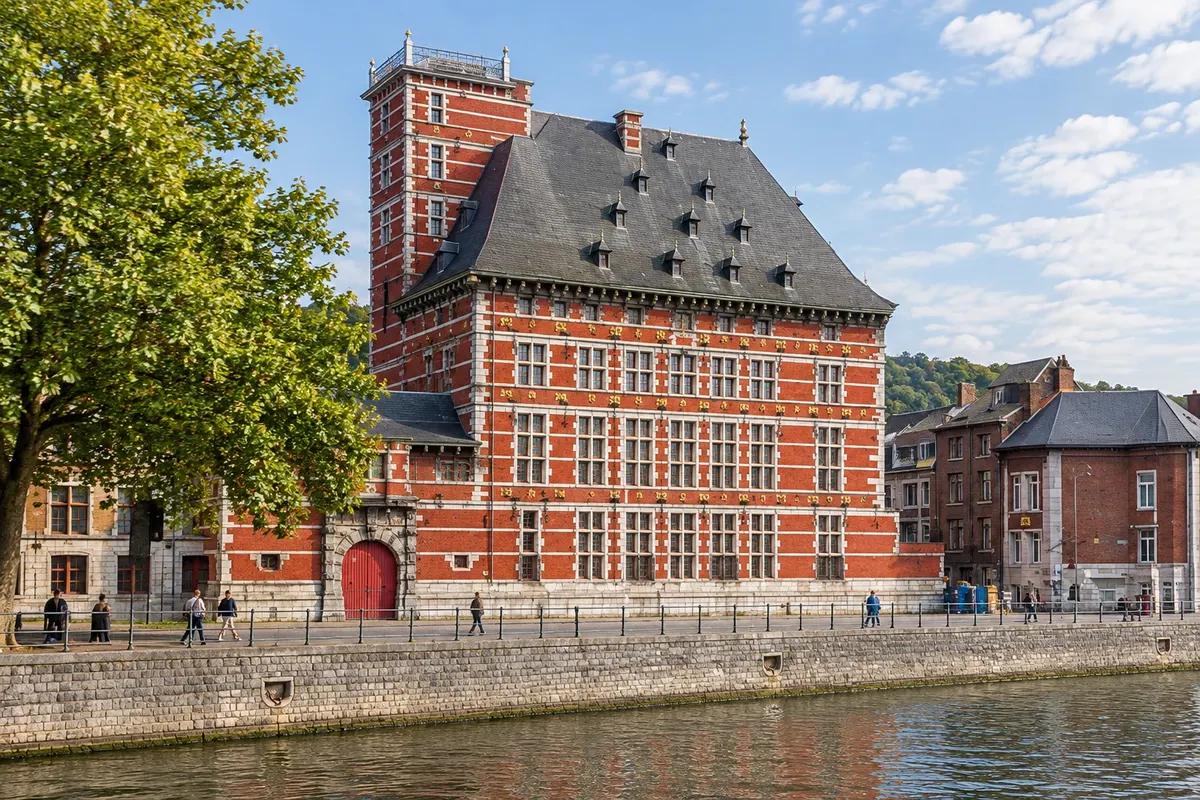
Museum of Art and History of Liège, on the banks of the Mosa, centred on the red-brick palace of industrialist Jean Curtius. It brings together archaeology, arms, religious and Mosan art, glass and decorative arts.
Illustrative images. The pictures in this guide are illustrations based on the real place, not photographs, and may differ from it.

Discover
About Grand Curtius
The Grand Curtius occupies an entire block between the Mosa and the collegiate church of Saint-Barthélemy. At its core is the palace built between 1597 and 1605 for Jean Curtius, an industrialist and arms supplier to Liège: a large red-brick house with bands of grey stone, regarded as an example of Mosan style.
The museum brings together collections that were previously scattered around the city, in five areas: archaeology, arms, religious and Mosan art, glass and decorative arts. There are thousands of items on display, covering more than 7,000 years, from Egyptian and Gallo-Roman antiquities to 19th-century furniture and objects.
Among the most sought-after pieces are a Neanderthal skull found at Engis, near Liège, the Evangeliary of Notger from the 10th century, capitals from the former cathedral of Saint-Lambert and one of the major arms collections in Europe, linked to the city's weapons-making tradition. The glass collection is also large, with pieces from various periods and regions.
In addition to the permanent collection, the museum hosts temporary exhibitions throughout the year. The courtyard and the brasserie, facing the quay, provide a break during the visit.
Before you go
Practical information
Cidade Turismo reviews its information regularly, but something may have changed. Check with the place before planning your trip.
How much time to set aside
Two to three hours to see the main rooms. Those interested in arms or medieval art can spend half a day.
Best time
Any time of year. On Sunday mornings you can combine it with the La Batte market, which runs in front. The first Sunday of the month tends to be busier. Check opening days before you go.
How to get there
It is on the Féronstrée, the street that runs from the Place Saint-Lambert towards the Mosa, about a ten-minute walk. The main entrance is on the Féronstrée and there is another on the quay side by the brasserie.
Tip
Start with Mosan art and the arms collections, which are the most typical of Liège, and leave the decorative arts until the end. On leaving, the neighbouring collegiate church of Saint-Barthélemy houses the 12th-century bronze baptismal font, one of the best-known works of Mosan art.
Official website
Get your questions answered
Frequently asked questions about Grand Curtius
Who was Jean Curtius?
Jean Curtius, or Jean de Corte, was an industrialist from Liège in the 16th and 17th centuries who made his fortune with gunpowder and weapons. He commissioned the palace on the Meuse that today is the heart of the museum.
Does the museum have texts in English?
Main labels are usually in French, with some in other languages. Check at the ticket office whether there is an audio guide or a leaflet in English.
Can it be visited together with the La Batte market?
Yes. The Sunday market runs along the quay in front of the museum, and both visits can fit into the same morning or afternoon.