

 Brazil
 Argentina
 Bolivia
 Chile
 Colombia
 Ecuador
 Guyana
 French Guiana
 Falkland Islands (Malvinas)
 Paraguay
 Peru
 Suriname
 Uruguay
 Venezuela
 Germany
 Austria
 Croatia
 Denmark
 Spain
 Finland
 France
 Greece
 the Netherlands
 Hungary
 Ireland
 Iceland
 Italy
 Luxembourg
 Norway
 Poland
 Portugal
 the United Kingdom
 the Czech Republic
 Sweden
 Switzerland
 Turkey
 the United States
 Mexico
 the Dominican Republic
 South Africa
 Australia
 Fiji
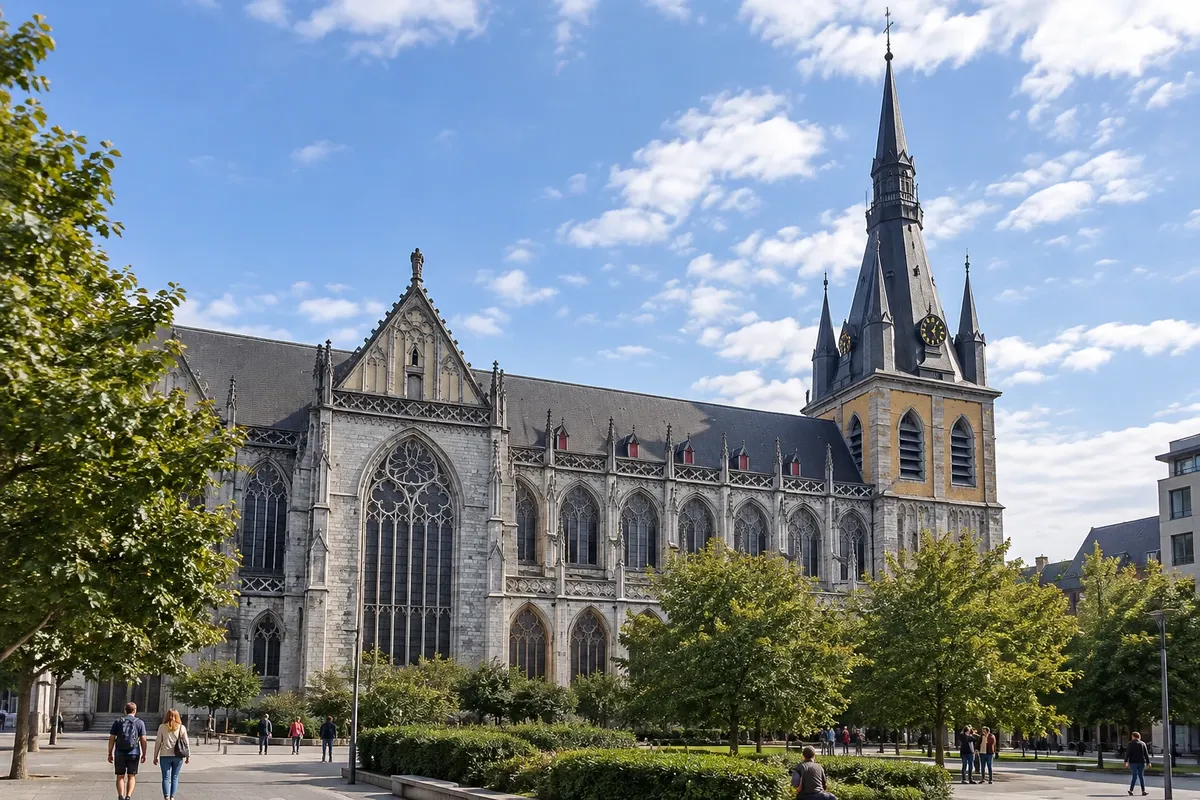
Church · Liège, Liège
Cathédrale Saint-Paul
Gothic cathedral of Liège, founded as a collegiate church in the 10th century and raised to cathedral status in 1802. In the cloister is the Trésor, which houses the bust-reliquary of São Lamberto and the reliquary given by Charles the Bold.
Illustrative images. The pictures in this guide are illustrations based on the real place, not photographs, and may differ from it.

Discover
About Cathédrale Saint-Paul
The Cathédrale Saint-Paul began as a collegiate church, founded by Bishop Éracle in the year 967. The present building was erected between the 13th and 15th centuries, in a Gothic style that ranges from the more sober forms of the nave to the five-sided apse, which is more ornate. In the 19th century the architect Jean-Charles Delsaux added the neo-Gothic decoration seen today.
It only became a cathedral in 1802. the former seat of the bishopric, the cathedral of Saint-Lambert, had been destroyed after the Revolution, and the relics and the cult of the patron saint were transferred to Saint-Paul. Inside, it is worth looking at the 16th-century stained glass, the carved pulpit and the choir statues.
Next to the church is the cloister, with galleries from the late 15th and early 16th centuries. In one of its wings is the Trésor de Liège, a museum of sacred art that preserves much of what was saved from the old cathedral. The best-known pieces are the bust-reliquary of São Lamberto, a goldsmith's work from the early 16th century, and the reliquary that Charles the Bold offered to the city in the 15th century, as well as carved ivories from the 11th century.
The cathedral is an active church with regular masses. The Trésor has its own entrance on rue Bonne Fortune and opening hours different from those of the nave.
Before you go
Practical information
Cidade Turismo reviews its information regularly, but something may have changed. Check with the place before planning your trip.
How much time to set aside
Half an hour for the nave and the cloister. With the Trésor, allow one and a half to two hours.
Best time
From Tuesday to Saturday during the day, when the Trésor is usually open; on Sundays it opens only in the afternoon and it's closed on Mondays. Avoid mass times when circulating through the nave.
How to get there
It is in the centre, about a ten-minute walk south of Place Saint-Lambert, near the Carré. From Gare de Liège-Guillemins the walk takes around 20 minutes.
Tip
Start with the Trésor and finish in the nave: after seeing the bust of São Lamberto up close, the cathedral's history becomes clearer. Ask for the audio guide or the leaflet, because the labels are in French.
Official website
Get your questions answered
Frequently asked questions about Cathédrale Saint-Paul
Why isn’t Liège’s cathedral Saint-Lambert?
Saint-Lambert cathedral was destroyed after the Revolution. In 1802 the collegiate church of Saint Paul became the diocese’s cathedral.
What is the most important thing in the Trésor?
The bust-reliquary of Saint Lambert from the early 16th century, the reliquary donated by Charles the Bold, and 11th-century ivories.
Is the Trésor inside the church?
It is in the cloister, beside the nave, with an entrance on Bonne Fortune Street and a separate ticket office.