

 Brazil
 Argentina
 Bolivia
 Chile
 Colombia
 Ecuador
 Guyana
 French Guiana
 Falkland Islands (Malvinas)
 Paraguay
 Peru
 Suriname
 Uruguay
 Venezuela
 Germany
 Austria
 Croatia
 Denmark
 Spain
 Finland
 France
 Greece
 the Netherlands
 Hungary
 Ireland
 Iceland
 Italy
 Luxembourg
 Norway
 Poland
 Portugal
 the United Kingdom
 the Czech Republic
 Sweden
 Switzerland
 Turkey
 the United States
 Mexico
 the Dominican Republic
 South Africa
 Australia
 Fiji
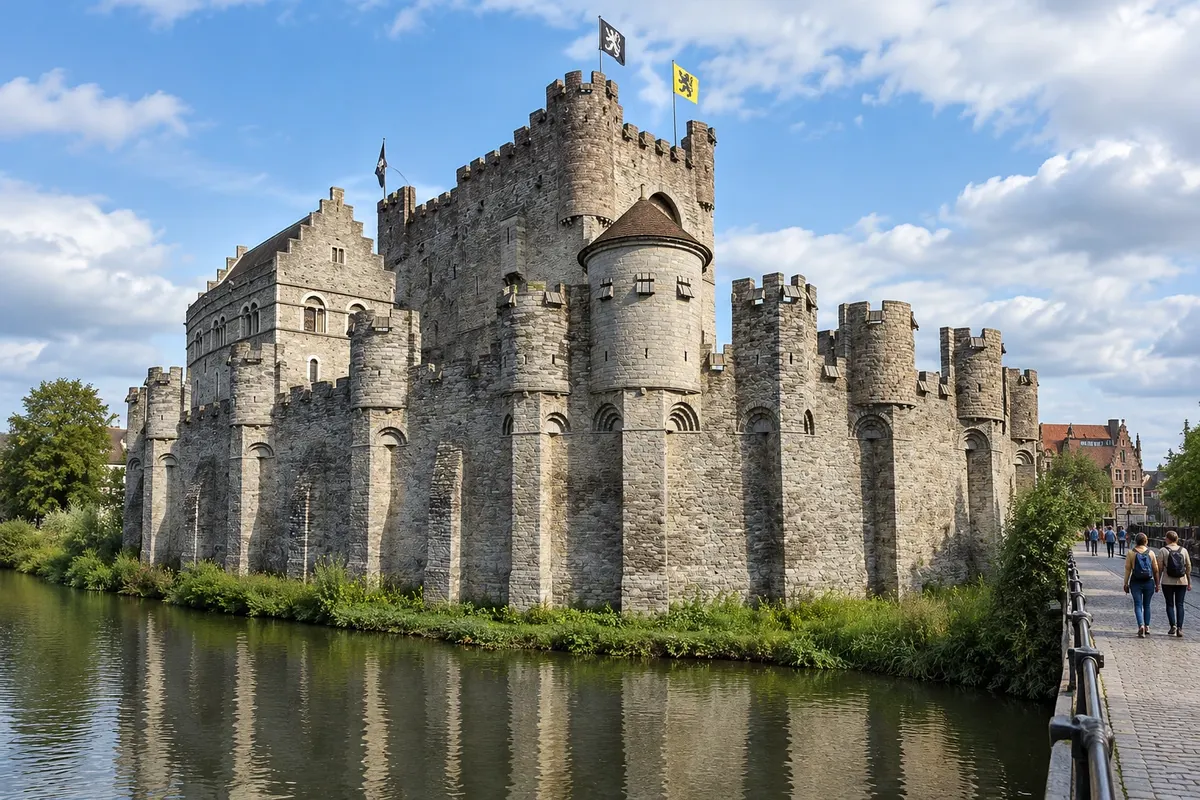
Castle · Gante, East Flanders
Gravensteen
Castle of the Counts of Flanders, from 1180, surrounded by a moat fed by the river Leie. The visit goes through the keep, the courtroom halls, a collection of torture instruments and reaches the ramparts.
Illustrative images. The pictures in this guide are illustrations based on the real place, not photographs, and may differ from it.

Discover
About Gravensteen
The Gravensteen, the Castle of the Counts, was built in 1180 by Filipe da Alsácia, Count of Flanders, on the site of an older fortification. It has a central keep, the count's residence, an oval curtain wall with 24 small watchtowers and a moat linked to the river Leie. Besides defending, the castle was used to intimidate Ghent's residents, who were often at odds with the counts.
The counts lived there until 1353. Afterwards the building served as a court and prison until the 18th century and operated as Ghent's mint between 1353 and 1491. In the 19th century it became a cotton spinning mill, with workers' houses attached to the walls, and was even slated for demolition.
The city gradually bought the parts and restored the castle between 1893 and 1907 with architect Joseph De Waele. The renovation followed a romantic Gothic style inspired by Viollet-le-Duc and reconstructed an idealized image of the 12th century. In 1949, 138 university students occupied the castle in protest against a beer tax, an episode the city recounts with humor.
The route crosses the gate, the keep, the old courtrooms and the count's residence. One room houses judicial objects and torture instruments from the prison era. The audio guide, narrated by Flemish comedian Wouter Deprez, has an English version. The visit ends on top of the ramparts, with views over the roofs of Patershol and the towers of the center.
Before you go
Practical information
Cidade Turismo reviews its information regularly, but something may have changed. Check with the place before planning your trip.
How much time to set aside
From one hour to one and a half hours. The audio guide offers a short route of about an hour and a full route of around an hour and a half.
Best time
Right at opening, before tour groups arrive. In spring and summer the views from the ramparts are more open. On heavy rain the ramparts become slippery: wear sturdy footwear.
How to get there
It is located on Sint-Veerleplein in the historic center, about a five-minute walk from Korenmarkt and Graslei. From Gent-Sint-Pieters station take the tram to Korenmarkt and continue on foot. The castle also features on several boat tours along the Leie.
Tip
Take the audio guide: it's included with admission and provides context for rooms that, without explanation, may seem empty. The torture instruments room can be upsetting for young children. After the visit, cross over to Patershol, just behind the castle, for lunch.
Official website
Get your questions answered
Frequently asked questions about Gravensteen
Is the castle original from the Middle Ages?
The structure dates from 1180, but much of its current appearance is due to the restoration from 1893 to 1907, which rebuilt the castle in an idealized Gothic style. Some details, like the flat roofs, do not follow the original.
Does the audio guide have a Portuguese version?
The city's tourism information lists an English version among other languages. Check at the ticket office which languages are available.
Is it worth bringing children?
Children usually enjoy it because of the walls, towers and narrow passageways. The room with torture instruments can frighten younger kids, so assess it before going in.