

 Brazil
 Argentina
 Bolivia
 Chile
 Colombia
 Ecuador
 Guyana
 French Guiana
 Falkland Islands (Malvinas)
 Paraguay
 Peru
 Suriname
 Uruguay
 Venezuela
 Germany
 Austria
 Belgium
 Croatia
 Denmark
 Spain
 Finland
 France
 Greece
 the Netherlands
 Hungary
 Ireland
 Iceland
 Italy
 Luxembourg
 Norway
 Poland
 Portugal
 the United Kingdom
 the Czech Republic
 Sweden
 Switzerland
 Turkey
 Canada
 the United States
 Mexico
 the Dominican Republic
 South Africa
 Fiji
 New Zealand
 Papua New Guinea
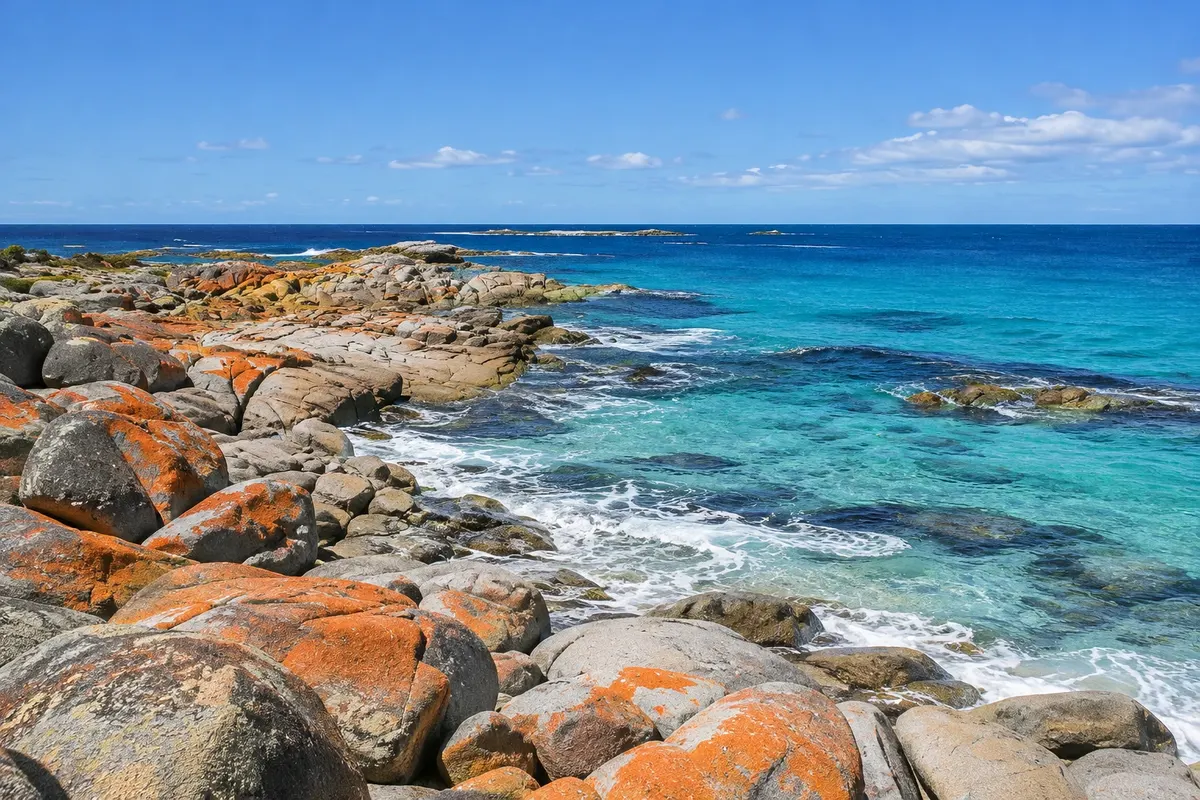
Beach · St Helens, Tasmania
Bay of Fires
A stretch of white-sand beaches, clear water and granite rocks covered in orange lichen between Binalong Bay and Cape Eddystone, on the northeast coast.
Illustrative images. The pictures in this guide are illustrations based on the real place, not photographs, and may differ from it.

Discover
About Bay of Fires
The Bay of Fires is about a 50 km stretch of coastline between Binalong Bay, roughly 10 km from St Helens, and Cape Eddystone to the north. White-sand beaches and clear water alternate with granite rocks coated in orange lichen, which gives the landscape its distinctive colours.
The name was given in 1773 by English navigator Tobias Furneaux, who saw the fires of the Aboriginal people living there from the coast. The area contains Aboriginal sites, such as ancient shell middens, protected by law.
The southern part, between Binalong Bay and The Gardens, has sealed roads and many stopping points. The northern section is in Mount William National Park, with access via dirt roads, and is also traversed by a multi-day guided walk.
There is no entry fee for the southern section. There are camping areas beside the beaches.
Before you go
Practical information
Cidade Turismo reviews its information regularly, but something may have changed. Check with the place before planning your trip.
How much time to set aside
From half a day to a full day.
Best time
On sunny days, in the morning or late afternoon, when the orange of the rocks stands out.
How to get there
By car, about 10 km from St Helens to Binalong Bay, and another roughly 13 km along Gardens Road to The Gardens.
Tip
Stop at several points on Gardens Road: each cove has different rocks and colours.
Official website
Get your questions answered
Frequently asked questions about Bay of Fires
Where does the Bay of Fires start?
At Binalong Bay, about 10 km from St Helens.
Why is it called Bay of Fires?
Navigator Tobias Furneaux saw the coastal Aboriginal peoples’ fires in 1773.
Is there a fee to visit the Bay of Fires?
There is no entry fee for the southern section. The northern part lies in a national park, which requires a pass.