

 Brazil
 Argentina
 Bolivia
 Chile
 Colombia
 Ecuador
 Guyana
 French Guiana
 Falkland Islands (Malvinas)
 Paraguay
 Peru
 Suriname
 Uruguay
 Venezuela
 Germany
 Austria
 Belgium
 Croatia
 Denmark
 Spain
 Finland
 France
 Greece
 the Netherlands
 Hungary
 Ireland
 Iceland
 Italy
 Luxembourg
 Norway
 Poland
 Portugal
 the United Kingdom
 the Czech Republic
 Sweden
 Switzerland
 the United States
 Mexico
 the Dominican Republic
 South Africa
 Australia
 Fiji
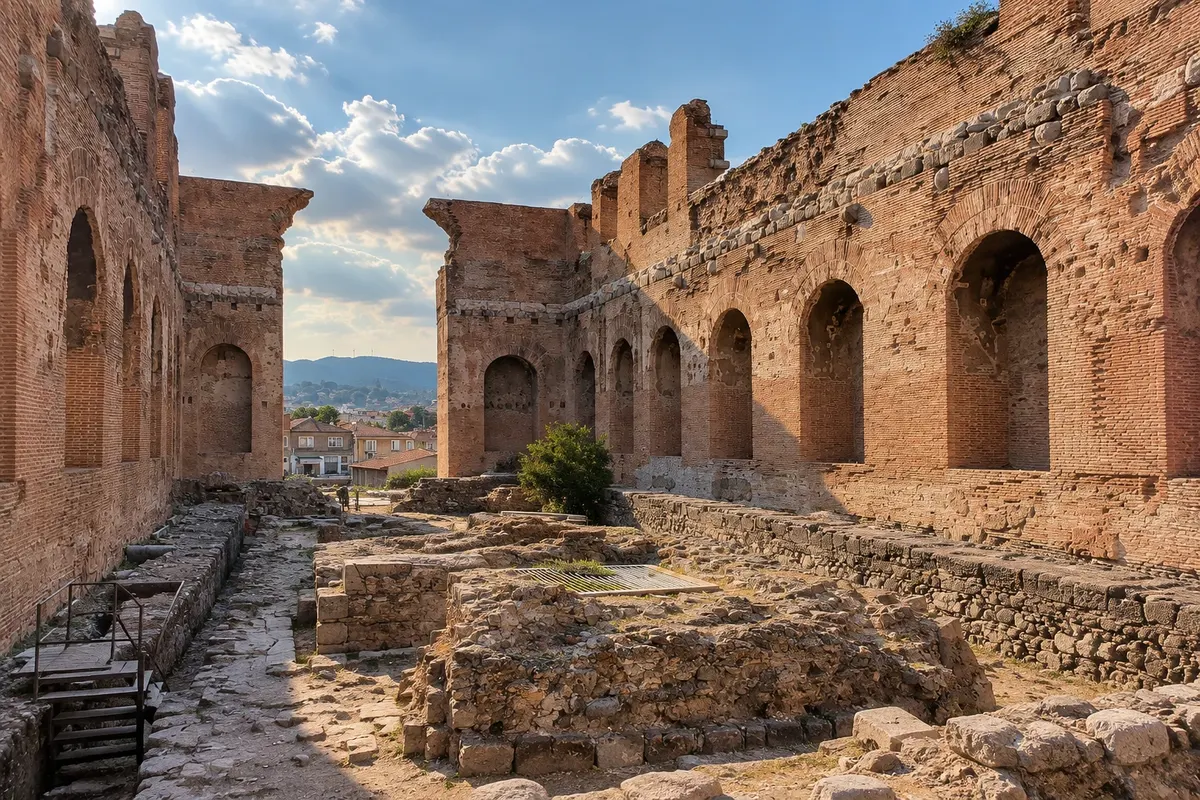
Archaeological site · Bergama, Izmir
Kızıl Avlu
Large red-brick complex in the center of Bergama, of Roman religious origin with later uses.
Illustrative images. The pictures in this guide are illustrations based on the real place, not photographs, and may differ from it.

Discover
About Kızıl Avlu
Kızıl Avlu lies within Bergama’s urban fabric and is notable for its red-brick volumes. The complex originated as a major Roman sanctuary linked to Egyptian deities and later received subsequent religious uses. Its scale is striking within the city’s layout, but the visit is archaeological, among surviving structures.
Note the height of the walls, the openings and the arrangement of the enclosure. These elements help you imagine the complex’s dimensions without reconstructing every lost part as a fact. Comparing it with the acropolis and the Asclepion shows how Pergamon was not limited to the hilltop.
Access from the center makes it easy to include the site on the same day, but you should check opening arrangements and allow time for the internal route. Don’t treat it merely as a roadside photo stop. The sun reaches much of the enclosure and the walk should respect the areas open to visitors.
Before you go
Practical information
Cidade Turismo reviews its information regularly, but something may have changed. Check with the place before planning your trip.
How much time to set aside
About 45 minutes to one hour.
Best time
During the day, in a cooler period and with opening confirmed.
How to get there
On foot or by local transport from Bergama center.
Tip
View the large volumes from outside first, then see how the internal route helps to understand them.
Get your questions answered
Frequently asked questions about Kızıl Avlu
Why is the place called the Red Basilica?
The common name relates to the large volumes of brick and the history of the complex's uses.
Is Kızıl Avlu located atop the acropolis?
No. The site is in the lower urban area of Bergama.
Is it a fully functioning church?
The visit focuses on the archaeological complex and its remains, according to the authorized sectors.