

 Brazil
 Argentina
 Bolivia
 Chile
 Colombia
 Ecuador
 Guyana
 French Guiana
 Falkland Islands (Malvinas)
 Paraguay
 Peru
 Suriname
 Uruguay
 Venezuela
 Germany
 Austria
 Belgium
 Croatia
 Denmark
 Spain
 Finland
 France
 Greece
 the Netherlands
 Hungary
 Ireland
 Iceland
 Luxembourg
 Norway
 Poland
 Portugal
 the United Kingdom
 the Czech Republic
 Sweden
 Switzerland
 Turkey
 the United States
 Mexico
 the Dominican Republic
 South Africa
 Australia
 Fiji
Before you go
Your trip to Roma.
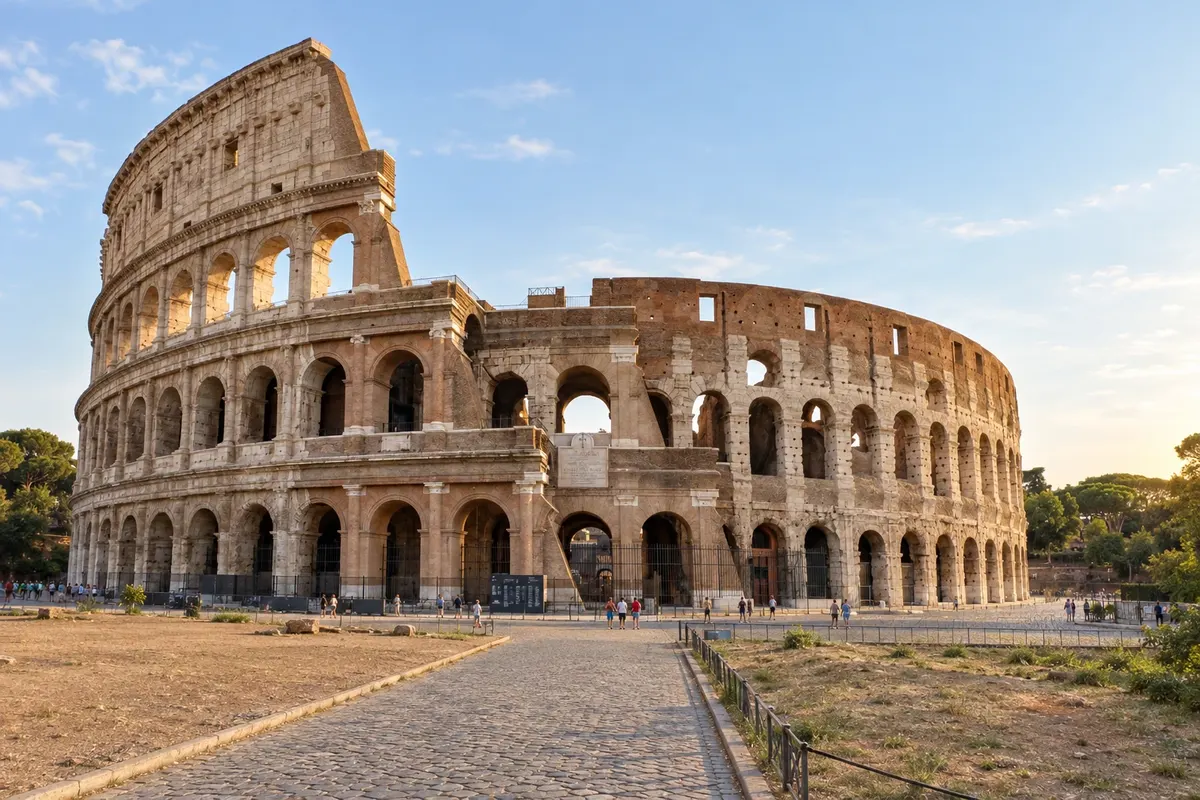
Illustrative images. The pictures in this guide are illustrations based on the real place, not photographs, and may differ from it.

Roma – Lazio Capital
How to get there
-
Aeroporto di Roma-Fiumicino Leonardo da Vinci (FCO) 30 km
-
Aeroporto di Roma-Ciampino G. B. Pastine (CIA) 15 km
-
Roma Termini 2 km
Approximate road distances. Check flights and bus schedules before you travel.
Confirm before booking. Flights arrive at Fiumicino airport, and the Leonardo Express train takes you to Roma Termini station in about 32 minutes. From Ciampino airport, buses run to Termini. At Termini the two main metro lines cross and trains depart for all over Italy.
How many days
Three days are the comfortable minimum: one for the Coliseu, the Foro Romano and Palatine Hill, one for the Vaticano and one for the historic center and the Galleria Borghese. With two days you see the essentials at a fast pace. One day only forces you to choose between ancient Roma and the Vaticano.
When to go
From April to June and from September to October the weather is usually good for walking. July and August are very hot, and queues grow. From December to February it is cold, with fewer tourists. Timed tickets for the Coliseu, the Museus Vaticanos and the Galleria Borghese sell out earlier in high season: book in advance.
The seasons shown are the most usual ones; nature doesn't always follow the calendar.
Do you need a car?
No. The center of Rome is a ZTL (limited traffic zone), closed to outside cars, with cameras at the entrances. The metro, buses and walking cover almost everything, and trains go to other cities. If you plan to use a car for the trip, take it out when leaving Rome.
Suggested itinerary
An order that works
Built with the places on this page. No rush: it's paced so you have time to see them.
One day in Roma
-
Morning
Coliseu, Foro Romano and Palatino
Start early at the Coliseu, with a ticket booked for the first time slot. The same ticket grants access to the Foro Romano and the Palatino, which are next door: walk along the Via Sacra to the Arch of Titus and climb the Palatino to see the Foro from above.
-
Afternoon
Pantheon and Piazza Navona
After lunch, head to the Pantheon and watch the light entering through the dome's oculus. A few minutes' walk away is the Piazza Navona, with Bernini's Fontana dei Quattro Fiumi in the center.
-
Late afternoon
Fontana di Trevi and Piazza di Spagna
Walk to the Fontana di Trevi and toss a coin over your shoulder, as tradition dictates. Continue to the Piazza di Spagna and climb the steps to the church of Trinità dei Monti to view the city's rooftops.
-
Evening
Dinner on the other side of the Tibre
For dinner, cross the river to Trastevere, with narrow streets full of trattorias. Dinner in Rome usually starts from 7:30 PM or 8:00 PM.
2 days in Roma
Day 1
-
Morning
Inside the Coliseu
Enter the Coliseu right at opening time, with a named ticket and scheduled entry. Walk the two tiers of seating and look down at the underground corridors where gladiators and animals passed.
-
Afternoon
Foro Romano and Palatino
In the afternoon, use the same ticket at the Foro Romano: the Curia, the Temple of Vesta, the arches of Titus and Septimius Severus. Climb the Palatino, where the emperors' palaces stood, and enjoy the view over the Circo Massimo.
-
Late afternoon
Campidoglio and the Vittoriano terrace
Climb Michelangelo's staircase to the Piazza del Campidoglio and peek at the Foro from the viewpoint behind the Palazzo Senatorio. Next door, the Vittoriano's elevator takes you to the Terraço das Quadrigas, with Rome in 360 degrees.
-
Evening
Night in Monti
Dine in Monti, the neighborhood between the Coliseu and the Via Nazionale, with enotecas and small restaurants on cobbled streets. On the way back, the illuminated Coliseu is just a few blocks away.
Day 2
-
Morning
Museus Vaticanos and Capela Sistina
Book the first time slot for the Museus Vaticanos. Pass by the Laocoonte, the Salas de Rafael and finish in the Capela Sistina, where photos are prohibited and silence is requested. Shoulders and knees must be covered.
-
Afternoon
Basilica of São Pedro and the dome
Exit via the Piazza San Pietro and enter the Basilica, where Michelangelo's Pietà is located. Climb the dome on foot or take part of the way by elevator: from the top you can see the entire square and the gardens of the Vaticano.
-
Late afternoon
Castel Sant'Angelo and the bridge of the angels
Walk along the Via della Conciliazione to the Castel Sant'Angelo, the former mausoleum of Hadrian. From the castle terrace, the sunset often paints the cúpula de São Pedro. Cross the Ponte Sant'Angelo, with its statues of angels.
-
Evening
Navona, Pantheon and Trevi at night
From the bridge, it's a few minutes to the Piazza Navona. Walk past the illuminated Pantheon and finish at the Fontana di Trevi: at night, outside controlled hours, the edge of the fountain does not require a ticket.
3 days in Roma
Day 1
-
Morning
Opening of the Coliseu
Start at the Coliseu at the first booked time, with a photo ID in hand. The amphitheatre was inaugurated in AD 80 and held tens of thousands of spectators at the games.
-
Afternoon
Ruins of the Foro and the Palatino
Head to the Foro Romano and the Palatino with the same ticket. Bring water and a hat: there is little shade among the ruins, especially from June to August.
-
Late afternoon
Musei Capitolini and Campidoglio
In the late afternoon, visit the Musei Capitolini, with the Loba Capitolina and the original equestrian statue of Marcus Aurelius. Through the Tabularium's underground gallery you reach a window overlooking the Foro.
-
Evening
Dinner in Monti
At night, dine in Monti, near ancient Rome, or walk down the Via dei Fori Imperiali to see the ruins lit up.
Day 2
-
Morning
Vatican: museums and the Sistine
Vatican day, which is another State but has no passport control. Enter the Museus Vaticanos with a timed slot and allow three hours to reach the Capela Sistina without rushing.
-
Afternoon
Basilica and dome of São Pedro
Visit the Basílica de São Pedro, with Bernini's baldachin over the papal altar, and climb the steps of the dome. Entrance to the basilica is free; the ascent to the dome requires a separate ticket.
-
Late afternoon
Castel Sant'Angelo
Walk to the Castel Sant'Angelo and ascend the ramps to the terrace of the bronze angel, with views over the Tibre and São Pedro. The castle is closed on Mondays: check before you go.
-
Evening
Night in Trastevere
Cross the Tibre to Trastevere to dine in the trattorias on the stone streets, one of Rome's liveliest neighborhoods after dark.
Day 3
-
Morning
Galleria Borghese
Start at the Galleria Borghese, with mandatory reservation and a visit of about two hours. See Apollo and Daphne and the Rape of Proserpina by Bernini, and Canova's Paulina Borghese.
-
Afternoon
Villa Borghese and the Pincio
Cross the Villa Borghese park, with its lake and the Temple of Aesculapius, to the Pincio terrace. From there you descend to the Piazza di Spagna via the Trinità dei Monti and the staircase.
-
Late afternoon
Fontana di Trevi and Pantheon
From the Piazza di Spagna, walk to the Fontana di Trevi and then to the Pantheon. Go inside and see the tombs of Raphael and of Italy's early kings.
-
Evening
Farewell at the Piazza Navona
End at the Piazza Navona, with its three illuminated fountains and street performers. For the last meal, the small streets around the square have trattorias and pizzerias.
Check before you go. Opening hours and days change, and places may close for renovations, holidays or events. This itinerary is a suggestion from Cidade Turismo, not a commitment: plan yours by checking directly with each place you intend to visit.
Before you go
Frequently asked questions
Is the Vatican another country? Do I need to show a passport?
Yes, the Cidade do Vaticano is an independent State, surrounded by Rome. But there is no passport control: you enter on foot via the Piazza San Pietro. In the basilica and museums there is only security screening, and clothing that covers shoulders and knees is required.
How to get from Fiumicino to central Rome?
The Leonardo Express train departs the station inside the airport and goes non-stop to Roma Termini in about 32 minutes. From Termini, the metro and buses serve the rest of the city. There are also buses and taxis. Check schedules before you go.
Which attractions in Rome require timed reservations?
The Coliseu has a nominal ticket with a scheduled time, and a photo ID is required at the entrance. The Museus Vaticanos recommend booking online. At the Galleria Borghese reservation is mandatory. The Pantheon and the terrace of the Vittoriano charge admission, and access to the edge of the Fontana di Trevi is controlled during the day.
How to get around Rome?
The metro has lines that stop at the Coliseu, Termini, Piazza di Spagna and near the Vatican. Buses cover the rest. In the historic center the distances between the Pantheon, Piazza Navona and the Fontana di Trevi are short, and it's worth walking.
What are meals like in Rome?
Lunch usually runs from 12:30 to 14:30 and dinner starts around 19:30 or 20:00. Typical Roman dishes are carbonara, cacio e pepe, amatriciana and artichokes alla romana. The city's tourist tax is charged at accommodation.