

 Brazil
 Argentina
 Bolivia
 Chile
 Colombia
 Ecuador
 Guyana
 French Guiana
 Falkland Islands (Malvinas)
 Paraguay
 Peru
 Suriname
 Uruguay
 Venezuela
 Germany
 Austria
 Belgium
 Croatia
 Denmark
 Spain
 Finland
 Greece
 the Netherlands
 Hungary
 Ireland
 Iceland
 Italy
 Luxembourg
 Norway
 Poland
 Portugal
 the United Kingdom
 the Czech Republic
 Sweden
 Switzerland
 Turkey
 the United States
 Mexico
 the Dominican Republic
 South Africa
 Australia
 Fiji
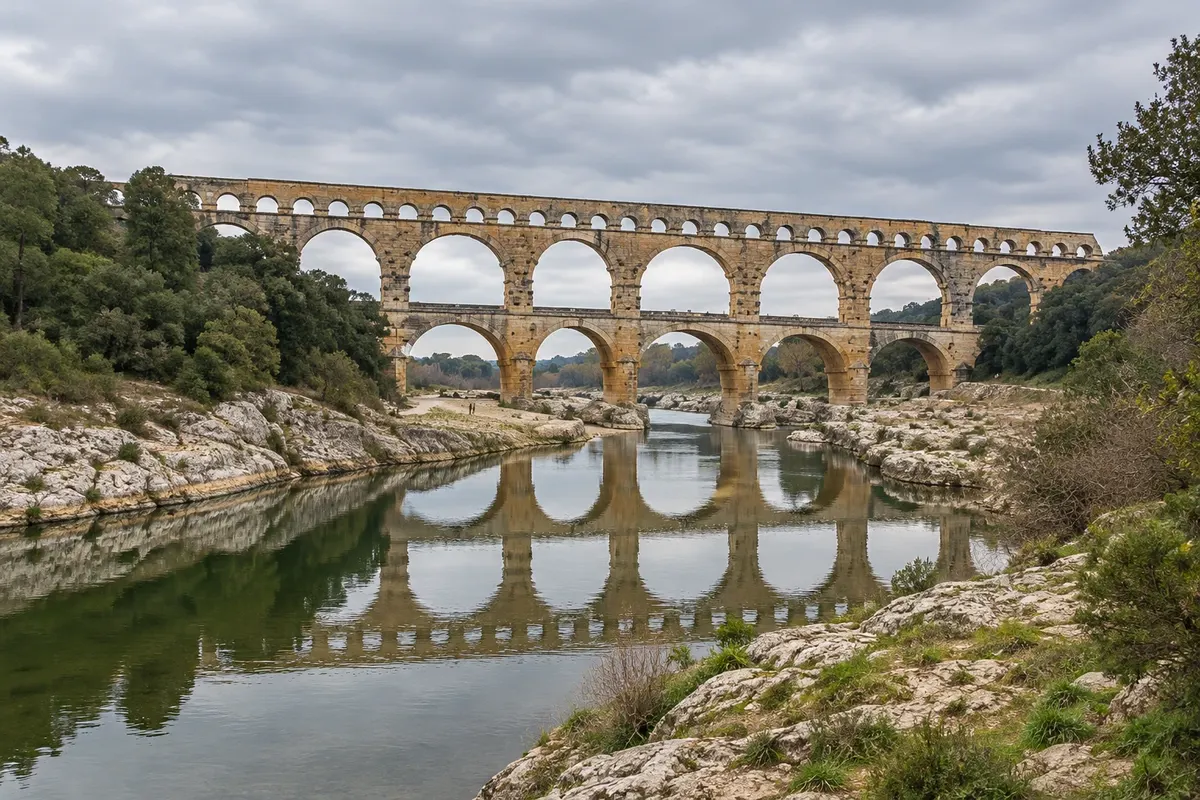
Monument · Avignon, Provence-Alpes-Côte d'Azur
Pont du Gard
Roman aqueduct of three tiers across the Gardon River, built in the 1st century to bring water to Nîmes. It is the tallest aqueduct-bridge known from the Roman world and a UNESCO World Heritage Site.
Illustrative images. The pictures in this guide are illustrations based on the real place, not photographs, and may differ from it.

Discover
About Pont du Gard
The Pont du Gard is the tallest part of a Roman aqueduct that carried water from Uzès to Nîmes for about 50 km. It was probably built in the first half of the 1st century and stopped functioning around the 6th century. At nearly 49 metres high with three tiers of arches, it is the tallest known aqueduct-bridge of the Roman world.
The lowest tier has 6 arches, the middle tier 11, and the upper tier, which carried the water, has a long row of smaller arches. Today the structure measures 275 metres at its longest point. The stones were fitted without mortar, and you can still see protrusions used to support the scaffolding during construction. In the Middle Ages the monument came to be used as a bridge, and in the 18th century a road bridge was built alongside it, now for pedestrians only.
The site lies in a natural area on the banks of the Gardon and includes a museum about Roman water engineering and use, woodland trails and viewpoints. Access to the channel at the top is only possible on guided tours on specific dates.
The Pont du Gard is in the department of Gard, in the neighbouring region, about 25 km from Avignon. It has been on the UNESCO World Heritage List since 1985 and is often visited together with Avignon, Nîmes or Uzès.
Before you go
Practical information
Cidade Turismo reviews its information regularly, but something may have changed. Check with the place before planning your trip.
How much time to set aside
About 2 to 3 hours with the museum and a walk along the banks. In summer, those who want to swim in the river may spend half a day.
Best time
In the morning or late afternoon, when the golden light hits the stone. In summer (June to August) many people swim in the Gardon below the aqueduct; the sun is strong and there is little shade near the bridge. The museum areas are closed on Monday mornings and have winter closures: check before you go.
How to get there
By car, about 25 km from Avignon via the N100, with paid parking on site. There is a regional bus between Avignon coach station and the Pont du Gard, with limited schedules; confirm before you go.
Tip
Cross the 18th-century road bridge attached to the aqueduct and climb the trails on the right bank to view the monument from above. Bring a hat and water in summer. The entrance fee covers parking and the museum.
Official website
Get your questions answered
Frequently asked questions about Pont du Gard
Can you get to the Pont du Gard without a car?
Yes, there is a regional bus that departs from Avignon and also from Nîmes and Uzès, but with limited schedules. Check the timetable beforehand and plan your return. Organized tours leaving from Avignon also include the Pont du Gard.
Can you swim in the river?
In summer many people swim in the Gardon, near the aqueduct. Respect the designated areas and local signage, which can change according to the water level.
Can you walk on top of the aqueduct?
The top level, where the water ran, is only open on guided visits on specific dates. The normal crossing is via the 18th-century road bridge attached to the first tier of arches.