

 Brazil
 Argentina
 Bolivia
 Chile
 Colombia
 Ecuador
 Guyana
 French Guiana
 Falkland Islands (Malvinas)
 Paraguay
 Peru
 Suriname
 Uruguay
 Venezuela
 Germany
 Austria
 Belgium
 Croatia
 Denmark
 Spain
 Finland
 Greece
 the Netherlands
 Hungary
 Ireland
 Iceland
 Italy
 Luxembourg
 Norway
 Poland
 Portugal
 the United Kingdom
 the Czech Republic
 Sweden
 Switzerland
 Turkey
 the United States
 Mexico
 the Dominican Republic
 South Africa
 Australia
 Fiji
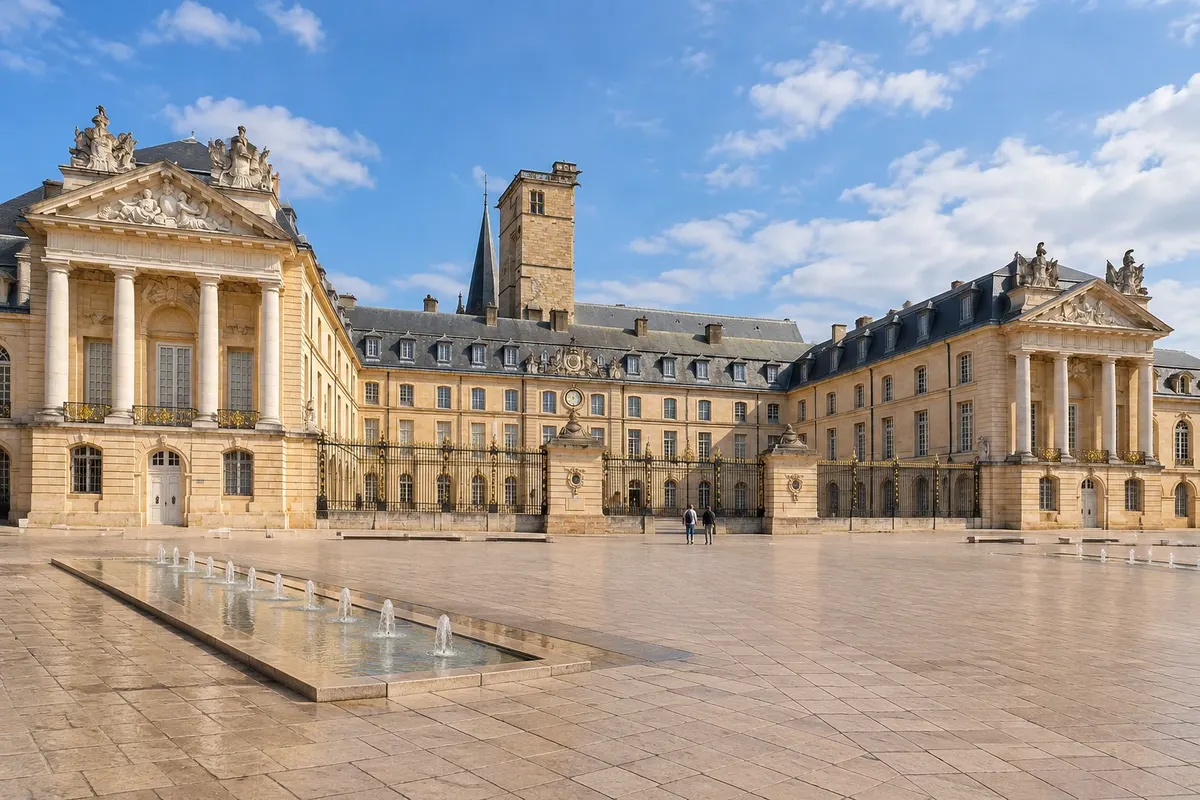
Palace · Dijon, Borgonha-Franco-Condado
Palais des ducs et des États de Bourgogne
A complex of buildings in the heart of Dijon that brings together the palace of the Dukes of Burgundy, from the 14th and 15th centuries, and the Palace of the States, from the 17th and 18th centuries. Today it houses the town hall and the Musée des Beaux-Arts.
Illustrative images. The pictures in this guide are illustrations based on the real place, not photographs, and may differ from it.

Discover
About Palais des ducs et des États de Bourgogne
The Palais des ducs et des États de Bourgogne has been Dijon’s political center for almost a thousand years. The oldest part is the ducal palace from the 14th and 15th centuries, in Gothic style, with the logis des ducs visible from the Place des Ducs, the former ducal kitchens in the cour de Bar and two towers, the Tour Philippe le Bon and the Tour de Bar.
After the duchy was incorporated into the Kingdom of France, the building became a royal residence and, in the 17th century, the seat of the États de Bourgogne, the province’s assembly. Most of what you see today dates from that classical phase, with a design linked to Jules Hardouin-Mansart, the architect of Versalhes. In front, the semicircular Place de la Libération was laid out as a royal square and today has ground fountains where children play in summer.
The complex houses Dijon’s city hall and the Musée des Beaux-Arts, which occupies the wing of the former ducal palace. The palace’s most noble rooms, such as the Gabriel staircase, the Salle des États and the Salle de Flore, open only for events or on guided tours organized by the tourist office.
Behind the palace begins the Rue des Forges, one of the city’s oldest streets, with hôtels particuliers, urban mansions of wealthy families, like the Hôtel Chambellan and the Hôtel Aubriot. Hôtel here does not mean hotel: it is the French word for an urban mansion.
Before you go
Practical information
Cidade Turismo reviews its information regularly, but something may have changed. Check with the place before planning your trip.
How much time to set aside
Half an hour for the courtyards and the square. With the Musée des Beaux-Arts and the climb to the Tour Philippe le Bon, allow three to four hours.
Best time
In the morning, when the museum opens and the Place de la Libération is still quiet. In the late afternoon the square fills with people at the cafés. At night, the illuminated façade is worth a walk.
How to get there
It is in the historic centre, about a 15-minute walk from Dijon-Ville station, along the Rue de la Liberté, the city’s main shopping street. The centre is almost entirely pedestrian; drivers park in one of the nearby underground car parks.
Tip
Enter through the courtyards (cours) to see the building’s different phases: the classical cour d'honneur and the cour de Bar, with the medieval tower and the statue by sculptor Claus Sluter. To see the Salle des États, look for the guided tour at the tourist office and check the days in advance.
Get your questions answered
Frequently asked questions about Palais des ducs et des États de Bourgogne
Can you visit the interior of the palace?
Partly. The ducal wing houses the Musée des Beaux-Arts, open to the public. The courtyards are freely accessible. The rooms of the Palace of the States, such as the Salle des États, only open for events and on guided tours organized by the tourist office; check the dates.
What is the Place de la Libération?
It is the semicircular square in front of the palace, designed in the 17th century as a royal square. Today it is the city's meeting point, with cafés and ground fountains.
What are the hôtels particuliers on Rue des Forges?
They are urban town-houses built by wealthy families between the Middle Ages and the 18th century. On Rue des Forges are, among others, the Hôtel Chambellan and the Hôtel Aubriot. The word hôtel here means mansion, not hotel.