

 Brazil
 Argentina
 Bolivia
 Chile
 Colombia
 Ecuador
 Guyana
 French Guiana
 Falkland Islands (Malvinas)
 Paraguay
 Peru
 Suriname
 Uruguay
 Venezuela
 Germany
 Austria
 Belgium
 Croatia
 Denmark
 Spain
 Finland
 Greece
 the Netherlands
 Hungary
 Ireland
 Iceland
 Italy
 Luxembourg
 Norway
 Poland
 Portugal
 the United Kingdom
 the Czech Republic
 Sweden
 Switzerland
 Turkey
 the United States
 Mexico
 the Dominican Republic
 South Africa
 Australia
 Fiji
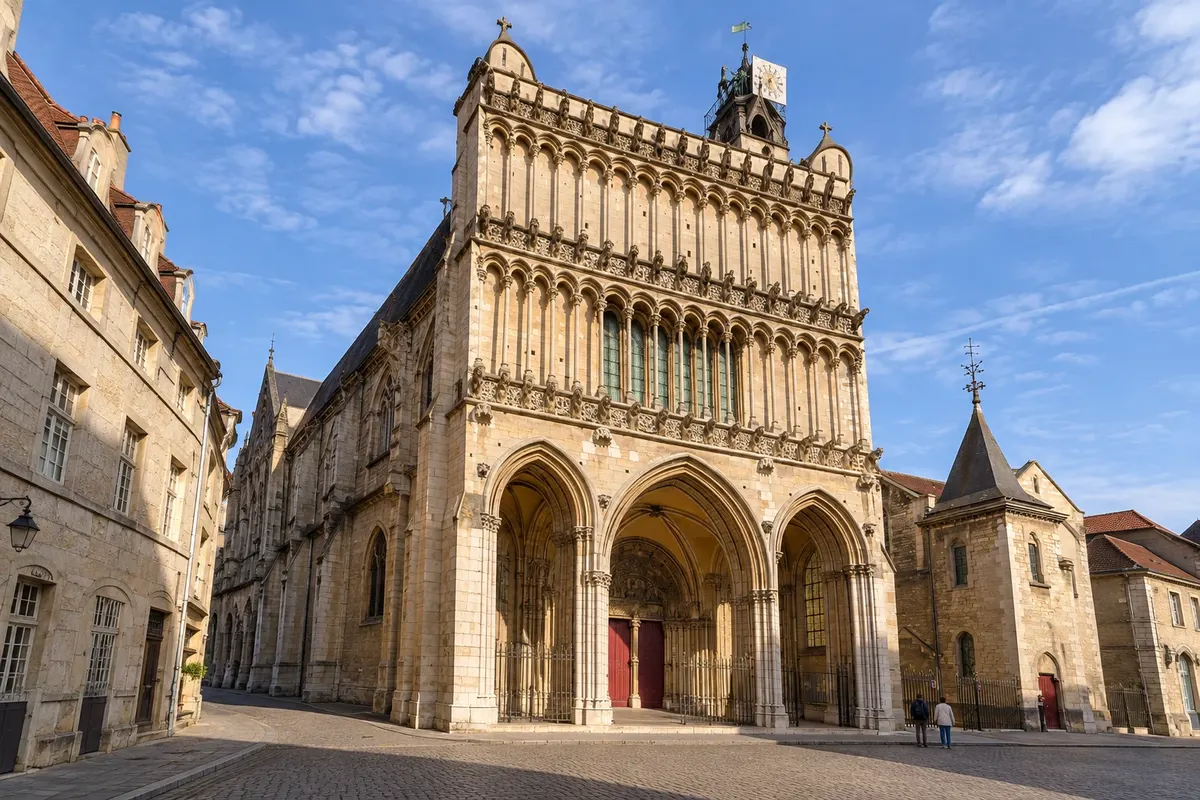
Church · Dijon, Borgonha-Franco-Condado
Église Notre-Dame de Dijon
13th-century Gothic church with a façade of fake gargoyles, the Jacquemart clock, and on the side wall the small stone owl that Dijon locals touch with their left hand to make a wish.
Illustrative images. The pictures in this guide are illustrations based on the real place, not photographs, and may differ from it.

Discover
About Église Notre-Dame de Dijon
Église Notre-Dame de Dijon was built between the 1220s and 1250s and is considered a masterpiece of 13th-century Gothic. It stands on the Place Notre-Dame, a few steps from the Palais des ducs, within the historic center listed as a World Heritage site.
The façade is notable for its two arcaded galleries and its 51 gargoyles, which are purely decorative: they do not drain rainwater. At the top of the south tower, the Jacquemart — a clock with iron figures that strike the hours — was brought from Flanders by Duke Philip the Bold in the 14th century. Over time it acquired a wife and two children. Inside, the church houses the statue of Notre-Dame de Bon-Espoir, formerly known as the Black Virgin.
On the north wall, facing the Rue de la Chouette, is the city’s most beloved symbol: the chouette, a small owl carved into a buttress about 1.80 metres above the ground. Tradition says that whoever touches it with the left hand, the hand of the heart, and makes a wish will have it granted. From so much stroking, the stone has become smooth and shiny.
The owl also lends its name to the Parcours de la Chouette, the walking route through the historic centre marked by bronze arrows in the ground, which passes in front of the church.
Before you go
Practical information
Cidade Turismo reviews its information regularly, but something may have changed. Check with the place before planning your trip.
How much time to set aside
About 20 to 40 minutes, including the walk around the outside to see the owl and the Jacquemart.
Best time
During the day, outside mass times. In the morning there are fewer people in line to touch the owl. Around the hour you can see the Jacquemart strike the bell.
How to get there
It is on the Place Notre-Dame, in the historic centre, about a 3-minute walk from the Palais des ducs and roughly 15 minutes from Dijon-Ville station. The owl is on the side of the church, on the Rue de la Chouette.
Tip
By tradition, touch the owl with your left hand. They say looking at the carved salamander right beside it cancels the wish. Please respect silence during services.
Get your questions answered
Frequently asked questions about Église Notre-Dame de Dijon
Where is the Dijon owl?
On the north wall of the Église Notre-Dame, on Rue de la Chouette, carved into a buttress about 1.80 metres above the ground. It is small, about 35 centimetres, and easy to find due to the polished stone.
Why do people touch the owl?
By tradition, whoever touches it with their left hand and makes a wish will have it granted. The habit is so old the stone has become smooth.
What is the Jacquemart?
It is the clock with iron figures at the top of the south tower that strike the hours on the bell. It was brought from Flanders in the 14th century by Duke Philip the Bold.
Is there an entry fee for the church?
No, there is no entrance fee. It is a functioning church, so avoid visiting during masses.