

 Brazil
 Argentina
 Bolivia
 Chile
 Colombia
 Ecuador
 Guyana
 French Guiana
 Falkland Islands (Malvinas)
 Paraguay
 Peru
 Suriname
 Uruguay
 Venezuela
 Germany
 Austria
 Belgium
 Croatia
 Denmark
 Spain
 Finland
 France
 Greece
 the Netherlands
 Hungary
 Ireland
 Iceland
 Italy
 Luxembourg
 Norway
 Poland
 Portugal
 the United Kingdom
 the Czech Republic
 Sweden
 Switzerland
 Turkey
 the United States
 Mexico
 the Dominican Republic
 South Africa
 Australia
 Fiji
 New Zealand
 Papua New Guinea
Lake · Lake Louise, Alberta
Peyto Lake
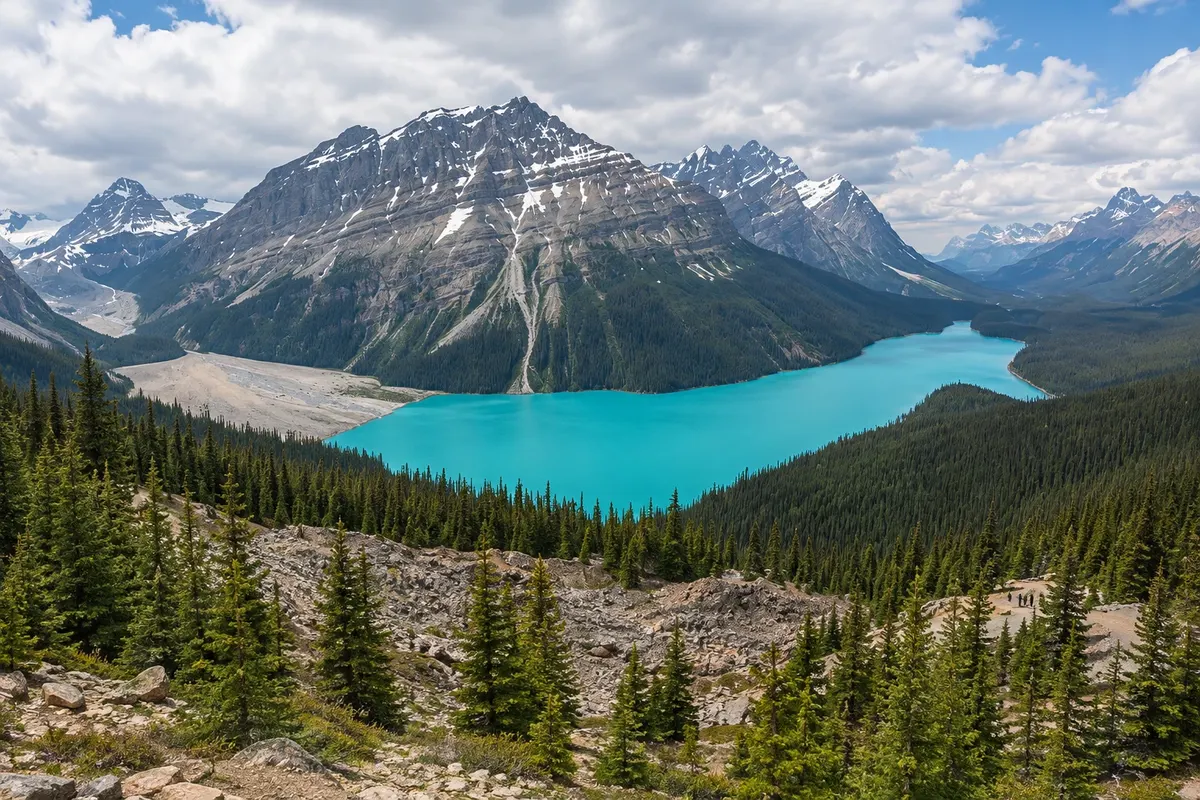
A glacier lake shaped like a wolf’s head, seen from the top of Bow Summit, the highest point of the Icefields Parkway, about 40 km from Lake Louise.
Illustrative images. The pictures in this guide are illustrations based on the real place, not photographs, and may differ from it.

Discover
About Peyto Lake
Peyto Lake is in Banff National Park, beside the Icefields Parkway, the road that links Lake Louise to Jasper. It’s seen from above, from a viewpoint near Bow Summit, the highest point on the road, at about 2,070 meters. The lake’s shape, seen from above, is often compared to a wolf’s head.
The water has a milky blue tone that becomes more intense in mid-summer, when meltwater from the Peyto Glacier brings more rock flour. The paved trail from the parking area to the viewing platform is short but uphill. A longer trail continues through alpine meadows that flower in summer.
The lake is named for Bill Peyto, an early 20th-century mountain guide. Only the national park pass is needed; there is no separate entrance fee.
Before you go
Practical information
Cidade Turismo reviews its information regularly, but something may have changed. Check with the place before planning your trip.
How much time to set aside
From 30 minutes to 1 hour.
Best time
In July and August, when the lake’s color is usually strongest and snow has cleared from the trail. In the morning, when there are fewer people at the viewpoint.
How to get there
Via the Icefields Parkway, about 40 km north of Lake Louise, with parking at Bow Summit.
Tip
Combine it with Bow Lake, a few kilometres earlier at the roadside. On the Icefields Parkway, refuel beforehand: gas stations are few.
Official website
Get your questions answered
Frequently asked questions about Peyto Lake
Where is Peyto Lake?
On the Icefields Parkway, about 40 km north of Lake Louise, near Bow Summit.
Is the Peyto Lake trail long?
No. It’s short and paved, uphill to the observation platform.
When is Peyto Lake at its strongest color?
Generally in July and August, with glacier melt.