

 Brazil
 Argentina
 Bolivia
 Chile
 Colombia
 Ecuador
 Guyana
 French Guiana
 Falkland Islands (Malvinas)
 Paraguay
 Peru
 Suriname
 Uruguay
 Venezuela
 Germany
 Austria
 Croatia
 Denmark
 Spain
 Finland
 France
 Greece
 the Netherlands
 Hungary
 Ireland
 Iceland
 Italy
 Luxembourg
 Norway
 Poland
 Portugal
 the United Kingdom
 the Czech Republic
 Sweden
 Switzerland
 Turkey
 the United States
 Mexico
 the Dominican Republic
 South Africa
 Australia
 Fiji
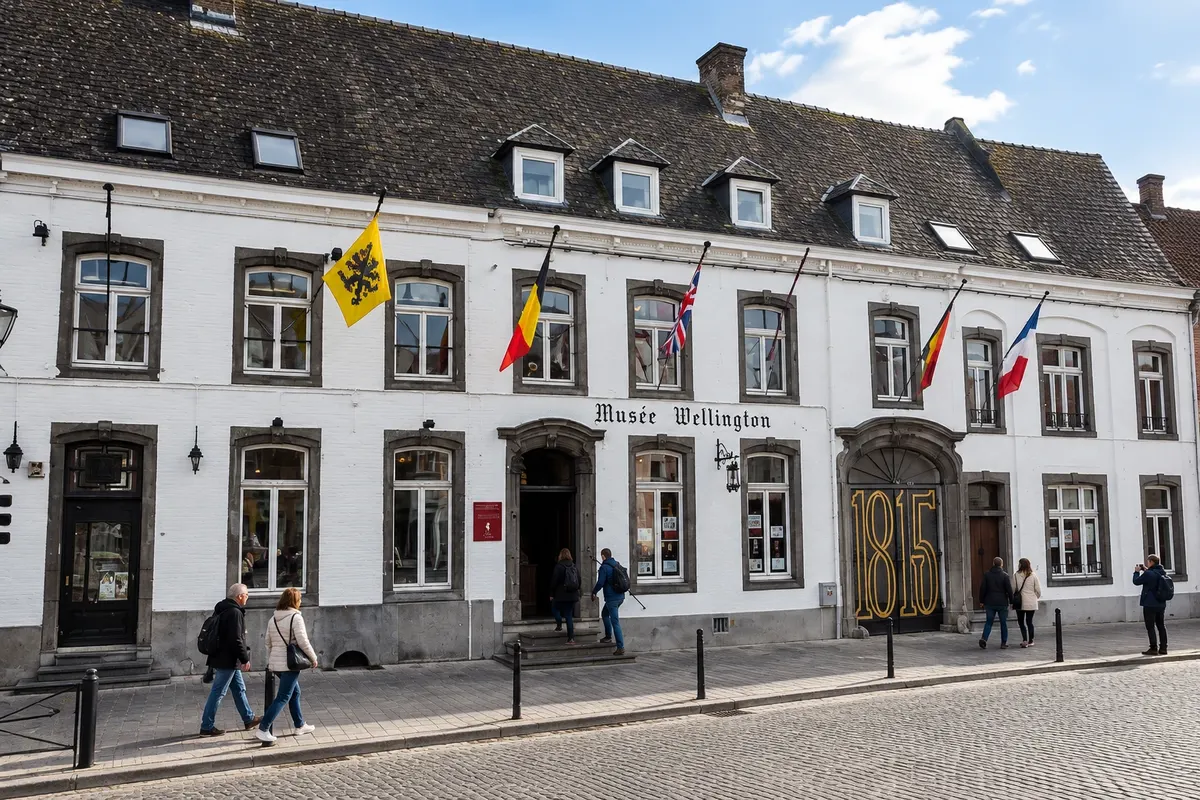
Museum · Waterloo, Brabante Valão
Musée Wellington
Museum in the former inn where the Duke of Wellington set up his headquarters and wrote the victory communiqué in June 1815, in the centre of Waterloo.
Illustrative images. The pictures in this guide are illustrations based on the real place, not photographs, and may differ from it.

Discover
About Musée Wellington
The Musée Wellington occupies the former Bodenghien inn, dating from 1705, on the Chaussée de Bruxelles in the centre of Waterloo. In June 1815 the British general staff set up the Duke of Wellington's headquarters there.
Wellington slept in the house on the nights of 17 and 18 June and wrote the victory communiqué there. By dating the text "Waterloo", the town's name became linked to the battle, fought a few kilometres to the south.
The roughly 14 rooms display weapons, prints, portraits, flags and personal items. Among the most notable pieces are the table on which the communiqué was written and the mechanical leg of Lord Uxbridge, commander of the allied cavalry, who lost his real leg in the battle.
Opposite is the chapel of Saint-Joseph, of 17th-century royal origin, with plaques honoring the British and Dutch soldiers who died.
Before you go
Practical information
Cidade Turismo reviews its information regularly, but something may have changed. Check with the place before planning your trip.
How much time to set aside
About an hour.
Best time
Before the battlefield, so you arrive there already familiar with the history. The museum usually closes one weekday outside summer: check before you go.
How to get there
From Waterloo station it's about a 15-minute walk to the Chaussée de Bruxelles. TEC buses W and 365 from Brussels stop nearby. By car there is parking in the centre.
Tip
Cross the street and enter the chapel of Saint-Joseph to see the regimental plaques. Waterloo's tourist office is next door. The Pass 1815 includes this museum.
Official website
Get your questions answered
Frequently asked questions about Musée Wellington
Why is the battle called Waterloo if it took place somewhere else?
Wellington had his headquarters at this inn in Waterloo and datestamped the victory dispatch there. The fighting took place a few kilometres to the south, in Braine-l'Alleud and Plancenoit.
What is the most curious thing at the Musée Wellington?
The prosthetic leg of Lord Uxbridge, commander of the allied cavalry, and the table on which Wellington wrote the victory dispatch.