

 Brazil
 Argentina
 Bolivia
 Chile
 Colombia
 Ecuador
 Guyana
 French Guiana
 Falkland Islands (Malvinas)
 Paraguay
 Peru
 Suriname
 Uruguay
 Venezuela
 Germany
 Austria
 Croatia
 Denmark
 Spain
 Finland
 France
 Greece
 the Netherlands
 Hungary
 Ireland
 Iceland
 Italy
 Luxembourg
 Norway
 Poland
 Portugal
 the United Kingdom
 the Czech Republic
 Sweden
 Switzerland
 Turkey
 the United States
 Mexico
 the Dominican Republic
 South Africa
 Australia
 Fiji
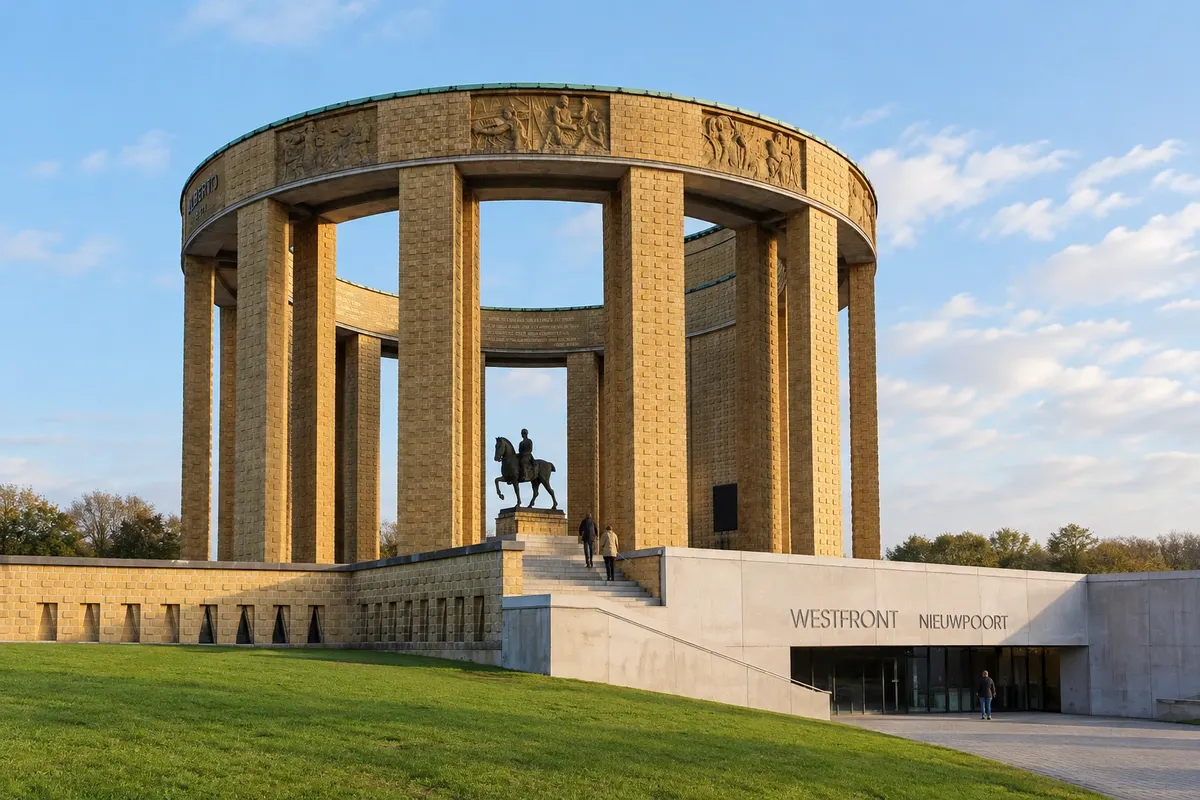
Museum and monument · Nieuwpoort, Flandres Ocidental
Westfront Nieuwpoort
Visitor centre beneath the monument to King Albert I, beside the Ganzepoot sluices. It tells the story of the 1914 flooding of the IJzer plain and has an upper gallery with views over the polder.
Illustrative images. The pictures in this guide are illustrations based on the real place, not photographs, and may differ from it.

Discover
About Westfront Nieuwpoort
The monument to King Albert I stands on the right bank of the IJzer, next to the Ganzepoot sluice complex, at the entrance to Nieuwpoort. It was designed by Julien De Ridder and inaugurated on 24 July 1938. It is a circle of ten brick columns, 25 metres high and 30 metres in diameter, surrounding the equestrian statue of the king made by Karel Aubroeck.
On 18 October 2014 the monument was restored and the Westfront Nieuwpoort centre was added beneath it. The exhibition tells how, on the nights at the end of October 1914, the Belgian army opened the sluices at high tide and closed them at low tide. By 1 November the water covered a strip about 15 km long and up to 4 km wide.
The highlight of the exhibition is the projection of the Panorama of the IJzer, a painting 115 metres long. An elevator leads to the monument's upper gallery, with orientation tables facing the polder and the coast.
Opposite stands the Nieuport Memorial, a British column commemorating 566 officers and soldiers killed on the Belgian coast, especially in 1917. Since 2023 it has been part of the UNESCO World Heritage.
Before you go
Practical information
Cidade Turismo reviews its information regularly, but something may have changed. Check with the place before planning your trip.
How much time to set aside
About 1 hour 30 minutes for the exhibition and the upper gallery.
Best time
On a clear day, the view from the top reaches the coast and the polder. From June to August the area is busier because of the beach. Check opening times before you go.
How to get there
It is on the Kustweg, at the eastern entrance of Nieuwpoort, next to the sluices. The Kusttram passes through Nieuwpoort; check the nearest stop. By car there is parking beside the site.
Tip
After the exhibition, walk over the bridges of the Ganzepoot: there you can see the sluices and the canals that were used in the 1914 flooding.
Get your questions answered
Frequently asked questions about Westfront Nieuwpoort
What was the 1914 flooding?
At the end of October 1914, the Belgians opened sluices in Nieuwpoort at high tide and closed them at low tide over several nights. Seawater flooded the IJzer plain and halted the German advance. The river became the front line until 1918.
Can you climb up the monument?
Yes. An elevator leads to the upper gallery, with orientation tables and views over the polder and the sea.
Who were Hendrik Geeraert and Karel Cogge?
Geeraert was a boatman from Nieuwpoort and knew the sluices. Cogge was an official of the polder drainage administration and indicated how to flood the plain. The two guided the Belgian soldiers during the operation.