

 Brazil
 Argentina
 Bolivia
 Chile
 Colombia
 Ecuador
 Guyana
 French Guiana
 Falkland Islands (Malvinas)
 Paraguay
 Peru
 Suriname
 Uruguay
 Venezuela
 Germany
 Austria
 Croatia
 Denmark
 Spain
 Finland
 France
 Greece
 the Netherlands
 Hungary
 Ireland
 Iceland
 Italy
 Luxembourg
 Norway
 Poland
 Portugal
 the United Kingdom
 the Czech Republic
 Sweden
 Switzerland
 Turkey
 the United States
 Mexico
 the Dominican Republic
 South Africa
 Australia
 Fiji
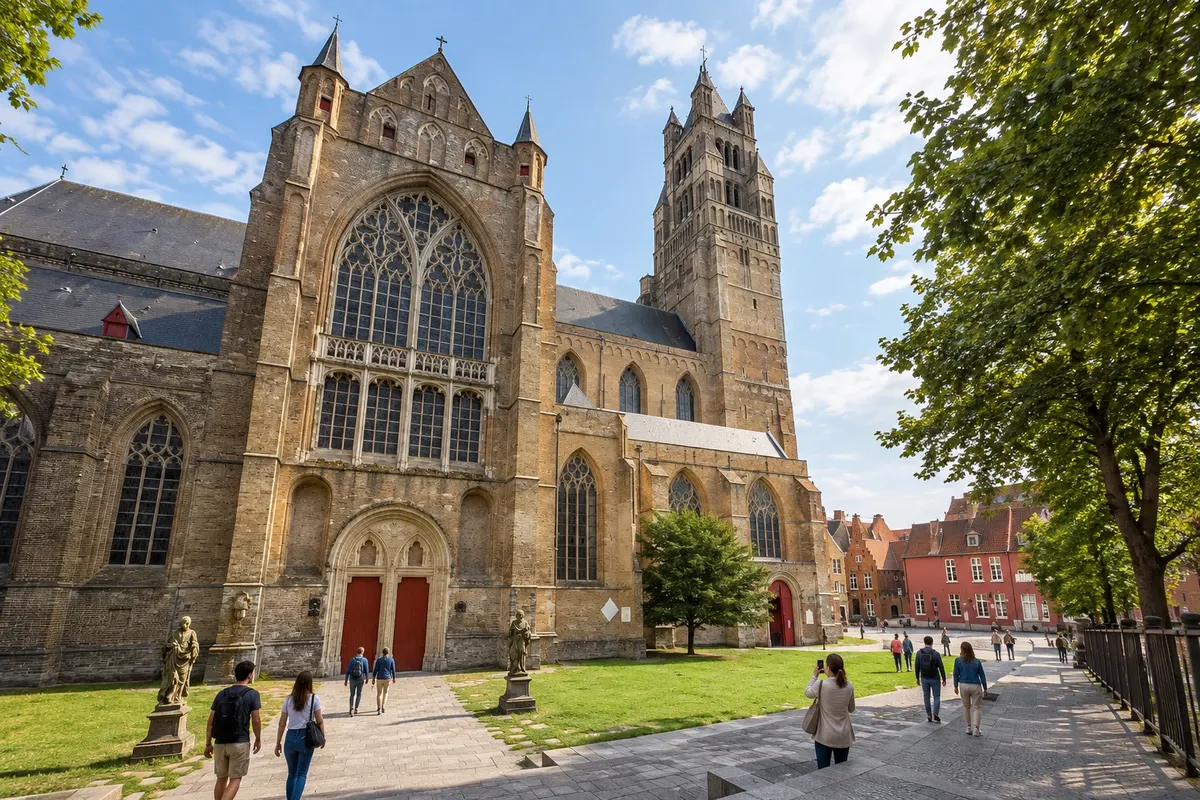
Church · Bruges, Flandres Ocidental
Sint-Salvatorskathedraal
Bruges cathedral since 1834, on Steenstraat between the Markt and 't Zand. A medieval-origin brick church with a fortress-like tower, 18th-century Brussels tapestries and a baroque organ.
Illustrative images. The pictures in this guide are illustrations based on the real place, not photographs, and may differ from it.

Discover
About Sint-Salvatorskathedraal
The Sint-Salvatorskathedraal, Cathedral of the Holy Saviour, is on Steenstraat, the shopping street that connects the Markt to 't Zand. As early as the 10th century there was a parish church here. The current brick church began construction around 1250 and took about a century to complete; the base of the tower, from the 12th century, is the oldest part.
For centuries the main church of Bruges was the Sint-Donaaskathedraal in the Burg. At the end of the 18th century, under French occupation, it was demolished. After Belgium’s independence, a new bishop settled in the city and in 1834 the Church of the Holy Saviour became the cathedral.
A fire in 1839 brought down the roof. In the rebuilding, the English architect Robert Chantrell designed the upper part of the tower in a Neo-Romanesque style, which caused controversy at the time; the monuments commission ordered the addition of the small pinnacle at the top. Inside, the nave is about 100 meters long.
Many works came from the former St. Donatian’s Cathedral. In the choir are tapestries woven in Brussels in 1731 by Jasper van der Borcht, and the paintings that served as models for them are also in the church. The organ, built 1717–1719, has been enlarged several times and is used for the cathedral’s concerts. There is also a treasury with goldsmiths’ pieces and paintings.
Before you go
Practical information
Cidade Turismo reviews its information regularly, but something may have changed. Check with the place before planning your trip.
How much time to set aside
Allow 30 to 45 minutes for the nave and choir. Add another half hour if the treasury is open.
Best time
It is open every day, with reduced hours on Sundays because of masses. The treasury has its own opening days. Avoid service times if you want to walk through the nave. Confirm before you go.
How to get there
It is on Steenstraat, about a five-minute walk from the Markt and ten minutes from the 't Zand square. From Brugge station, it's roughly a 15-minute walk along 't Zand.
Tip
Enter via Steenstraat and walk to the choir to see the tapestries up close. Combine the visit with Onze-Lieve-Vrouwekerk, a few minutes away, and compare the two brick towers that define the city skyline.
Get your questions answered
Frequently asked questions about Sint-Salvatorskathedraal
Since when has the church been a cathedral?
Since 1834. Bruges' former cathedral, the Sint-Donaaskathedraal in the Burg, was demolished at the end of the 18th century, and the igreja do Santo Salvador assumed the role after Belgium's independence.
What is there to see inside the cathedral?
The 1731 Brussels tapestries in the choir, the paintings that served as models for them, the early 18th-century organ, and works brought from the former cathedral.
Why does the tower look different?
After the fire of 1839, architect Robert Chantrell designed the upper part in a neo-Romanesque style. The small pinnacle was added at the request of the monuments commission.