

 Brazil
 Argentina
 Bolivia
 Chile
 Colombia
 Ecuador
 Guyana
 French Guiana
 Falkland Islands (Malvinas)
 Paraguay
 Peru
 Suriname
 Uruguay
 Venezuela
 Germany
 Austria
 Croatia
 Denmark
 Spain
 Finland
 France
 Greece
 the Netherlands
 Hungary
 Ireland
 Iceland
 Italy
 Luxembourg
 Norway
 Poland
 Portugal
 the United Kingdom
 the Czech Republic
 Sweden
 Switzerland
 Turkey
 the United States
 Mexico
 the Dominican Republic
 South Africa
 Australia
 Fiji
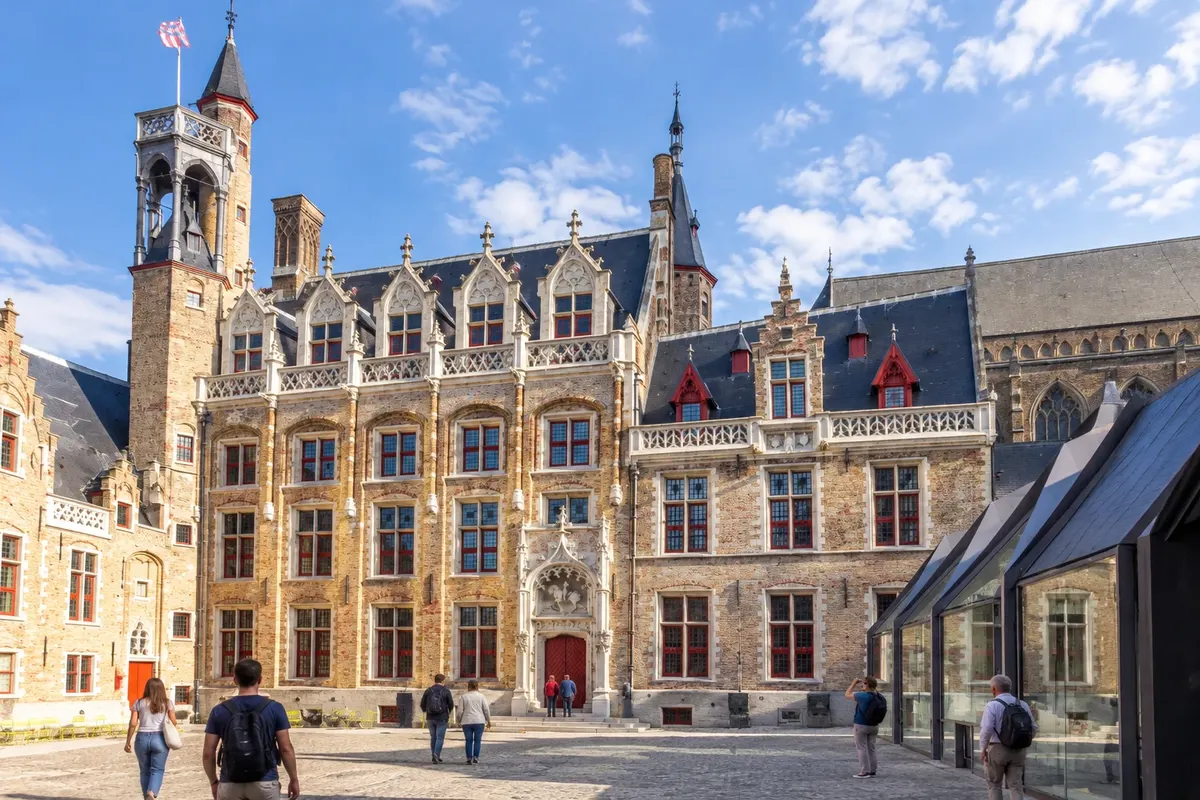
Museum · Bruges, Flandres Ocidental
Gruuthusemuseum
Urban palace of the lords of Gruuthuse, on the Dijver next to the Onze-Lieve-Vrouwekerk. It showcases five centuries of Bruges' history in tapestries, stained glass, wooden sculptures, lace and manuscripts, and has an oratory that opens onto the choir of the neighbouring church.
Illustrative images. The pictures in this guide are illustrations based on the real place, not photographs, and may differ from it.

Discover
About Gruuthusemuseum
The Gruuthusemuseum occupies the palace of the Gruuthuse family on the canal at the Dijver. The name comes from gruut, the mixture of herbs used to flavour beer before hops: the building would have been a warehouse for that product, controlled by a wealthy local family that levied a tax on it.
At the beginning of the 15th century Jan IV van der Aa converted the warehouse into a luxury residence. Lodewijk van Gruuthuse, a noble connected to the Burgundian court, added a second wing and commissioned the private oratory that links the house to the Onze-Lieve-Vrouwekerk. His motto, Plus est en vous, appears in several places in the palace.
Later the building passed to King Philip II of Spain, housed the city's mount of piety from 1623 and was bought by the municipal authorities in 1875. The architect Louis Delacenserie restored it between 1883 and 1895, and much of the interior seen today is a neogothic reconstruction from that time.
The collection covers about five hundred years of Bruges' history through objects: Flemish tapestries, stained glass, wooden sculptures, antique lace, Burgundian-era manuscripts and Chinese porcelain. The highlight is the late 15th-century oratory, from which you can see the church's Gothic choir, and the balcony over the canal.
Before you go
Practical information
Cidade Turismo reviews its information regularly, but something may have changed. Check with the place before planning your trip.
How much time to set aside
Between one hour and one and a half hours for the complete route, including the oratory and the balcony.
Best time
Right at opening in the morning the rooms are quieter and you can stay in the oratory without queuing. The museum is closed on Mondays, except Easter Monday and Whit Monday. Check the opening days before you go.
How to get there
It is on the Dijver, between the Groeningemuseum and the Onze-Lieve-Vrouwekerk, about a five-minute walk from the Markt. From Brugge station it's about a 15-minute walk along the Minnewater and Mariastraat, or a few minutes by De Lijn bus to the centre.
Tip
Entrance is by stairs only and the museum is not wheelchair-accessible. Save the balcony and the oratory for last: from there you can see how the family attended mass without leaving the palace. The municipal museums of Bruges sell a combined ticket, useful if you also plan to visit the Groeningemuseum and the Sint-Janshospitaal.
Official website
Get your questions answered
Frequently asked questions about Gruuthusemuseum
Where does the name Gruuthuse come from?
From gruut, the mix of herbs used in medieval beer before hops. The building is said to have stored this product, on which a wealthy family from Bruges levied a fee.
What is the oratory of the Gruuthusemuseum?
It is a private chapel from the late 15th century, built by Lodewijk van Gruuthuse, which opens onto the choir of the Onze-Lieve-Vrouwekerk. Through it the family attended Mass without leaving their home.
Is the museum accessible?
Entrance is only by stairs and the building is not adapted for wheelchair users. There are tactile features and a descriptive audio guide for people with visual impairments.