

 Brazil
 Argentina
 Bolivia
 Chile
 Colombia
 Ecuador
 Guyana
 French Guiana
 Falkland Islands (Malvinas)
 Paraguay
 Suriname
 Uruguay
 Venezuela
 Germany
 Austria
 Belgium
 Croatia
 Denmark
 Spain
 Finland
 France
 Greece
 the Netherlands
 Hungary
 Ireland
 Iceland
 Italy
 Luxembourg
 Norway
 Poland
 Portugal
 the United Kingdom
 the Czech Republic
 Sweden
 Switzerland
 Turkey
 the United States
 Mexico
 the Dominican Republic
 South Africa
 Australia
 Fiji
Before you go
Your trip to Piura.
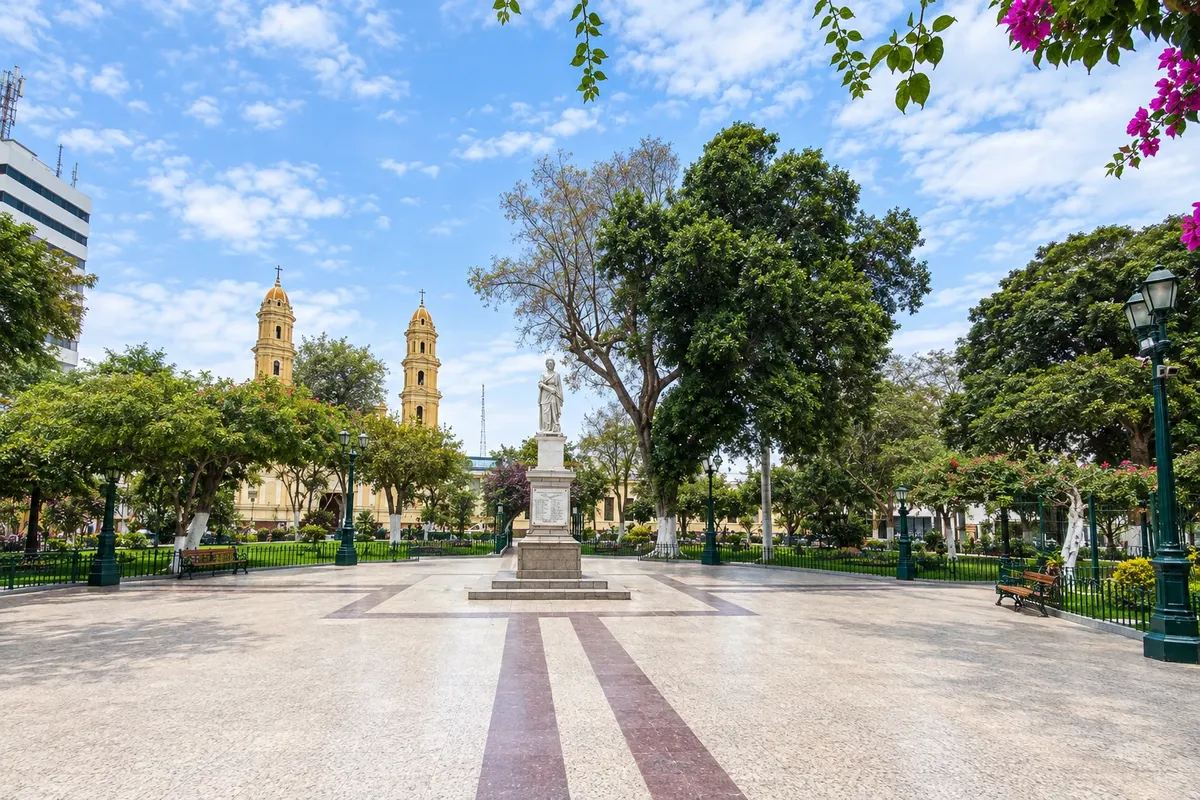
Illustrative images. The pictures in this guide are illustrations based on the real place, not photographs, and may differ from it.

Piura – Piura Capital
How to get there
-
Aeropuerto Internacional Capitán FAP Guillermo Concha Iberico (PIU) 2 km
Approximate road distances. Check flights and bus schedules before you travel.
Piura’s international airport, in the Castilla district, is about 2 km from the Plaza de Armas and has daily flights from Lima. By road, the city is on the Panamericana Norte, with buses from Lima, Trujillo and Chiclayo. From the airport to the center you go by taxi.
How many days
Two days. On the first day, the center: Plaza de Armas, cathedral, Casa Museo Grau, church of San Francisco and the Vicús Museum. On the second day, Catacaos, about 12 km to the south, with Calle Comercio, the church of San Juan Bautista and Narihualá.
When to go
It is warm year‑round, with highs above 30 °C for most months. From June to November it is usually a bit less hot and it almost never rains. From January to April is the hottest period and concentrates the few annual rains. At Holy Week, Catacaos receives many visitors.
The seasons shown are the most usual ones; nature doesn't always follow the calendar.
Do you need a car?
No. The historic center is walkable. For Catacaos and Narihualá there are taxis, mototaxis and local buses, as well as organized tours by local agencies.
Suggested itinerary
An order that works
Built with the places on this page. No rush: it's paced so you have time to see them.
One day in Piura
-
Morning
Plaza de Armas and cathedral
Start at the Plaza de Armas, shaded by tamarinds, with the statue of Liberty that Piurans call La Pola. Enter the cathedral to see the gilded altarpiece of the Virgin of Fátima and the main altar rebuilt after the 1912 earthquake.
-
Afternoon
Casa Museo Grau and San Francisco
Follow Tacna Street to the house where Miguel Grau was born, a quincha and adobe building from the late 18th century. Then go to the church of San Francisco, next to the Eguiguren malecón, in whose atrium Piura swore independence on January 4, 1821.
-
Late afternoon
Vicús Museum and malecón
Visit the municipal Vicús Museum and the Gold Room, with gold pieces from the Vicús culture. In the late afternoon, walk along the malecón on the banks of the Piura River, when the heat eases.
-
Evening
Dinner in the center
Have dinner downtown and try the seco de chabelo or a fish ceviche from the Piuran coast.
2 days in Piura
Day 1
-
Morning
Piura center
Plaza de Armas, cathedral and Casa Museo Grau.
-
Afternoon
San Francisco and Vicús Museum
The church of San Francisco, where the city swore independence, and the Vicús Museum, with the Gold Room.
Day 2
-
Morning
Narihualá
Go to the Narihualá site, about 17 km south of Piura, to see the large adobe huaca of the Tallán people and the site museum.
-
Afternoon
Catacaos
In Catacaos, walk through the arcades of Calle Comercio, with filigree, straw hats and pottery, and go into the church of San Juan Bautista by the square. Have lunch at a village picantería.
Check before you go. Opening hours and days change, and places may close for renovations, holidays or events. This itinerary is a suggestion from Cidade Turismo, not a commitment: plan yours by checking directly with each place you intend to visit.
Before you go
Frequently asked questions
What to do in Piura?
Visit the Plaza de Armas and the cathedral, the Casa Museo Grau, the church of San Francisco and the Vicús Museum in the center. To the south, Catacaos, with Calle Comercio of the artisans, and the archaeological site of Narihualá.
Why is Piura called the city of eternal heat?
Because it is hot year-round: highs exceed 30 °C for most months and approach 35 °C between January and March.
What is Piura's typical dish?
The seco de chabelo, green plantain fried and mashed with dried meat, chicha de jora and ají, whose recipe is recognized as an Officially Guaranteed Traditional Specialty in Peru.
Where was Miguel Grau born?
In Piura, in the house on calle Tacna that today is the Casa Museo Grau, with family objects, documents and a replica of the monitor Huáscar.
How far is Catacaos from Piura?
About 12 km to the south. By taxi or local bus, the trip takes around 15 to 20 minutes.