

 Brazil
 Argentina
 Bolivia
 Chile
 Colombia
 Ecuador
 Guyana
 French Guiana
 Falkland Islands (Malvinas)
 Paraguay
 Peru
 Suriname
 Uruguay
 Venezuela
 Germany
 Austria
 Belgium
 Croatia
 Denmark
 Spain
 Finland
 France
 Greece
 the Netherlands
 Hungary
 Ireland
 Iceland
 Italy
 Luxembourg
 Norway
 Poland
 Portugal
 the United Kingdom
 the Czech Republic
 Sweden
 Switzerland
 Turkey
 the United States
 the Dominican Republic
 South Africa
 Australia
 Fiji
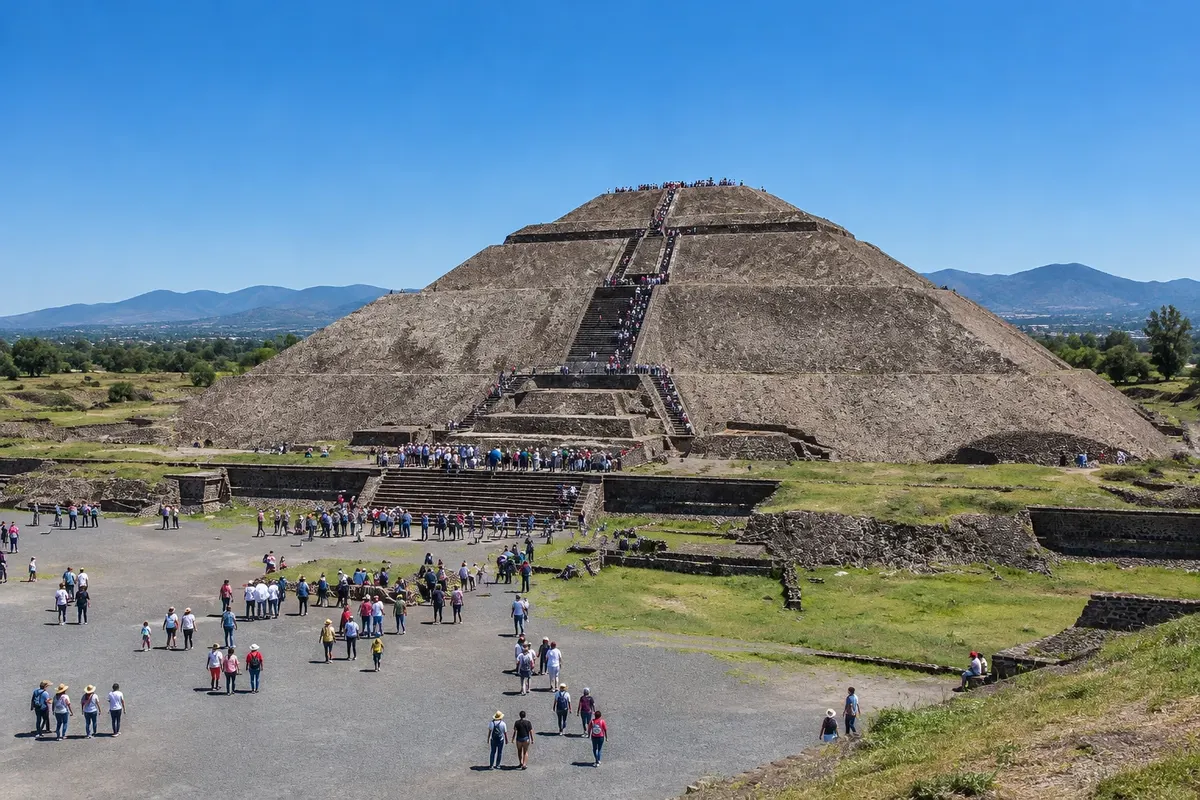
Archaeological site · Teotihuacan, Estado do México
Zona Arqueológica de Teotihuacan
The ancient city of the Pyramids of the Sun and the Moon and the Calzada de los Muertos, one of the largest pre-Hispanic cities in the Americas, a World Heritage Site since 1987.
Illustrative images. The pictures in this guide are illustrations based on the real place, not photographs, and may differ from it.

Discover
About Zona Arqueológica de Teotihuacan
Teotihuacan was one of the largest cities of ancient America. Between roughly 100 BCE and 550 CE it had close to 100,000 inhabitants and influenced cultures across Mesoamerica. When the Aztecs arrived in the valley centuries later, the city was already in ruins, and they gave it the name Teotihuacan, meaning "the place where men become gods." UNESCO inscribed it as a World Heritage Site in 1987.
The axis of the city is the Calzada de los Muertos, an avenue of about 2 km open to visitors. At the southern end is the Citadel, a large plaza surrounded by platforms, with the Temple of the Feathered Serpent decorated with stone heads of Quetzalcoatl. In the middle stands the Pyramid of the Sun, about 65 meters high, the largest structure on the site. At the northern end the Pyramid of the Moon closes the avenue facing a plaza.
Beside the Plaza of the Moon, the Palace of Quetzalpapálotl preserves pillars with bird reliefs and traces of paint. There are also residential compounds with murals, such as Tepantitla, and two museums: the Museum of Teotihuacan Culture next to the Pyramid of the Sun, and the mural museum near Gate 3.
Climbing the pyramids is often closed to the public; visits are made along the avenue and plazas, where the scale of the constructions can be appreciated. The site is extensive, at about 2,300 meters of altitude, and has very little shade.
Before you go
Practical information
Cidade Turismo reviews its information regularly, but something may have changed. Check with the place before planning your trip.
How much time to set aside
Three to four hours.
Best time
At opening, before the tour groups and the strong sun. At the March equinox, around the 21st, the site receives thousands of visitors and special operations are often in place.
How to get there
Direct buses depart from Mexico City's Terminal Norte to the gates of the archaeological zone in about an hour. By car, take the México–Pirámides highway. There are five gates: Gate 1 is next to the Citadel, Gate 2 near the Pyramid of the Sun and Gate 3 near the Pyramid of the Moon.
Tip
Start at the Citadel in the south and walk north: the Pyramid of the Moon appears at the end of the avenue, with Cerro Gordo behind it.
Official website
Get your questions answered
Frequently asked questions about Zona Arqueológica de Teotihuacan
When was Teotihuacan built?
The city grew between roughly 100 BCE and 550 CE. The Pyramid of the Sun dates to the early centuries of the Common Era. The name Teotihuacan was given by the Aztecs centuries after its abandonment.
How tall is the Pyramid of the Sun?
About 65 meters high. It is the largest structure in Teotihuacan and one of the largest pyramids in the Americas.
Can you climb the Pyramid of the Sun?
Climbing is usually closed to the public for conservation. Rules have changed in recent years; check with INAH before you go.
Which gate should I use to enter Teotihuacan?
Those arriving by bus usually get off at Gate 1 next to the Citadel and walk the avenue from south to north. Gate 2 is near the Pyramid of the Sun and Gate 3 by the Pyramid of the Moon.