

 Brazil
 Argentina
 Bolivia
 Chile
 Colombia
 Ecuador
 Guyana
 French Guiana
 Falkland Islands (Malvinas)
 Paraguay
 Peru
 Suriname
 Uruguay
 Venezuela
 Germany
 Austria
 Belgium
 Croatia
 Denmark
 Spain
 Finland
 Greece
 the Netherlands
 Hungary
 Ireland
 Iceland
 Italy
 Luxembourg
 Norway
 Poland
 Portugal
 the United Kingdom
 the Czech Republic
 Sweden
 Switzerland
 Turkey
 the United States
 Mexico
 the Dominican Republic
 South Africa
 Australia
 Fiji
Fortress · Besançon, Borgonha-Franco-Condado
Citadelle de Besançon
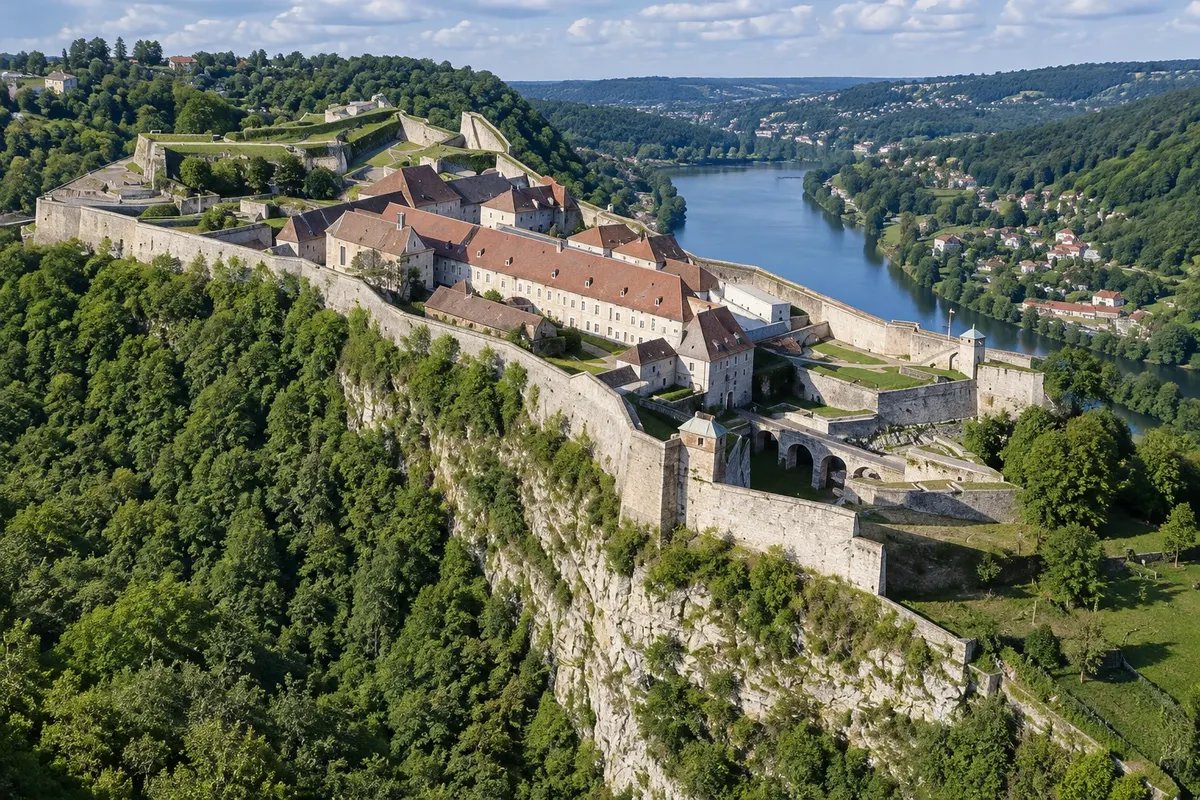
Vauban fortress from the 17th century on top of monte Saint-Étienne, a World Heritage site, with walls above the Doubs bend, three museums and a small zoo.
Illustrative images. The pictures in this guide are illustrations based on the real place, not photographs, and may differ from it.

Discover
About Citadelle de Besançon
The cidadela of Besançon covers about 11 hectares on top of monte Saint-Étienne, 130 metres above the Doubs, at the point that closes the river bend where the city has formed since Antiquity. The first stone was laid in 1668, when the city still belonged to Spain. After the Franco-Condado passed to France in 1678, Luís XIV commissioned engineer Vauban to finish the work, which made the fortress a central part of the east of the kingdom's defences.
The complex includes bastions, walls, moats and ramparts adapted to the hill's relief. It was a barracks and arms depot in the 18th century, a military prison in the 19th, and during the German occupation a place of execution for members of the Resistance. Since 2008 it has been part of the Vauban fortifications World Heritage ensemble.
Within the walls operate three museums: the da Resistência e da Deportação, the Museu Comtois, about traditional life in the Franco-Condado, and the natural history museum, with a zoological garden, aquarium and insectarium. From the ramparts you can see the whole city within the river bend and the surrounding hills.
Down below, the tourist boats round the Doubs bend and pass through a tunnel dug beneath the cidadela.
Before you go
Practical information
Cidade Turismo reviews its information regularly, but something may have changed. Check with the place before planning your trip.
How much time to set aside
From 3 hours to a full day, including the museums.
Best time
On clear days, for the view. In summer opening hours are longer. Check opening times before you go.
How to get there
From the centre, city buses climb up to the entrance, and in season there is a tourist train. On foot, the climb via the rue de la Convention, passing the cathedral, takes about 20 to 30 minutes.
Tip
Allow a full day if you plan to visit all three museums. For the widest view of the Doubs bend, follow the ramparts to the bastions on the river side.
Official website
Get your questions answered
Frequently asked questions about Citadelle de Besançon
Is the Citadel of Besançon by Vauban?
Construction began in 1668, still under Spanish rule, and was completed by Vauban after the city became French in 1678. It has been part of the World Heritage listing of Vauban's fortifications since 2008.
What is inside the citadel?
Three museums: the Museum of Resistance and Deportation, the Musée Comtois and the natural history museum, with a zoo, aquarium and insectarium.
How do you get up to the citadel?
By city bus or the tourist train in season, or on foot in 20 to 30 minutes via the rue de la Convention.