

 Brazil
 Argentina
 Bolivia
 Chile
 Colombia
 Ecuador
 Guyana
 French Guiana
 Falkland Islands (Malvinas)
 Paraguay
 Peru
 Suriname
 Uruguay
 Venezuela
 Germany
 Austria
 Belgium
 Croatia
 Denmark
 Finland
 France
 Greece
 the Netherlands
 Hungary
 Ireland
 Iceland
 Italy
 Luxembourg
 Norway
 Poland
 Portugal
 the United Kingdom
 the Czech Republic
 Sweden
 Switzerland
 Turkey
 the United States
 Mexico
 the Dominican Republic
 South Africa
 Australia
 Fiji
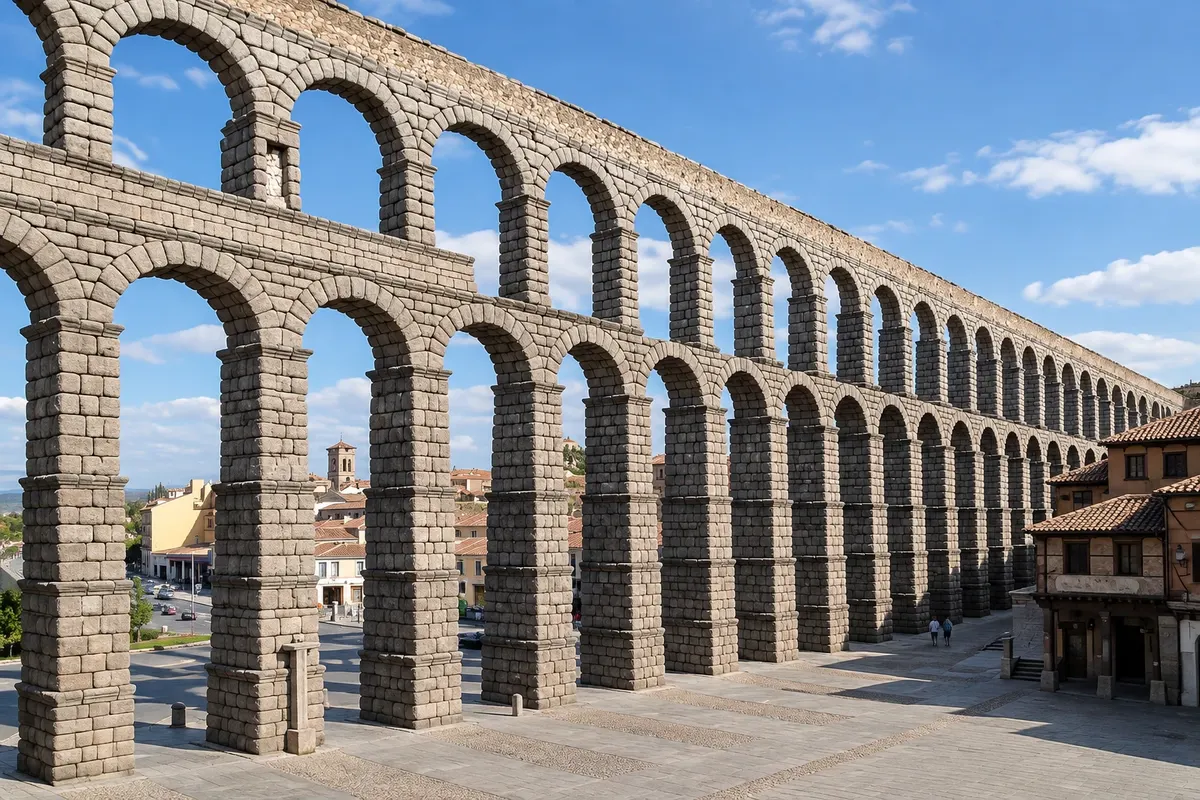
Monument · Segovia, Castile and León
Segovia Aqueduct
Roman Aqueduto from the early 2nd century, with 167 granite arches assembled without mortar. The arcade crosses the Plaza del Azoguejo and reaches 28 meters at its highest point.
Illustrative images. The pictures in this guide are illustrations based on the real place, not photographs, and may differ from it.

Discover
About Segovia Aqueduct
The Aqueduct was built in the early 2nd century AD, at the end of Trajan’s reign or the start of Hadrian’s. It brought water to the city from the Fuenfría in the mountains, about 17 km away, and remained in use until 1973. The part everyone photographs is the arcade that crosses the Plaza del Azoguejo at the entrance to the old town.
There are 167 arches in total. The granite blocks are fitted together without mortar. At the highest section the structure reaches 28 m, with two tiers of arches on pillars that taper from bottom to top. At the top runs the U-shaped channel that carried the water.
In the 15th century, during the time of the Catholic Monarchs, 36 arches destroyed in 1072 were rebuilt, with pointed arches that are distinguishable from the Roman ones. The work was directed by Pedro Mesa, prior of the nearby monastery of El Parral. In the 16th century, the two upper niches received images of the Virgin and of Saint Sebastian; today the niche shows a replica and the original image is in the museum of the Casa de la Moneda.
A local legend says the devil raised the aqueduct in one night, in a pact with a girl tired of fetching water, and lost the bet when the rooster crowed before the last stone. A modern sculpture of a devil taking a selfie, by sculptor José Antonio Abella, stands on the Cuesta de San Juan beside it. The Aqueduct and the old town have been a UNESCO World Heritage Site since 1985.
Before you go
Practical information
Cidade Turismo reviews its information regularly, but something may have changed. Check with the place before planning your trip.
How much time to set aside
About 20 to 40 minutes to see the lower arcade and climb the side stairs up to the top of the wall.
Best time
Early, before the tour buses arrive, the square is quieter for photos. At night the arcade is usually lit and looks quite different. In winter, from December to February, the cold in the open square is strong; bring warm clothing.
How to get there
It is on the Plaza del Azoguejo, the gateway to the historic centre. From Segovia-Guiomar station, the city buses that link to the high-speed rail station stop near the Aqueduct. From the bus station it is about a 10-minute walk.
Tip
Climb the stairways beside the arcade, in the Azoguejo: from the top you can see the channel up close and the entire arcade in perspective. To understand the engineering, the Centro de Interpretación del Acueducto operates inside the Real Casa de Moneda, sharing the museum's entrance.
Official website
Get your questions answered
Frequently asked questions about Segovia Aqueduct
How old is the Aqueduct of Segóvia?
It was built at the beginning of the 2nd century AD, between the end of Trajan's reign and the start of Hadrian's. In other words, it's about 1,900 years old.
Does the Aqueduct still carry water?
No. It supplied Segóvia until 1973. Today it is only a monument, but the channel along the top of the arcade is still there and can be seen up close by climbing the side stairs.
Is it true there is no cement between the stones?
Yes. The granite blocks were fitted without mortar, and the structure is held up by its own weight and by the balance of the arches.
Do you have to pay to see the Aqueduct?
There is no ticket: the arcade is in a public square and can be seen at any time. What requires a ticket is the Centro de Interpretación del Acueducto, inside the Real Casa de Moneda.